A Slow-Mode Vision for Codex: Doubling Coding Quota with Flex API

A proposal to use OpenAI's Flex API for a Codex slow mode that doubles coding quota by trading speed.
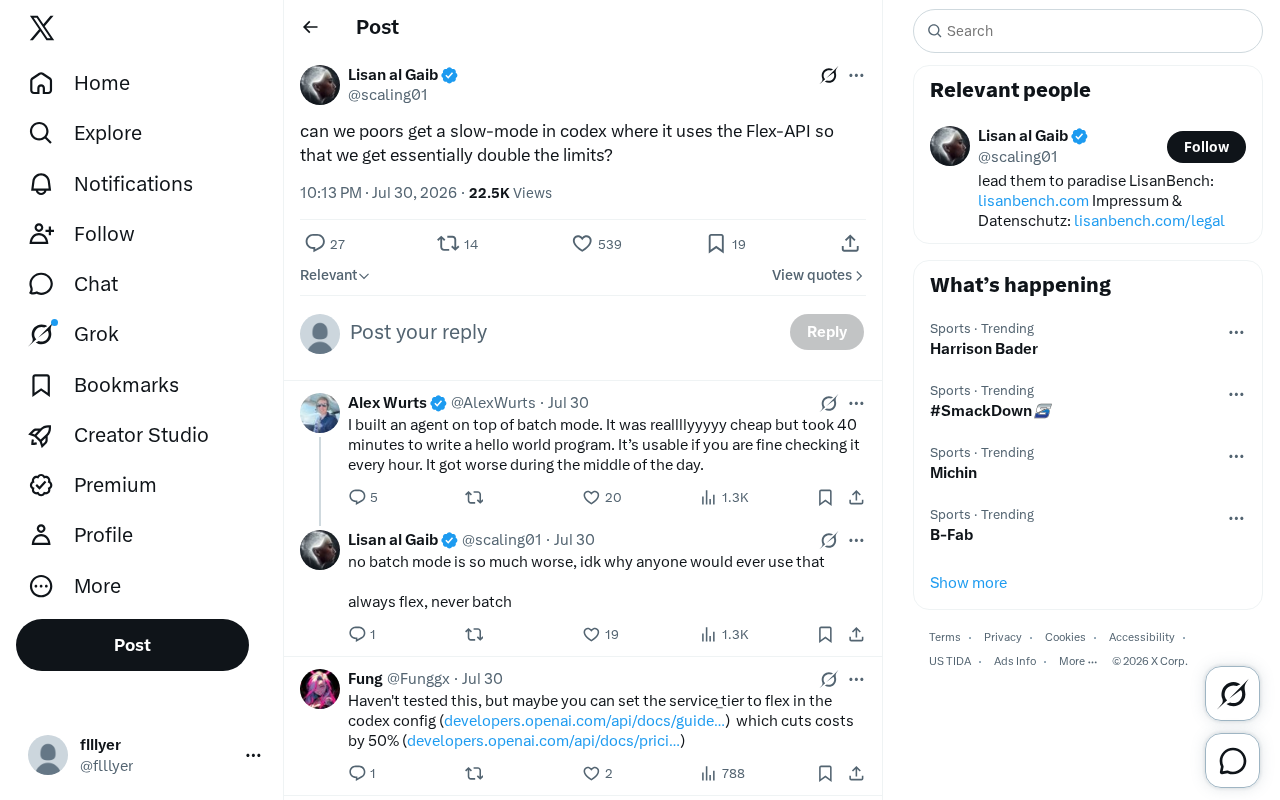
A developer's tweet proposes a "slow mode" for Codex powered by OpenAI's Flex API, letting budget-conscious users trade response speed for nearly double the usage quota. This article examines the product logic behind this tiered strategy, its technical feasibility through batched inference and off-peak scheduling, and the business challenges of potential premium tier cannibalization—exploring how AI coding tools can lower cost barriers.
A Tweet That Sparked a Conversation
Recently, a developer took to Twitter with a plea: could OpenAI offer a "slow-mode" for Codex aimed at budget-conscious users (self-described as "poors")? The core idea is simple—by leveraging OpenAI's Flex API, users with limited budgets could trade response speed for nearly double the usage quota.
This seemingly tongue-in-cheek tweet actually touches on a real pain point in AI coding tools: the balance between cost and accessibility. For individual developers, students, and small teams, quota limits on AI coding assistants are a very real barrier. Understanding this pain point requires looking at the cost structure of large model inference: for a GPT-4-class model, a single complex coding task might involve thousands to tens of thousands of input/output tokens, with compute costs on high-end GPUs (like NVIDIA H100) ranging from a few cents to tens of cents per request. For an active developer making dozens or even hundreds of calls per day, monthly costs can reach tens to hundreds of dollars—far exceeding what most individual developers are willing to pay in subscription fees (typically $20–$200/month). This forces platforms to impose quota limits to control losses.
What Is the Flex API?
The Positioning of the Flex Processing Tier
Flex API (also called Flex processing) is a low-priority, low-cost inference service tier offered by OpenAI. The core logic is straightforward: users accept longer response latency and possible queuing in exchange for significantly lower call costs—typically around half the price of the standard API.
This model is nothing new in cloud computing. It's essentially analogous to AWS "Spot Instances" or various "off-peak computing" services: selling idle compute capacity at a discount to users who aren't in a rush for results. Since AWS launched Spot Instances in 2009, this model has proven commercially viable—users get compute resources at 60–90% off market price but must accept the risk of instance interruption. Google Cloud's Preemptible VMs and Azure's Spot VMs follow similar logic. In the LLM inference space, this tiered approach is particularly compelling because GPU cluster utilization fluctuates significantly throughout the day, with load differences between off-peak hours and business hours often exceeding 3–5x. Flex API essentially monetizes this "valley" compute capacity.
Why Flex API Is Well-Suited for Coding Tasks
For many programming tasks, a few extra seconds or even tens of seconds of waiting is perfectly acceptable. Batch code refactoring, documentation generation, test suggestions, and other background-type tasks don't require millisecond-level instant feedback. This makes them ideal use cases for the Flex API.
From a technical implementation standpoint, Flex mode's low cost comes not only from off-peak scheduling but also from batched inference optimization. When multiple low-priority requests can be accumulated and processed together, GPU throughput increases significantly. Modern inference frameworks like vLLM and TensorRT-LLM support continuous batching, dynamically adjusting the processing order of requests at different priority levels while maintaining high GPU utilization. This means slow-mode requests may be processed more efficiently in batches behind the scenes, with actual marginal costs genuinely lower than real-time response requests.
The Product Logic Behind a Codex Slow Mode
A Tiered Strategy: Trading Time for Quota
This developer's proposal is valuable because it points toward a more granular user tiering strategy. Current AI coding tools mostly apply uniform quota limits regardless of whether users actually need the fastest possible response times.
It's worth noting that "Codex" in today's context is no longer the standalone code generation model from its early days, but rather an umbrella term for the programming assistance capabilities OpenAI offers across ChatGPT and its API ecosystem—encompassing code completion, code review, bug fixing, and architecture suggestions. In the 2025 competitive landscape, it faces competition from GitHub Copilot, Anthropic Claude, Google Gemini Code Assist, and vertical coding IDEs like Cursor and Windsurf. Quota limits are a shared monetization challenge across all these services—and whoever breaks through on pricing models first could gain a significant competitive advantage.
If Codex introduced a "slow mode" option, users could proactively choose:
- Standard mode: Fast responses, with quota consumed at the normal rate
- Slow mode (Flex): Slower responses, but nearly double the number of calls for the same budget
The elegance of this design lies in giving users the choice, letting them decide based on task urgency rather than passively accepting uniform limits.
The time-for-resources tiered strategy has rich precedent in the software industry. GitHub Actions gives free users fewer concurrent runs and longer queue times; Vercel's free tier limits build time and concurrent deployments; Cloudflare Workers' free version has request limits but complete base functionality. This "freemium + performance tiering" model has proven effective for expanding developer ecosystems. The key is that the free/low-cost tier's experience can't be so poor that users abandon it, while the premium tier's speed advantage must be compelling enough to drive paid conversion.
A Win-Win for the Platform
From the platform's perspective, introducing a slow mode offers tangible benefits. It can smooth out peaks and valleys in compute demand—routing non-urgent requests to off-peak periods, thereby improving overall GPU utilization and reducing unit costs. This is precisely why OpenAI is willing to offer discounted pricing for the Flex tier.
Real-World Feasibility and Challenges
Technical Implementation Isn't the Hard Part
From a technical standpoint, switching Codex's backend to the Flex API tier isn't difficult—OpenAI already provides the interface. The real challenges lie more in product design and user experience: how to clearly communicate latency expectations to users, how to handle queue timeouts, and how to seamlessly toggle between modes in the interface.
The Business Strategy Trade-Off
The deeper issue is commercial. Discounted quota could cannibalize some paid demand—users who would otherwise pay full price for high-priority service might switch to the cheaper slow mode. Platforms therefore need to carefully design pricing gradients to avoid cannibalizing their premium market.
However, in the long run, lowering the barrier to entry helps expand the user base—especially by attracting price-sensitive groups like students and indie developers—which benefits ecosystem building.
Conclusion: A Gateway to Accessible AI Programming
Though casually worded, this tweet raises a universally relevant question: How can budget-constrained developers fully leverage AI coding tools?
The Flex API's "trade time for cost" approach offers a viable path toward making AI tools more accessible. As competition among AI coding assistants intensifies, whoever can lower the barrier to entry first while keeping costs manageable stands to win a broader developer community. For Codex and similar products, introducing flexible tiered modes may well be a direction worth serious consideration.
Key Takeaways
Related articles

AAAI-27 Phase 1 Review Results Approaching: What Submitters Need to Know
AAAI-27 Phase 1 review results are expected on September 24. This article breaks down the phased review mechanism, what results mean for submitters, and tips for the waiting period.

FAISS Vector Search in Practice: Lessons Learned From Embeddings to RAG
A developer shares hands-on lessons building FAISS vector search and RAG pipelines, covering embeddings, metadata filtering, query rewriting, and hybrid retrieval.

H3 Camera Control v3 Is Coming: Video Camera Control and Fast Render on the Way
H3 previews Camera Control v3 with video camera control and Fast Render upgrades, aiming to boost AI video creativity and rendering efficiency.