A Tiny Satirical Work on AI Progress from Show HN: A Cool-Headed Reflection on Tech Hype
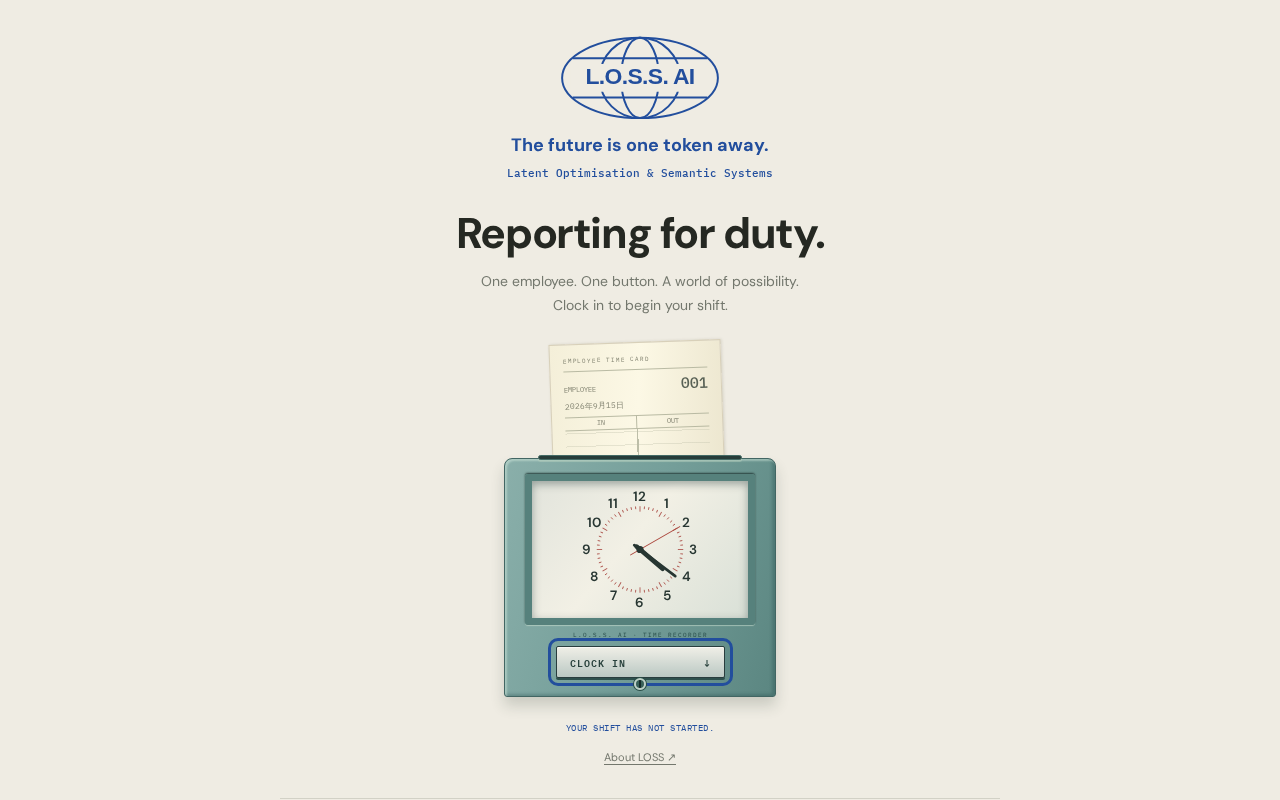
"Loss." is a minimal HN satire that quietly questions AI hype using a machine learning double entendre.
A project called "Loss." appeared on Hacker News as a tiny satire about AI progress, cleverly borrowing the machine learning term "loss function" to double as a meditation on the cost of progress. With only 10 upvotes and 2 comments, the post sparked reflection on why satirical works emerge during tech hype cycles — not to reject technology, but to gently critique blind enthusiasm. The piece highlights a developer tradition of using small, darkly humorous projects as cultural statements, and argues that the capacity for self-reflection is an essential marker of a healthy tech community.
One Small Project, One Big Question
A project called "Loss." appeared on Hacker News, with its creator describing it as "a tiny satire about AI progress." The post attracted 10 upvotes and 2 comments — modest numbers, but telling ones. It reflects a quietly growing sentiment within the tech community: a desire to step back and poke fun at the AI frenzy itself.
In the Show HN section, the vast majority of projects showcase how they use AI to solve real problems, boost efficiency, or create value. "Loss." takes the opposite approach — using satire to offer a calm, sideways glance at the current AI boom. That kind of counter-mainstream expression is, in itself, a testament to the cultural diversity of the tech community.
Why the Tech World Is Starting to Laugh at Itself
When a technology hits an explosive growth phase, the discourse around it tends to polarize: on one end, boundless optimism and grand promises; on the other, anxiety and skepticism. AI is squarely in that phase right now — new models launch daily, new capabilities are announced constantly, and new use cases are painted in ever more vivid strokes.
In this climate, satirical works are almost inevitable. They rarely reject the technology itself. Instead, they offer a gentle critique of the hype surrounding it — the blind bandwagon-jumping, the inflated expectations, the collective suspension of skepticism. Projects like "Loss." use the smallest possible canvas to nudge people into asking: what exactly are we chasing, and what are we giving up along the way?
The title "Loss" is particularly loaded. In the context of AI training, loss — as in the loss function — is the core metric for measuring a model's error. By choosing this word as a title, the author pulls off a clever double meaning: borrowing machine learning jargon while simultaneously hinting at "the cost of progress" in a broader, more human sense.
Historically, this kind of satirical backlash is nothing new to tech. Every major wave — from the dot-com bubble of the 1990s to the blockchain craze of the 2010s — has generated its own culture of self-deprecating humor. Gartner famously mapped this pattern onto the Hype Cycle: new technologies peak at the "Peak of Inflated Expectations," then tumble into the "Trough of Disillusionment," before slowly climbing toward the "Plateau of Productivity." A surge of satirical content often signals that the market is beginning to slide off the peak — that some participants are starting to reflect. In today's discourse around large language models and generative AI, voices questioning capability limits, hallucination problems, and energy consumption are growing louder. The tech community's self-deprecating humor is a creative outlet for exactly that collective unease.
The Value of Saying Something Small
"Tiny" is the key word in how this project positions itself. In an age of information overload, something short, restrained, and full of white space can land harder than a thousand-word argument. "Loss." doesn't try to deliver a grand verdict or build a complex case — it simply offers a minimal form and leaves a question worth sitting with.
This kind of expression is well-established in developer culture. Many programmers build small, darkly humorous projects as a way of commenting on industry trends — they function as both technical exercises and cultural statements. Compared to long-form opinion pieces, these bite-sized works often travel further, precisely because they hand the interpretation over to the reader.
What the Numbers Say About Community Sentiment
It's worth noting that this post earned only 10 upvotes and 2 comments. On one hand, that means it never went viral. On the other, it reflects something real: satirical content like this is naturally niche within a section like Show HN, where the default expectation is "show us something useful."
But niche doesn't mean insignificant. Its very existence is a signal — even among the people most enthusiastically embracing new technology, there are always those who maintain a critical distance. That capacity for self-reflection is an essential part of any healthy tech community. When everyone else is cheering for progress, someone willing to ask uncomfortable questions through satire is performing a quiet but genuine service.
A quick note on context: Show HN is the dedicated showcase section of Y Combinator's Hacker News, created by founder Paul Graham to encourage developers to share things they've actually built and get early feedback from peers. The section skews heavily toward tools, open-source libraries, and SaaS products — its informal evaluation criteria favor "utility" and "technical novelty." This context helps explain "Loss."'s modest 10-upvote haul: the implicit social contract of Show HN is "what did you build, and what problem does it solve?" — not "what point of view does it express?" That doesn't mean critical or artistic works are unwelcome; it just means they're entering an evaluation space wired for function-first thinking, and even leaving a small footprint there requires a real resonance.
Closing Thought: Keeping a Clear Head in the Middle of the Hype
"Loss." is a tiny project. It won't shift any technological trajectory or become an industry talking point. But in a lightweight way, it touches on something heavy: how we think about "progress" itself, in a moment when AI is advancing faster than our ability to fully process what that means.
Technology's advances deserve celebration. But blind worship of progress deserves scrutiny just as much. The value of works like this isn't in the answers they provide — it's in making people willing to pause mid-sprint and look back for a moment. Maybe that's exactly what the author wanted to say through this tiny project: real clarity often hides inside a well-timed joke at your own expense.
Related articles
DeepSeek Harness in Practice: Building a Low-Cost AI Coding Powerhouse
Learn how to transform DeepSeek's open-source harness using Claude Code, Bright Data scraping, and vision models to build an AI coding workflow costing just half a cent per task.
Overseas Developer Tests: DeepSeek Already Rivals Opus — Stop Waiting for the Next Model
An overseas developer finds DeepSeek V4 Pro rivals Opus 4.8 at a fraction of the cost. Learn how DeepSeek + BrightData compares to Claude Code for building SaaS.
DeepSeek V4.1 Flash Hands-On: Can a Small-Activation New Architecture Top the Open-Source Charts?
DeepSeek V4.1 Flash deep dive: new MoE encoder-decoder architecture, 552B total params, tiny active params, reduced KV cache. Open-source on Hugging Face. Full hands-on test from BrowserOS to 3D printing.