A24 Bets on an SCP Movie: The Reputation Risks of Adapting Internet Horror IP

A24's SCP Foundation horror film faces community backlash the moment it's announced, putting the studio's brand on the line.
A24 has announced V/H/S: SCP, a horror anthology film set in the SCP Foundation universe, looking to build on the commercial success of The Backrooms by tapping into internet horror IP. The SCP Foundation is a globally crowdsourced fictional archive operating under a CC license, and its decentralized, authorless nature makes any official adaptation inherently vulnerable to legitimacy challenges. The project drew negative community reactions from the moment of its announcement — fans fear commercialization will erode the original spirit, while A24's carefully cultivated image as a taste-driven, anti-commercial studio faces pressure from what many see as opportunistic IP monetization.
A24 Doubles Down on Internet Horror IP
Following the success of The Backrooms, independent studio A24 appears to be positioning itself to profit from yet another internet horror trend — an officially announced new entry in the V/H/S anthology series set within the SCP Foundation universe. But the backlash arrived almost immediately: V/H/S: SCP looks shaky from the moment of its announcement.
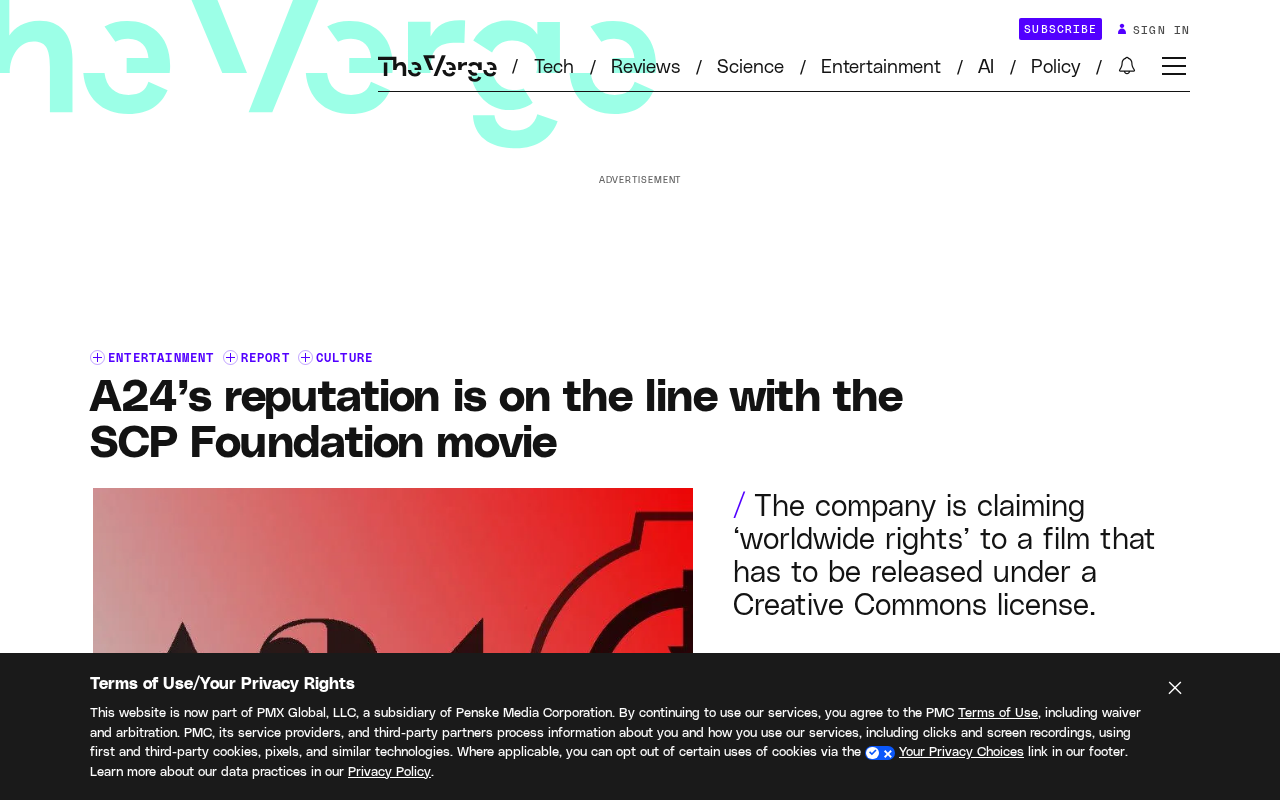
For A24 — a studio whose brand reputation is built on curated taste and championing auteur-driven filmmaking — this adaptation is being widely viewed as a notable gamble. The controversy surrounding the project reflects a recurring tension that emerges whenever internet-native content is adapted for traditional film and television.
The SCP Foundation and the Challenges of Adapting Internet Horror
The SCP Foundation is a collaboratively written fictional archive centered on the theme of "Secure, Contain, Protect" — cataloguing anomalous entities and phenomena. Much of its appeal stems from its open, community-driven creative model and its documentary-style narrative format. Content of this kind is inherently decentralized, with no fixed author — and that is precisely the core challenge when attempting to translate it to the screen.
The success of The Backrooms demonstrated that internet horror aesthetics have real commercial potential. But the SCP Foundation's sprawling lore and massive community base mean that any official adaptation will face intense scrutiny from its native audience. Fan anxiety that commercialization will dilute the spirit of the source material is the predictable starting point for the discourse surrounding projects like this.
The SCP Foundation was established in 2008, originating in the paranormal board of 4chan before evolving into a large-scale collaborative writing platform with thousands of entries across multiple languages. Each "SCP entry" is typically presented in the form of a classified document, describing an anomalous object, entity, or phenomenon contained by the Foundation, complete with containment procedures, descriptions, and supplementary files. This narrative structure — "the world exists, but I am merely the archivist" — gives SCP content a distinctive sense of immersion and verisimilitude. Unlike traditional IP, the SCP Foundation operates under a CC BY-SA Creative Commons license, meaning anyone can freely use and adapt its content. This makes "official authorization" an inherently ambiguous concept within the SCP community, and is both the legal and emotional root cause of why commercial adaptation projects are so easily called into question.
Why the Backlash Erupted at Announcement
The V/H/S series is itself a well-established found-footage horror anthology franchise. Grafting its framework onto the SCP universe represents a relatively safe genre pairing from a production standpoint. But the community's resistance suggests that the perceived legitimacy of an adaptation — and the creative sincerity behind it — tends to matter far more to audiences than the formal choices involved.
For A24, its reputation has been built on maintaining distance from mainstream commercial formulas. If this project comes to be seen as mere IP monetization riding a trending wave, it risks a backlash against the brand image the studio has worked hard to cultivate. That is the real meaning of the "reputation on the line" framing.
The V/H/S series, produced by Bloody Disgusting in collaboration with multiple directors, has been a defining low-budget found-footage horror anthology brand since its first installment in 2012. By stringing together multiple short films through the conceit of "videotapes," the format sidesteps the risks of a single long-form narrative while creating a distinctive fragmented horror aesthetic. Found-footage as a form traces its roots to The Blair Witch Project (1999), with its core appeal lying in the simulation of raw, authentic-looking footage to heighten audience immersion and visceral fear. Grafting this format onto the SCP universe has genuine narrative logic — SCP content already depends on the "authenticity" of documents and recorded evidence. Yet genre compatibility does not automatically confer emotional legitimacy. What the community cares about most is who is telling this story, and why.
Implications for the Content Industry
This case reflects a universal tension in adapting internet-native IP: on one side, established studios see a commercial opportunity; on the other, communities seek to protect the spirit of original, grassroots creation. How well any given project balances commercialization against genuine respect for that community creative legacy will ultimately determine its fate.
With limited public information available at this stage, the actual quality and market reception of the film remain to be seen. What is certain, however, is that the wave of internet horror adaptations shows no signs of slowing in the near term — and each attempt adds to the industry's accumulated knowledge of how to adapt collectively authored content.
Related articles

Frontend to AI Agent Development: A Frontline Architect Explains Career Paths and Opportunities
A frontline AI architect explains the industry changes and practical paths for frontend developers transitioning to AI Agent development: why pure frontend jobs are disappearing, why Agent + full-stack has become mainstream in hiring, and three transformation routes—Agent development engineer, FDE, and remote contracting—along with corresponding learning strategies.

How to Choose an AI Agent Development Course: Five Pitfall-Avoidance Guidelines
A mechanical-engineering career changer's two-year pitfall-tested checklist for screening AI Agent development courses: complete delivery pipeline, resume-worthy projects, real development perspective, update frequency, and coaching feedback—with concrete judgment methods and pitfall-avoidance tips.

Coze AI Agent Building for Beginners: A Zero-Code AI Agent Development Guide
Coze, ByteDance's one-stop AI application development platform, supports zero-code drag-and-drop AI agent building. This article outlines Coze's core concepts, three advantages, differences between the domestic and international versions, and the distinction between agents and apps, helping beginners quickly get started with AI Agent development.