Frontend to AI Agent Development: A Frontline Architect Explains Career Paths and Opportunities

Pure frontend jobs are rapidly disappearing, and Agent + large frontend is the top transformation direction for frontend developers.
Based on a Bilibili sharing by a frontline architect who transitioned from traditional frontend management to AI, the article points out that the contraction of pure frontend positions is not a short-term fluctuation but a restructuring of R&D job structures. After code generation models completed key iterations in July-August 2025, CRUD and page-building work were the first to be replaced, and job descriptions generally shifted to "AI frontend" and "Agent full-stack." Companies' cost logic of using one or two people to replace an original five-to-six-person team is driving up demand for Agent + full-stack, and testing positions are equally unsafe. The author gives three transformation paths: AI Agent development engineer, FDE forward deployed engineer, and remote work or independent contracting, and emphasizes building a continuous input learning rhythm and accumulating demonstrable results through project practice rather than vaguely learning AI.
Pure frontend positions are rapidly disappearing, with "frontend developer" in job descriptions being replaced by "AI frontend" or "frontend Agent direction." A frontline architect who transitioned from traditional frontend management to AI shared on Bilibili that this is not a short-term fluctuation but a fundamental restructuring of R&D job structures. His judgment is direct: "Agent + large frontend" is the transformation direction most worth investing in for frontend developers today, and an annual salary of 300K+ is just the starting point.
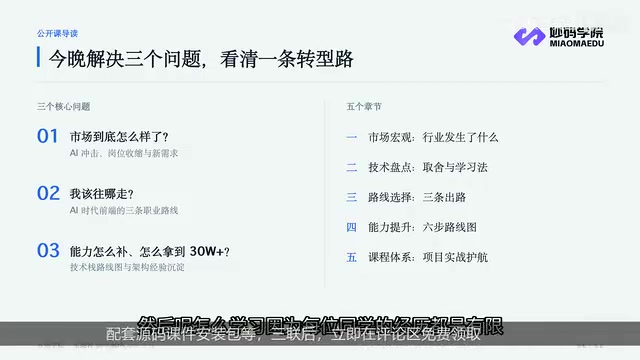
Where Did Frontend Jobs Go: The Timeline and Underlying Logic of AI's Impact
Many people attribute AI's impact on frontend to "the poor overall environment," but this architect provides a more specific origin: the real turning point occurred after model capabilities were significantly upgraded—code generation models represented by tools like Claude and Codex completed key iterations in July-August 2025, and writing code rapidly shifted from "high-value labor" to "low-value labor." The first to be hit were pure frontend and pure backend positions focused on CRUD and page building.
His observation is that pure frontend positions "are now almost nonexistent," with some companies even just copying others' JD templates, but descriptions like "AI frontend" and "Agent full-stack" are becoming increasingly common. The hiring logic behind this is not complicated: bosses want one or two people to replace the R&D workload of five or six people, and even if they don't know exactly what AI can do, they will require candidates to "know AI, know Agents, know full-stack." This is similar to the pre-2015 era when frontend and backend were not separated—job forms are reaggregating amid contraction.

CRUD is the abbreviation for Create, Read, Update, and Delete—four operations referring to development work centered on adding, deleting, modifying, and querying data tables, which is the basic form of most business system pages. Page building refers to quickly generating interfaces by dragging components or configuring templates, commonly seen in low-code platforms and admin systems. What these jobs share is repetitive logic, fixed patterns, and weak dependence on business context, making them easiest for code generation models to complete with high accuracy. In contrast, work requiring cross-system coordination, understanding ambiguous requirements, and making architectural trade-offs still depends on human judgment. This is also why in the same round of AI impact, junior CRUD positions rapidly shrank while people who could organize AI capabilities into production pipelines became scarce.
Why "Agent + Full-Stack" Became the New Favorite
To understand the change in hiring demands, the key is to see through companies' cost calculations. The original article does the math: a five-to-six-person R&D team in a tier-one city, with an average monthly salary of 20K, plus social security and housing fund, costs over 100K per month. When AI can cover parts of the frontend, backend, and testing pipelines, companies naturally tend to use fewer people to complete full-pipeline output.
This also explains why junior and mid-level frontend, backend, testing, and operations positions "collapsed overnight"—jobs with low entry barriers are the first to be covered by automated closed loops. The architect warns that testing is not a safe haven: AI can equally write automation scripts and test cases, and testing salaries are already low, making the replacement path shorter. The real opportunity is not to find a narrow niche that "AI cannot replace for now," but to proactively master AI capabilities so you can lead the full production pipeline of frontend, backend, and testing.

Agent in an engineering context refers to a program system with a large language model as its reasoning core, capable of calling tools, accessing external data, and autonomously planning multi-step operations toward goals. Unlike traditional "call an API once and return a piece of text," an Agent has the loop capability of task decomposition, tool selection, execution feedback, and self-correction, and can complete pipelines like "read requirements → generate code → run tests → fix errors" end to end. Full-stack refers to having complete delivery capabilities across frontend, backend, and even deployment and operations. The significance of combining the two is: the Agent amplifies per-person output, while full-stack capability ensures the developer can independently close a production line rather than completing only a small segment of the chain.
Three Actionable Transformation Paths
For the core question of "how to transition," the speaker does not stop at slogans but gives three specific paths:
Path 1: AI Agent Development Engineer. This is the most direct job-seeking direction, aimed at developers who want to enter companies to work on intelligent agent application development. The focus is on filling in Agent-related engineering capabilities rather than continuing to dig deep into frontend framework principles.
Path 2: FDE (Forward Deployed Engineer). Suitable for developers who already have some business experience and strong capabilities. These positions require technical implementation close to customer scenarios, with additional requirements for communication and solution capabilities.
Path 3: Remote work/independent contracting. For developers who do not want to be bound to a single employer, remote work and independent contracting are viable monetization methods, but they also require complete Agent development capabilities as support.
His advice is to stop making "frontend expert" a career goal and instead shift to a combined positioning of "versatile Agent + large frontend." With limited learning energy, the key is to identify the information gap—knowing what to learn, what not to learn, and in what order.

FDE (Forward Deployed Engineer) first took shape in data and AI companies such as Palantir, referring to engineers stationed at customer sites to directly face business stakeholders for technical implementation. Their work is not to maintain general products but to adapt company platform capabilities to customers' specific scenarios: sorting out business processes, designing data and integration solutions, debugging on site, and delivering usable systems. Therefore, FDE requires more breadth than depth in technology, along with strong communication, requirement clarification, and solution presentation skills. At the stage of AI application implementation, customer scenarios are highly non-standardized, making FDE a key role connecting model capabilities with real business, and salaries are usually higher than pure development positions of the same seniority.
Learning Strategy: From Output-Oriented Development to Continuous Input
There is a candid reminder in the sharing: many developers work overtime every day doing business output but have no time for input, and only when the company no longer needs them do they realize their technical capabilities and architectural design skills have not improved in tandem. "When the market was good, companies fought over you; now they pick and choose like buying vegetables at a market."
This is also the most common pitfall when transitioning to AI Agent development—treating learning as an extra burden rather than an investment. The architect's experience is that the learning path needs to match a clear target position (Agent development, FDE, or remote contracting) and use project practice to accumulate demonstrable business points rather than vaguely "learning AI." As for language choice (Java, Python, or Node.js), the original article says it will elaborate later, but the priority direction is already clear: the combination of Agent and large frontend capabilities is currently the most cost-effective choice for frontend developers' transformation.
It should be noted that this article is based on a single video source, and the judgments about the speed of job disappearance and timing are the speaker's personal observations; readers can cross-verify with the job market in their own cities.
One-line Summary
Pure frontend positions are rapidly disappearing, and Agent + large frontend has become the top transformation direction for frontend developers.
Paragraph Summary
Based on a Bilibili sharing by a frontline architect who transitioned from traditional frontend management to AI, the article points out that the contraction of pure frontend positions is not a short-term fluctuation but a restructuring of R&D job structures. After code generation models completed key iterations in July-August 2025, CRUD and page-building work were the first to be replaced, and job descriptions generally shifted to "AI frontend" and "Agent full-stack." Companies' cost logic of using one or two people to replace an original five-to-six-person team is driving up demand for Agent + full-stack, and testing positions are equally unsafe. The author gives three transformation paths: AI Agent development engineer, FDE forward deployed engineer, and remote work or independent contracting, and emphasizes building a continuous input learning rhythm and accumulating demonstrable results through project practice rather than vaguely learning AI.
Related articles

AI Digital Twin in Action: Using DOT to Automatically Track Bugs and User Feedback
DOTS engineers demonstrate how AI digital twin DOT collects cross-platform user feedback, categorizes issue themes, opens threads to investigate bug root causes, and submits PRs—showcasing a complete AI agent workflow for defect triage with auditable design.

Why Transistors Are No Longer Flat: The Evolution from Planar to Gate-All-Around
Transistor evolution from planar to FinFET to gate-all-around: why gates went from three-sided to four-sided wrapping to suppress short-channel effects and leakage current, extending Moore's Law.

Swarm Intelligence = a Single RL Agent? A Proof of Multi-Armed Bandit Equivalence
A paper proves that collective decision-making through local imitation in swarms is mathematically equivalent to single-agent reinforcement learning: N blind imitators act as N parallel environment samples, with an effective learning rate of 1/N. This article explains the derivation and implications of the Maynard-Cross Learning algorithm.