Coze AI Agent Building for Beginners: A Zero-Code AI Agent Development Guide

ByteDance's Coze platform lowers the barrier to AI application development with zero-code agent and app building.
This article systematically introduces Coze, the one-stop AI application development platform launched by ByteDance. Through visual drag-and-drop and natural language development, Coze allows non-programmers to quickly build AI agents, greatly lowering the development barrier. The article outlines Coze's three core advantages: extremely low development barrier, powerful ecosystem and plugin integration, and enterprise-grade solutions (though large projects still have limitations). It also compares the model differences between the domestic version (coze.cn) and the international version (coze.com), noting that the international version is more capable due to access to the GPT series. In addition, it distinguishes agents (conversational interaction) from apps (with front-end interfaces and business logic), and emphasizes the platform's naming convention that a Bot is an AI Agent. Finally, it summarizes the entry points to provide clear guidance for beginners.
In the field of AI application development, the Coze platform launched by ByteDance is changing the game. It enables non-programmers to quickly build AI agents through drag-and-drop and natural language, greatly lowering the barrier to AI application development. This article, based on tutorial content from Bilibili creator "百战程序员" (Baizhan Programmer), systematically outlines Coze's core concepts, version differences, and practical entry points.
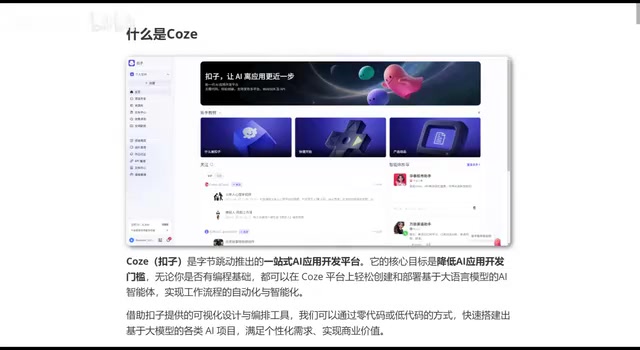
What Is Coze: A One-Stop AI Application Development Platform
Coze is a one-stop AI application development platform launched by ByteDance. As the parent company of Douyin, ByteDance's flagship large model is Doubao, and Coze is a development tool built on these large model capabilities. Its core goal is clear: lower the barrier to AI application development.
Regardless of whether you have a programming background, you can easily create and deploy AI agents based on large language models on the Coze platform to automate and intelligentize workflows. The platform adopts a visual drag-and-drop and natural language development paradigm—users simply describe their needs in Chinese or English, and Coze automatically generates the necessary code.
This zero-code/low-code approach means non-programmers can independently build AI applications. For example, a customer service representative at a travel company can create an agent that, upon inputting parameters such as the user's destination and number of days, automatically generates a complete itinerary—reducing work that originally took ten minutes to eight hours down to ten seconds.
Large Language Model (LLM) is the core engine of the Coze platform. LLM refers to deep learning models trained on massive text data that possess general-purpose language understanding and generation capabilities, such as ByteDance's Doubao and OpenAI's GPT series. In Coze, users do not need to interact directly with the model's底层 (underlying layer); instead, they configure prompts, plugins, and workflows through a visual interface, and the LLM drives the agent to complete tasks. The capability boundaries of the LLM (such as context length, reasoning accuracy, and multilingual support) directly determine the agent's performance—this is also the fundamental reason why different versions of Coze produce different results due to the models they integrate.
Coze's Three Core Advantages
According to the creator's summary, Coze's core advantages are reflected in three aspects:
Extremely low development barrier. The visual drag-and-drop and natural language development paradigm allows users without a programming background to quickly build AI applications. The platform even supports AI-generated code, so users do not need to write code by hand at all.
Powerful ecosystem and integration. Coze integrates a rich plugin system that can easily connect to external APIs such as Feishu and Amap. It also supports multiple mainstream large language models and provides knowledge base (RAG) functionality, making it easy to build agents with verifiable sources.
Enterprise-grade solutions. It supports team collaboration, permission management, and version control, providing full-chain services from development and testing to deployment and monitoring. However, the creator also candidly points out that Coze still has limitations for large enterprise-level projects, and its advantages are more evident in small, rapidly developed AI projects.
RAG (Retrieval-Augmented Generation) is the technical foundation of Coze's knowledge base functionality. RAG refers to retrieving relevant document fragments from an external knowledge base before the LLM generates an answer, and inputting them as context into the model, thereby grounding the answer in evidence and reducing hallucinations. In Coze, users can upload documents, web pages, or structured data to build a knowledge base, and the agent automatically calls the retrieval results during conversations. This is particularly suitable for scenarios such as enterprise customer service and internal Q&A that require precise citation of private materials, and is one of the key capabilities that distinguishes Coze from pure conversational chatbots.
Domestic vs. International Versions: Clear Differences in Model Capabilities
Coze is available in two versions: the domestic version (coze.cn) and the international version (coze.com), with the main differences being language and available models.
The domestic version has a Chinese interface and supports domestic large models such as Doubao, DeepSeekAd, Kimi, and StepFun, and is accessible via a normal network connection. The international version has an English interface and can use GPT-4o, GPT-5, Gemini, DeepSeek and other model series, but requires a VPN.
The creator states plainly in the tutorial that AI agents developed on the international version are usually more powerful, with the core reason being differences in model capabilities—the GPT series remains among the most capable models currently available. This course chooses to teach based on the domestic version because, on the one hand, it is convenient to access, and on the other hand, the Chinese interface is more conducive to learning.
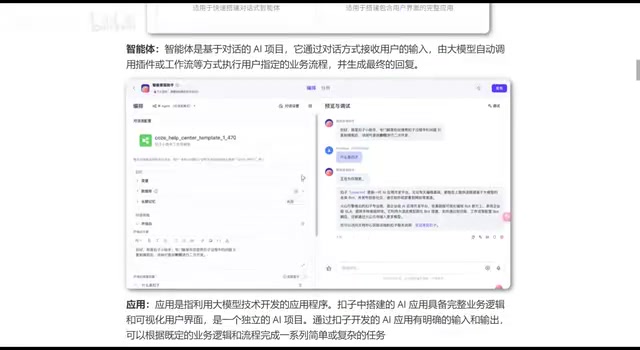
Agents vs. Apps: What Coze Can Do
Coze was originally positioned for building agents (conversation-based AI projects), where users let the AI complete work tasks through dialogue. Today, the platform also supports directly creating AI apps—independent AI projects with front-end pages, complete business logic, and clear input/output, similar to a small app.
The difference between the two: agents receive input through conversation, and the large model automatically calls plugins or workflows to execute tasks and generate replies; apps have a visual user interface and complete a series of simple or complex tasks according to established business processes. For example, in a translation tool app, users input content and click translate to get the result without conversational interaction. Currently, the app creation feature is still in Beta testing.
Workflow is the core mechanism in Coze for orchestrating complex tasks. It allows users to connect multiple steps (such as calling plugins, LLM nodes, conditional judgment, and code blocks) into a flowchart via drag-and-drop, enabling automated processing from input to output. Agents can call workflows to execute multi-step tasks, while apps often use workflows as their back-end logic. Workflows reduce the difficulty of implementing branches, loops, and external API integration, enabling non-programmers to build AI processes with business logic—an important embodiment of Coze's "low-code" philosophy.
A Key Term: Bot = Agent
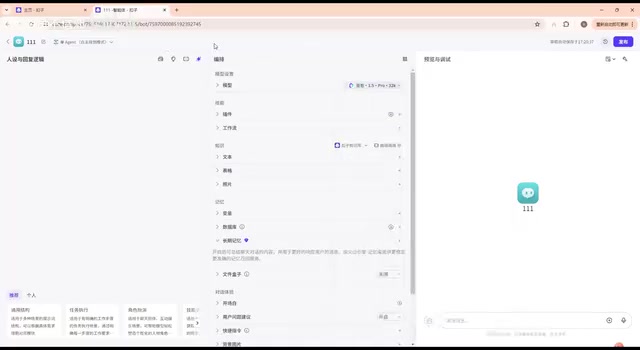
On the Coze platform, an AI agent is not called an AI Agent but a Bot. A Bot can perform various tasks, including automated services and intelligent conversations, improving user experience and efficiency through advanced AI technology. Understanding this is important for subsequent learning and reading documentation—a Bot is an AI Agent, just with a different name.
Entry Points Summary
- Coze is a one-stop AI application development platform launched by ByteDance, with the core goal of lowering the barrier to AI application development
- Zero-code/low-code drag-and-drop development enables non-programmers to quickly build AI agents
- Three major advantages: extremely low development barrier, powerful ecosystem integration, and enterprise-grade solutions (though large projects still have limitations)
- The main difference between the domestic and international versions lies in available models; the international version can use the GPT series
- Agents are based on conversational interaction, while apps have complete front-end interfaces and business logic
- A Bot on the Coze platform is an AI Agent, just with a different name
Related articles

WorkBuddy Agent in Action: From AI Q&A to Automated Office Work
WorkBuddy is Tencent's AI agent desktop workbench that reads local files, operates office software, executes multi-step tasks, and runs on schedules. This article explains its core features, key differences from traditional AI tools, and use cases.

Anthropic Research: LLMs Make Formal Software Verification at Scale Possible
Anthropic Frontier Red Team research shows LLMs can generate formal proofs at the RISC-V assembly level for over 100 real open-source libraries, covering 123 OSS-Fuzz libraries and 239 entry points, totaling about 180 million lines of Rocq proofs and finding hundreds of bugs. The article analyzes specification generation, the proof pipeline, trust boundaries, and cost reduction paths.

Prompt Engineering for Beginners: From Writing Prompts to Building AI Collaboration Skills
From the four functions of prompts to the six-step prompt engineering process, this article systematically covers core concepts, business value, and three layers of limitations to help beginners build a complete cognitive framework for prompt engineering.