How to Choose an AI Agent Development Course: Five Pitfall-Avoidance Guidelines

A mechanical engineering career changer summarizes five criteria to help you screen AI Agent courses that can truly be deployed.
A developer who transitioned from mechanical engineering, drawing on over two years of pitfall experience, proposes five standards for screening AI Agent courses: whether it covers a complete delivery pipeline from requirement decomposition to engineering deployment (courses only teaching Prompt are Prompt courses); whether projects can go on a resume (requiring clear input/output, real toolchain integration, and quantifiable metrics); whether it has a production-level development perspective (Token cost control, tool call fault tolerance, data security); update frequency and code repository maintenance to avoid becoming outdated; and coaching/feedback mechanisms, where assignment grading and Q&A are more valuable to career changers than video quantity. The article also reminds that the free course promoted in the video is single-source lead-generation content whose quality has not been independently verified; when selecting courses, one should still check each item against the checklist.
If you come across an AI Agent tutorial promising to take you "from beginner to expert in 7 days," don't rush to bookmark it. A developer who transitioned from mechanical engineering spent over two years and hit countless pitfalls before distilling this screening logic—which is more worth reading than the course itself.
Why Most AI Agent Courses Leave You Knowing Nothing After "Finishing"
According to the Bilibili creator's own account in the video, he originally majored in mechanical engineering, with a resume full of CAD, Solidworks, and material mechanics—yet the positions he applied for were mostly factory shift work or low-paying jobs. What truly made him commit to a career change was an observation: many seemingly advanced AI applications are essentially about getting the model API to work, then adding a layer of engineering encapsulation to turn it into a runnable product.
The engineering background's logical decomposition and process delivery skills are transferable; what was missing was just a path into AI application development. But he soon discovered that publicly available tutorials on the market all share the same problem—they cover a pile of concepts, can say a thing or two about Prompt, Agent, and Function Calling, but when it comes to hands-on work, you can't build a decent project. Following scattered videos to write code, you build a chat box today, connect an interface tomorrow, and the day after you're stuck on deployment and resume packaging.
The creator summed up this state as "it feels like I learned something, but I didn't actually learn it." According to analyses from multiple AI engineering content creators on YouTube, this is actually a common predicament for current AI Agent learners: fragmented knowledge, lack of a complete delivery pipeline, and no presentable works.
Function Calling (tool invocation) is the core mechanism through which large models interact with external systems: developers declare available tools and their parameters in structured descriptions (such as JSON Schema), and the model determines during conversation whether to invoke a tool, which tool to invoke, and generates a call request in the proper format, which the runtime executes and returns the result to the model for continued reasoning. It upgrades the Agent from "only able to chat" to an execution entity that "can query databases, send emails, and operate spreadsheets." Understanding this mechanism is fundamental to judging whether a course covers a real toolchain—courses that only teach Prompt techniques without covering tool invocation protocols, error handling, and result parsing can hardly support deployable Agent projects.
Screening Criterion One: Check for a Complete Delivery Pipeline
A high-quality Agent course should cover at least this pipeline: requirement decomposition → model selection → API calls → tool invocation (Function Calling / Tools) → RAG retrieval → memory and state management → evaluation and monitoring → engineering deployment.

The method is straightforward: flip through the course outline and search for these keywords. If a course's core content is "teaching you how to write prompts to make the model play a certain role," then it's more of a Prompt course, not an Agent development course. According to the consensus of the creator and multiple tech bloggers, Prompt engineering is merely the entry point of Agent development; what truly determines whether a project can be deployed is the toolchain and engineering capability.
RAG (Retrieval-Augmented Generation) refers to retrieving relevant fragments from external knowledge bases (documents, databases, web pages) before the model generates an answer, then injecting those fragments as context into the prompt, so that answers are based on the latest or private materials rather than relying solely on the model's parameter memory. A complete RAG pipeline typically includes document parsing and chunking, vectorization (Embedding), vector store retrieval, re-ranking, context assembly, and citation tracing. For enterprise knowledge base Q&A Agents, RAG is the key link that determines answer accuracy and maintainability, and it's also the touchstone for whether a course clearly explains "how data enters the system."
Criterion Two: Can the Project Go on a Resume?
According to the creator, an Agent project that can go on a resume must meet three points: clear input and output (what the user inputs, what the system outputs); integration with at least one real toolchain (retrieval, database, API, spreadsheet, enterprise system); and quantifiable metrics or a closed loop (accuracy, hit rate, response time, cost).
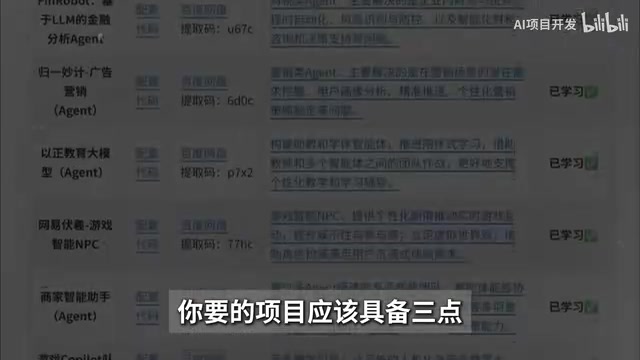
He gave two examples that meet the standard: an enterprise knowledge base Q&A Agent (RAG + permission control + citation tracing + backend management), or a multi-tool office Agent (read emails, read spreadsheets, generate weekly reports, auto-archive). Conversely, if the course project is just a chatbot interface paired with conceptual explanations of "agent planning, reflection" and the like, its value for job hunting is very limited. This judgment aligns with the views of maintainers of multiple open-source Agent projects on GitHub: recruiters look at the tool invocation chain and evaluation data, not the chat interface.
Criterion Three: Does It Have a Real Development Perspective?
The truly hard part of an Agent isn't getting it to run—it's getting it to run stably. The four production-level issues the creator listed are worth checking every course against: how to control Token costs, how to ensure compatibility when switching models or roles, how to prevent failures when tool calls fail, and how to ensure data security.
The course doesn't need to go particularly deep, but at least it should let students know where the pitfalls are. According to some practitioners' sharing in tech communities, students lacking this content tend to run into problems as soon as their projects go into production—this is not an isolated phenomenon but a typical manifestation of the disconnect between course design and engineering reality.
Token cost is the direct expense incurred by large model APIs billing based on the number of input and output tokens. In Agent scenarios, multi-turn conversations, tool call result passback, and RAG retrieval fragment assembly all significantly increase context length, driving up per-request costs; without strategies like context trimming, caching, and model tiering (using small models for simple tasks), post-launch costs can far exceed expectations. If a course only demonstrates "getting it to run" without teaching token estimation and cost control, students will find it hard to turn a Demo into an operable product.
Criterion Four: Update Frequency Determines Course Lifespan
Large models iterate quickly, and old courses easily become outdated by the time you finish. The creator suggests checking two things: whether the outline includes recent content (new tool invocation methods, framework updates, evaluation method iterations); and whether the assignment code repository is continuously maintained.
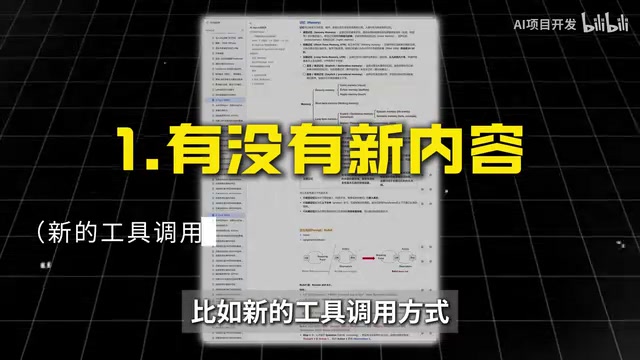
Be wary of "one-shot deal" courses. Regarding specific standards for update frequency, different bloggers have slightly different views—some think updates within three months are sufficient, others demand more frequent ones. But "having a continuously maintained code repository" has become a consensus across sources.
Evaluation and monitoring is an often-overlooked part of Agent engineering: evaluation refers to using test sets or manual annotation to measure an Agent's performance on metrics like accuracy, tool call success rate, and response time; monitoring refers to continuously collecting logs in the production environment, tracking each tool call and model output, and promptly detecting degradation or anomalies. Without evaluation, you can't tell whether switching models or changing prompts makes things better or worse; without monitoring, online failures can only be discovered through user complaints. This is also an important basis for judging whether a course has a production perspective.
Criterion Five: Coaching and Feedback Matter More Than Video Quantity
What career changers lack isn't videos to watch—it's someone to pull them out of the pit. The creator suggests prioritizing courses that offer assignment grading, project Q&A, community progress comparison, resume advice, or project packaging ideas.
This point is echoed in discussions across multiple platforms: according to some learners' feedback, the difference in video quality between courses isn't actually as large as imagined—what truly sets them apart is the speed of Q&A response and the quality of project retrospectives. There's also the view that if you have strong self-learning ability and can read English without issues, official documentation plus open-source projects can replace some paid courses—this is a minority view, but still valuable reference for budget-conscious learners.
About That "Free Course" in the Video
The creator promoted an Agent development course in the video that is reportedly "free now, possibly paid later," along with bonus notes, backend interview questions, and an AI big project practical resource pack.
It should be noted: this recommendation comes from a single source and is promotional content with a lead-generation nature; the course's actual quality has not been independently verified. Readers can claim the materials as a supplement, but when screening courses, it's still advisable to check each item against the five criteria above—don't skip the judgment step just because it's "limited-time free."
Final Thoughts
The value of this checklist isn't in recommending a particular course, but in providing a reusable judgment framework: is the delivery pipeline complete, can the project go on a resume, does it have a production perspective, are updates continuous, and is there someone coaching you. Stick these five criteria on the course selection page and tick them off one by one, and the probability of hitting pitfalls will be much lower. As the career changer in the image shows, only when the toolchain runs, the project is complete, and someone guides you will efficiency truly take off.
One-line Summary
A mechanical engineering career changer summarizes five criteria to help you screen AI Agent courses that can truly be deployed.
Paragraph Summary
A developer who transitioned from mechanical engineering, drawing on over two years of pitfall experience, proposes five standards for screening AI Agent courses: first, whether it covers a complete delivery pipeline from requirement decomposition to engineering deployment—courses only teaching Prompt are Prompt courses; second, whether the project can go on a resume, requiring clear input/output, real toolchain integration, and quantifiable metrics; third, whether it has a production-level development perspective, such as Token cost control, tool call fault tolerance, and data security; fourth, update frequency and code repository maintenance to avoid becoming outdated upon completion; fifth, coaching and feedback mechanisms, where assignment grading and Q&A are more valuable to career changers than video quantity. The article also reminds that the free course promoted in the video is single-source lead-generation content whose quality has not been independently verified; when selecting courses, one should still check each item against the checklist.
Related articles
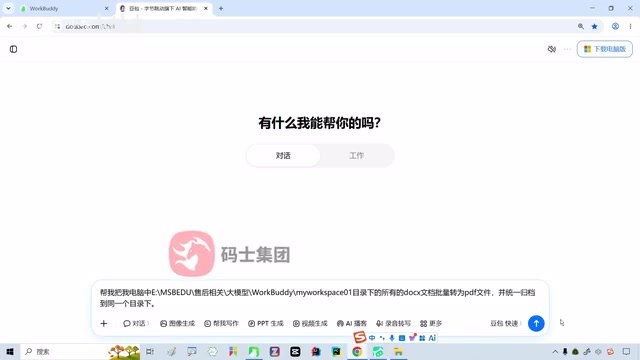
WorkBuddy in Action: How AI Agents Automate Batch File Conversion and Archiving
Bilibili creator Teacher Shanyao tests WorkBuddy vs. Doubao on batch file conversion, showing how AI Agents move from "giving solutions" to "direct execution," with a full workflow and credit cost reference.
High-Frequency AI Agent Interview Topics: RAG, Multi-Agent Systems, and Token Optimization
Based on a Bilibili Agent interview video, this article covers high-frequency AI Agent interview topics: RAG evaluation, single vs. multi-agent selection, token cost control, infinite loop troubleshooting, and project presentation techniques.

The Complete AI Agent Development Workflow: From Technical Build to Compliant Launch
A full AI agent development workflow for education: architecture, four teaching modules, deep synthesis and large model filings, high-concurrency deployment, and operations.