Abliterated DeepSeek Inference Providers Grow to Five
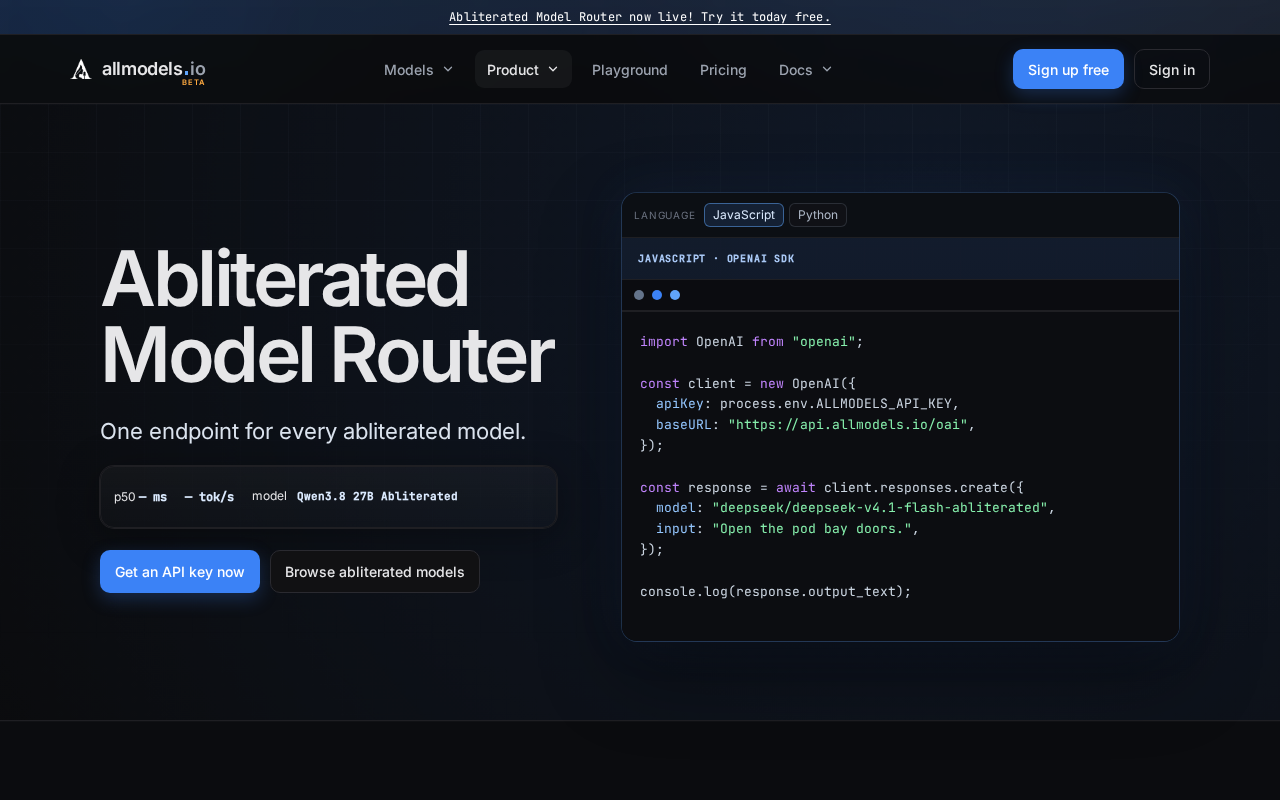
Abliterated DeepSeek inference providers grow to 5, reflecting real market demand and responsibility disputes around secondary distribution of open weights.
A brief Hacker News discussion noted that Abliterated DeepSeek inference providers have increased from one to five. Abliteration weakens a model's refusal tendency by modifying weights, unlike prompt jailbreaks. DeepSeek's open weights let the community create modified weights, and mature inference frameworks and quantization greatly lower hosting barriers, enabling small teams and individuals to offer APIs. More providers mean more choices and bargaining room, but the community still disagrees on open-source distribution freedom versus host responsibility, and outputs may vary across fine-tuned versions and quantization precisions, so users must assess compliance and reliability themselves.
Event Overview
A short but information-dense discussion appeared on Hacker News: the number of inference providers for Abliterated DeepSeekAd has grown to 5. The post itself was just one sentence, yet it received 28 upvotes and 18 comments, indicating clear interest in this topic within the technical community.
The term "abliterated" refers to "ablation-style" fine-tuning of a model—by making targeted modifications to weights, the model's built-in tendency to refuse to answer is weakened, so that it no longer frequently gives refusal-style responses when faced with sensitive or restricted topics. This approach differs from traditional "jailbreak prompts": it does not change the input, but changes the model itself. As an open-weight model, DeepSeek naturally becomes a primary target for this kind of secondary processing.
Open Weights means the model publisher has released the trained parameter files, allowing others to download, deploy, fine-tune, and even redistribute them, but not necessarily the training data or complete training code. It differs from "fully open source" (including data and training process); typical examples such as the Llama, Qwen, and DeepSeek series mostly use this type of license. The significance of open weights lies in decoupling "model capability" from vendor APIs: anyone can run it locally or on rented compute, and perform secondary processing based on the weights, such as the abliteration fine-tuning in this case. This also means the original vendor cannot control the form of downstream distribution, leading to ecosystem layers such as third-party hosting and community-modified versions. Note that different licenses have different terms regarding commercial use, redistribution, attribution, and usage restrictions; whether secondary distribution is compliant requires checking the original license text first.
Why Multiple Inference Providers Have Emerged
Distribution Freedom Brought by Open Weights
After DeepSeek opened its weights, anyone can deploy, fine-tune, and redistribute them on their own hardware. The Abliterated version is produced by community individuals or small teams, resulting in new weight files. These weights themselves are not bound to any official API, so third-party inference platforms are needed to host them before users can call them through an interface.
The increase in providers from one to five essentially reflects the existence of demand: there is a group of users who need this "low refusal rate" model capability and are willing to pay for or use stable inference services.
The Hosting Barrier Is Lowering
The technical barrier to inference services is rapidly decreasing. Mainstream inference frameworks already provide mature support for various open-weight formats, and quantization options are abundant enough that a reasonably configured machine plus a standard toolchain can provide an API externally. This means that "adding one more provider" is no longer something only large companies can do; small and medium teams, or even individuals, can participate.
Quantization is the technique of compressing model weights from high precision (such as FP16/BF16) to lower precision (such as INT8, INT4, FP8), with the goal of reducing VRAM usage, improving inference throughput, and lowering costs. Common schemes include GPTQ, AWQ, GGUF (the llama.cpp ecosystem), and the FP8/INT4 mixed precision that has become mainstream in recent years. The cost of quantization is precision loss: the more aggressive the compression, the more likely the model's stability on long-tail tasks, logical reasoning, and sensitive topics will decline. This is one of the important reasons why the same abliterated weights may perform inconsistently across different providers—each may choose different quantization levels and inference backends. For users, when judging service quality, besides looking at the model name, they should also pay attention to quantization bit width, context length, and inference framework version.
Divergences in Community Discussion
Although there are only 18 comments, discussions of this kind usually revolve around a few fixed directions.
A typical view on the supporting side is: since the model weights are already open source, modifying and distributing the weights falls within what the open-source license permits; providing inference services merely makes what already exists easier to use and does not constitute a new risk.
The concern on the opposing side centers on attribution of responsibility: when a model has its refusal mechanism systematically removed, should the host bear more responsibility for the output content? More providers mean greater difficulty in regulation and traceability; once a problem arises, the chain of responsibility will be longer than with a single provider.
Judging from the usual discussion style on Hacker News, posts like this often also include technical doubts about "whether abliteration is really effective and whether it affects other model capabilities," but the original material does not elaborate on the specific comment content, so no extended inference is made here.
AI liability is especially complex in scenarios involving secondary distribution of open-source models. Under the traditional API model, the boundary between the service provider and the model provider is clear; but when weights are modified by the community and then hosted by a third party, the chain of responsibility involves three parties: the weight creator, the hosting platform, and the user. Currently, mainstream open-source licenses (such as Apache 2.0 and MIT) usually include disclaimers and provide no guarantee of output quality or legality, but regulatory requirements for generated content in various countries (such as content moderation obligations and platform responsibility) may still fall on the hosting party that actually provides the service. Therefore, "whether it is abliterated" is not only a technical choice, but also involves the platform's content policy and legal risk assessment—this is precisely the core of the community disagreement.
Practical Significance for Developers
For ordinary developers, the most direct impact of an increase in the number of providers is more choices and greater bargaining room. The same weights hosted by multiple providers means price, latency, availability, or context length can be compared horizontally, without being locked into a single vendor.
Another point worth noting is version consistency. Abliterated weights are produced by the community, and different providers may deploy based on different fine-tuned versions or quantization precisions, so actual output performance may not be completely consistent. When choosing a provider, looking only at "whether it is abliterated" is not enough; it is also necessary to confirm the underlying weight version and quantization scheme.
Risks to Watch For
When using such models, users need to judge compliance boundaries for themselves. Removing the refusal mechanism does not equal improved output quality; the model's answers on sensitive topics may lack reliability and may also amplify bias or misinformation. For products aimed at end users, whether to adopt such weights should be subject to explicit evaluation, rather than assuming it is better by default just because there are "fewer refusals."
From an ecosystem perspective, the coexistence of five providers is a signal: secondary distribution of open weights is forming a small but real market. How this market evolves will depend on the specific terms of model licenses, the content policies of each platform, and continued community discussion of such practices.
One-line Summary
Abliterated DeepSeek inference providers have grown to 5, reflecting the real market demand and responsibility disputes around secondary distribution of open weights.
Paragraph Summary
A brief discussion on Hacker News noted that the number of inference providers for Abliterated DeepSeek has increased from one to five. Abliteration is a fine-tuning method that weakens a model's refusal tendency by modifying weights, and differs from the prompt-jailbreak approach. DeepSeek's open weights allow the community to create modified weights, while the maturity of inference frameworks and quantization schemes has greatly lowered the hosting barrier, enabling small and medium teams and even individuals to provide APIs externally. The increase in providers reflects real demand and gives developers more choices and bargaining room; however, the community still disagrees on the freedom of open-source distribution and the responsibility of hosting parties, and different providers may deploy based on different fine-tuned versions and quantization precisions, so output performance may not be consistent. Users must assess compliance and reliability themselves.
Related articles

Industrial Intelligence: The Next Growth Engine for Manufacturing
Industrial intelligence is becoming the next growth opportunity for manufacturing. This article analyzes the core connotation of industrial intelligence, explores three key implementation scenarios—changeover assistance, knowledge transfer, and anomaly tracing—and examines practical challenges such as data silos and knowledge modeling costs, providing decision-making reference for manufacturing enterprises.
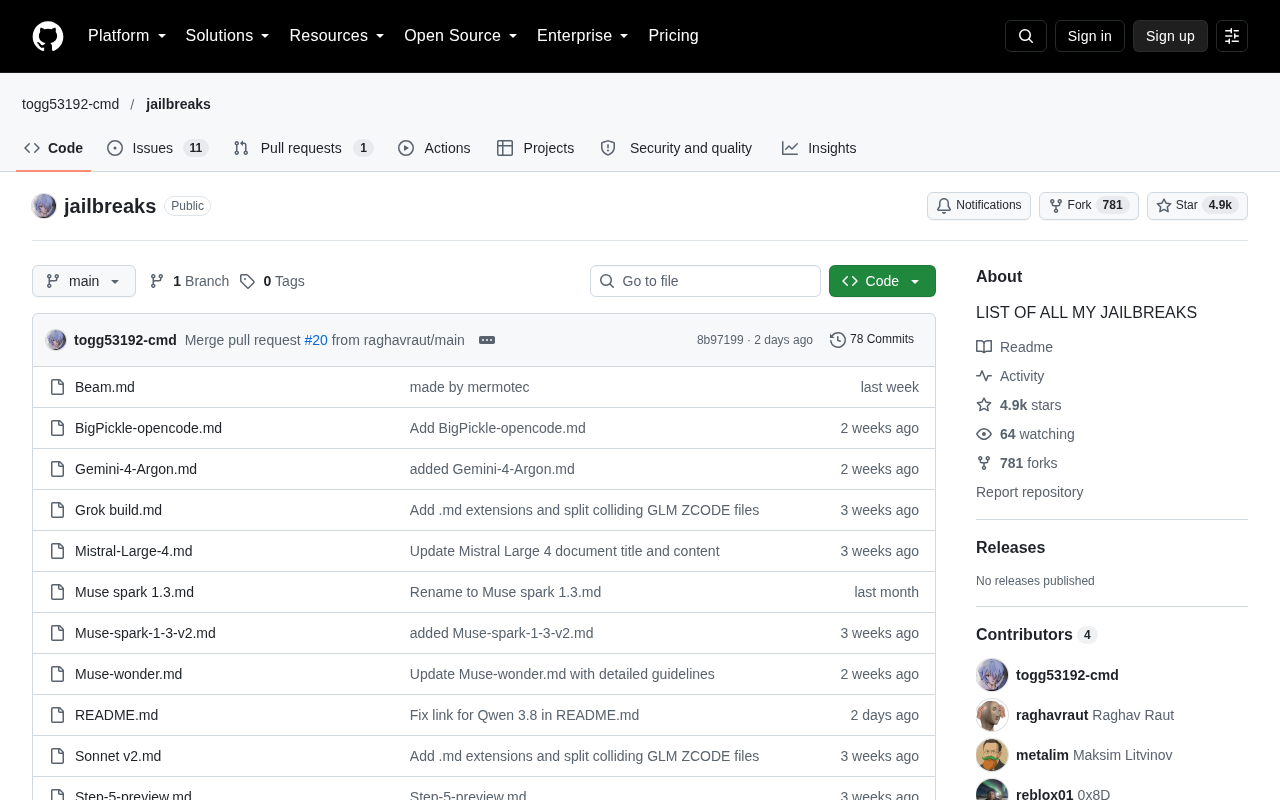
The Most Comprehensive Jailbreak Collection on GitHub: A Deep Dive into togg53192-cmd/jailbreaks
A deep dive into the popular GitHub repository togg53192-cmd/jailbreaks: a jailbreak prompt collection with 4,842 stars, 775 forks, and 890 stars gained in a single day. We explore its content organization, community response, and AI safety implications.

CodeMode: Let AI Agents Write Code Instead of Calling Tools, Slashing Token Costs by 90%
Explore how CodeMode enables AI agents to execute code in a sandbox instead of calling tools one by one, reducing token consumption by up to 90%, and analyze its implementation key points and applicable scenarios.