The Boundaries of LangGraph: When Does an Agent Become a Distributed Application?
When your Agent orchestration framework becomes a bottleneck, it's time to think in distributed systems terms.
This article examines the boundary between Agent orchestration frameworks like LangGraph and distributed application architecture. While LangGraph excels at state management, branching workflows, and multi-Agent coordination, production systems inevitably face operational concerns — persistence, observability, fault recovery, and permissions — that belong to distributed systems engineering. The key is layered architecture: let the framework handle orchestration, and delegate infrastructure concerns to purpose-built tools.
An Inescapable Architectural Question
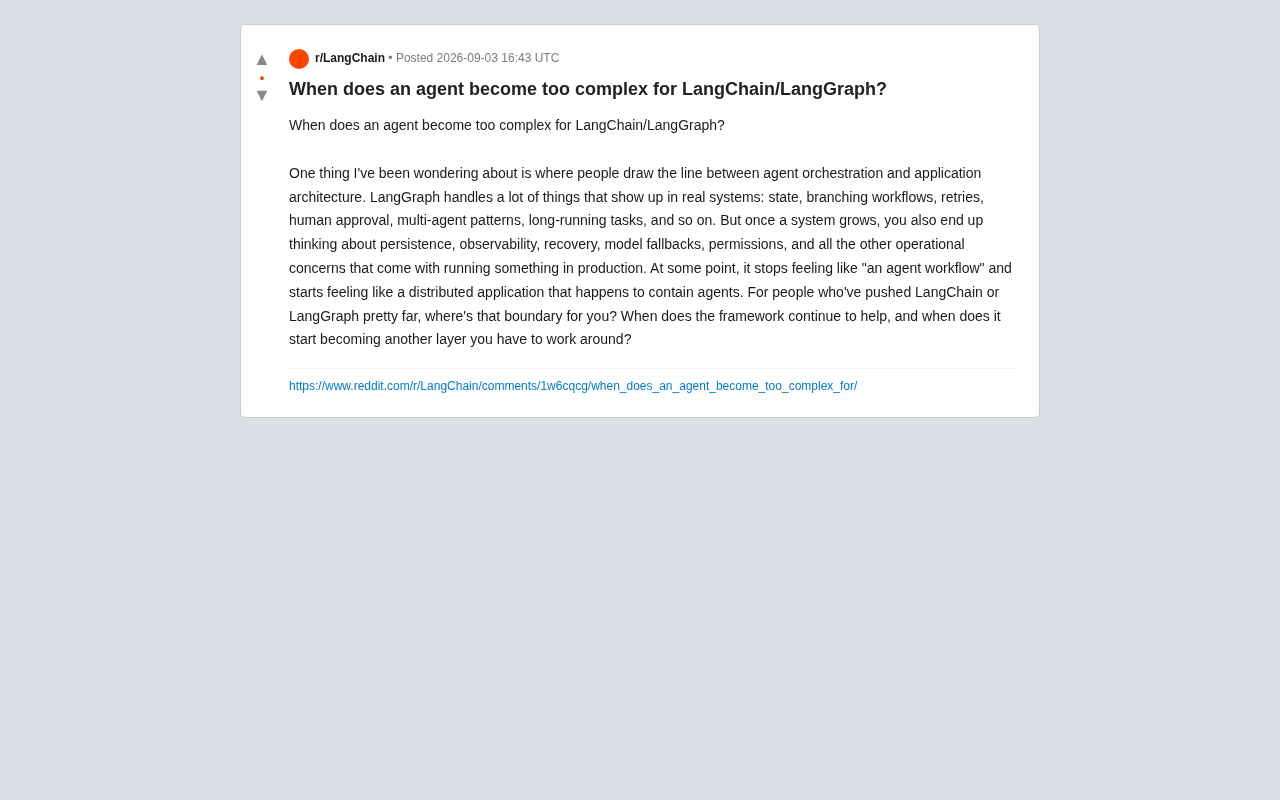
As AI Agents move from demos to production environments, an increasingly common question has surfaced: How much system complexity can Agent orchestration frameworks (like LangChain/LangGraph) actually handle? This question recently sparked a heated discussion on Reddit.
Agent orchestration frameworks are a category of software tools that have emerged over the past two years alongside the growing capabilities of large language models (LLMs). LangChain initially debuted as an LLM application development framework, providing a Chain abstraction that lets developers string together prompt templates, model calls, and tool usage. LangGraph is the advanced solution from the LangChain team, introducing the concept of a Directed Graph where each node represents a computation step (such as an LLM call, tool execution, or conditional check) and edges represent state transition paths. Compared to linear Chains, the Graph structure naturally supports loops, branching, and parallelism, making it better suited for modeling complex Agent behaviors — for example, an Agent that may need to repeatedly reason and invoke different tools after gathering information until a termination condition is met. This evolution from "chains" to "graphs" reflects the industry's deepening understanding of Agent system complexity.
The core of the discussion can be distilled into a single sentence: "At some tipping point, the system stops looking like 'an Agent workflow' and starts looking more like a distributed application that happens to contain Agents."
This isn't merely a tool selection issue — it's a deeper reflection on the boundary between orchestration and application architecture. For any team building production-grade AI systems, where you draw this line directly determines how much technical debt you'll accumulate.
What LangGraph Actually Solves
Credit where it's due: LangGraph provides solid capabilities at the Agent orchestration level. The original poster listed real system scenarios where it excels — precisely the areas that are most painful when writing code from scratch.
State and Flow Control
As a graph-structured orchestration engine, LangGraph is naturally suited for the following scenarios:
- State Management: Maintaining context across multi-turn interactions and multi-node transitions
- Branching Workflows: Dynamically determining the next step based on conditions
- Retries: Handling the inherent uncertainty of LLM calls
- Human Approval: Inserting human review at critical decision points. This Human-in-the-Loop pattern is especially important in high-risk scenarios (such as financial transaction approvals or medical recommendation confirmations), ensuring that AI's autonomous decisions don't bypass necessary human oversight
- Multi-Agent Collaboration Patterns: Having multiple Agents each handle their own responsibilities, similar to service orchestration in microservices architecture, where each Agent focuses on a specific capability domain (such as information retrieval, data analysis, or code generation), coordinated by the orchestration layer
- Long-Running Tasks: Supporting persistent workflows that need to pause and resume — extremely common in real business scenarios where an approval process might need to wait hours or even days for human confirmation
These capabilities cover the "skeleton" of an Agent system. If your needs stay within the scope of "getting a few Agents to collaborate logically to complete tasks," LangGraph can indeed significantly reduce boilerplate code and let you focus on business logic.
The Tipping Point: When Operational Concerns Take Over
However, the problems emerge precisely when the system "grows up." The original post pinpointed exactly when the shift occurs — when you find yourself having to seriously consider a series of operational concerns.
The "Heavy Lifting" Outside the Framework
Once an Agent system goes to production, the following issues arrive in quick succession:
- Persistence: Where does state live? How do you guarantee consistency? In distributed environments, state persistence requires considering transactional semantics — when an Agent crashes mid-execution, do the already-completed steps need to be rolled back? This directly involves checkpoint strategies and idempotency design
- Observability: How do you integrate logging, tracing, and metrics monitoring? Observability is one of the three pillars of modern distributed systems operations, consisting of Logs, Metrics, and Distributed Traces. This is especially critical in Agent systems because LLM calls are inherently non-deterministic — the same input may produce different outputs, token consumption and latency fluctuate significantly, and an Agent's reasoning path is hard to predict. The industry already has a mature tool stack: OpenTelemetry provides standardized telemetry data collection specifications, while LLM-specific observability tools like LangSmith and Langfuse can record each call's prompt, response, and token usage, helping developers understand an Agent's decision-making process
- Recovery: How do you resume from a breakpoint after a process crash?
- Model Fallbacks: How do you switch when the primary model becomes unavailable? This is a critical fault-tolerance mechanism in production-grade AI systems. In practice, LLM APIs can become unavailable due to service outages, rate limiting triggers, or network timeouts. A robust fallback strategy typically includes multiple tiers: first attempt the primary model (e.g., GPT-4o), switch to an alternative model (e.g., Claude Sonnet) on timeout, and ultimately fall back to rule-based logic. This pattern is known in traditional microservices architecture as the Circuit Breaker Pattern, first popularized by Netflix's Hystrix library. Notably, a fallback model may not support certain complex tool calls or reasoning tasks, and the system needs to dynamically adjust the Agent's behavioral strategy accordingly
- Permissions: Who can call what, and where are the boundaries?
These problems fundamentally belong to the domain of distributed systems engineering, not "Agent workflows." Distributed systems engineering is a highly mature field in computer science, with core challenges including network partition tolerance, data consistency guarantees, and service discovery and load balancing, all governed by foundational theory like the CAP theorem (you can't simultaneously guarantee consistency, availability, and partition tolerance). When an Agent system goes to production, it essentially becomes a distributed system: multiple Agents may run in different processes or containers, state needs to synchronize across nodes, and LLM API calls are inherently remote service calls. These are engineering problems refined through decades of industrial practice, with mature solutions (such as Kafka for message queuing, PostgreSQL for persistence, OpenTelemetry for observability) — not wheels that Agent frameworks need to reinvent.
When the team's energy is increasingly spent on these infrastructure issues, the Agent framework gradually shifts from being a "helper" to being "a layer to work around."
Signals That It's Gone from "Helping" to "Hindering"
To determine whether LangGraph has become a burden, watch for these key signals:
- You're compromising architectural design to accommodate the framework's conventions, rather than having the framework serve the architecture
- You're frequently "tricking" or "bypassing" the framework's abstractions just to implement a custom behavior. This phenomenon is known in software engineering as "Leaky Abstraction," coined by Joel Spolsky — all non-trivial abstractions are leaky to some degree, and when underlying complexity exceeds the abstraction's design expectations, developers are forced to reach below the abstraction layer to solve problems
- Debugging becomes difficult because the framework's abstraction layer obscures what's actually happening underneath
- More than half your team's code is "glue" connecting the framework to your own infrastructure
When these signals appear, it usually means the system's complexity has exceeded the comfort zone that the Agent orchestration framework was designed for.
How to Rationally Draw This Line
Synthesizing the community discussion, we can distill a more actionable decision framework. The key question isn't "Is LangGraph good or bad?" but rather "Is it still creating net value at your specific stage?"
Orchestration Logic vs. Application Logic
A practical principle: Let the framework focus on what it does best — orchestration logic — and hand application-level concerns to mature, purpose-built tools.
- Keep inside the framework: Agent decision flow, tool call sequencing, state passing between nodes, conditional branching
- Move outside the framework: Persistent storage (use databases), observability (use dedicated tracing systems), permissions (use an independent auth layer), task queues (use message middleware like RabbitMQ or Celery)
In other words, LangGraph should be one orchestration component in your system, not a "God Object" that carries all operational logic. The God Object is a classic anti-pattern in object-oriented design, referring to a class or component that takes on too many responsibilities — it knows too much, does too much, resulting in high coupling and poor maintainability. In software architecture, the Single Responsibility Principle and Separation of Concerns are the core weapons against God Objects. When an Agent orchestration framework is asked to simultaneously handle workflow orchestration, state persistence, permission management, monitoring and alerting, and more, it's evolving into a God Object. This not only increases the framework's own complexity but also makes it extremely costly for users to upgrade, migrate, or partially replace the framework, because all concerns are entangled together — pull one thread and everything unravels. When you try to make it do everything, it starts becoming a bottleneck.
Layered Thinking Is Key
A healthier architectural mindset treats the Agent system as a layered application:
- Orchestration Layer: LangGraph handles Agent logic flow
- Infrastructure Layer: Dedicated persistence, monitoring, and auth services handle their respective concerns
- Business Layer: Your own domain logic
This layered thinking is consistent with classic software architecture patterns. Whether it's the traditional three-tier architecture (presentation-business-data) or the more modern Hexagonal Architecture (also known as the Ports and Adapters pattern), the core idea is the same: isolate different concerns through clear boundaries and interfaces so that each layer can evolve and be replaced independently. In the Agent system context, this means you should be able to replace LangGraph with another orchestration engine (such as CrewAI or AutoGen) without rewriting business logic, or migrate state storage from SQLite to Redis without touching orchestration logic.
If you find the orchestration layer constantly encroaching on the infrastructure layer, or infrastructure requirements forcing you to rewrite orchestration logic, that's the signal to refactor or partially "de-framework."
Frameworks Are Tools, Not Dogma
The value of this discussion lies in reminding every AI engineer: No framework can cover the full complexity of a production system. LangChain and LangGraph remain powerful tools for rapidly prototyping Agents and handling orchestration logic, but when a system evolves into a true distributed application, operational concerns will inevitably spill beyond the framework's boundaries.
This pattern isn't unique to AI. Looking back at software engineering history, similar evolutionary trajectories have repeated themselves: Ruby on Rails made web development extremely efficient, but as applications grew beyond a certain scale, teams had to introduce message queues, caching layers, microservice decomposition, and other infrastructure beyond Rails. React revolutionized frontend UI development, but complex applications still require independent state management, routing solutions, and build toolchains. A framework's value lies in lowering the barrier to entry and boosting development efficiency for a specific problem domain, but it can never — and should never — try to solve every problem.
The truly mature approach isn't agonizing over "should I use LangGraph or not" but clearly recognizing its capability boundaries, using it at the appropriate layer, and re-evaluating that boundary at each stage of system growth. Frameworks should serve the architecture, not constrain it — and that may be the most important lesson on the journey from demo to production.
Key Takeaways
Related articles
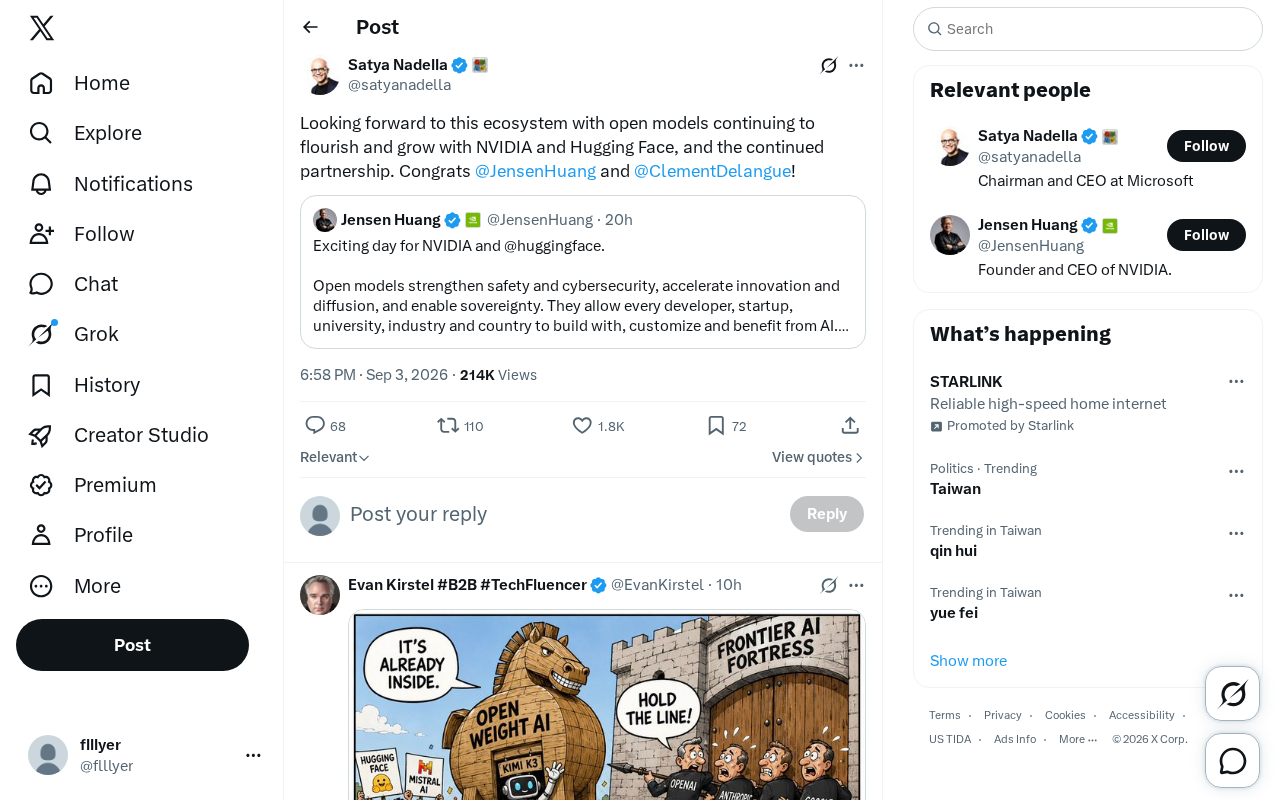
NVIDIA and Hugging Face Deepen Partnership: New Opportunities for the Open-Source AI Ecosystem
NVIDIA and Hugging Face deepen their partnership to boost open-source AI through performance optimization, better toolchains, and ecosystem expansion for developers and enterprises.
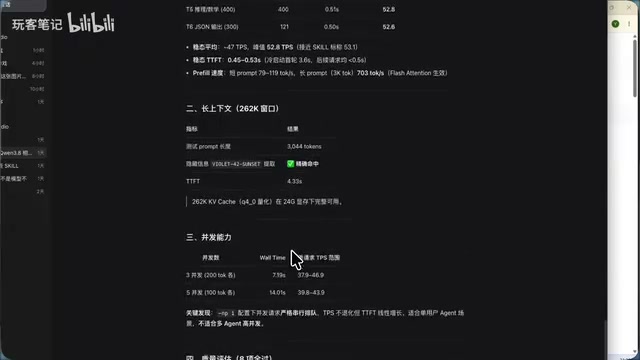
7900XTX Local Deployment of Qwen3 in Practice: 53 TPS Inference Speed Optimization Guide
Complete guide to deploying Qwen3 27B model on AMD RX 7900XTX 24GB: achieve 53 TPS inference through KV Cache Q4 quantization, 262K ultra-long context, and MTP speculative sampling, with installation tutorial and quantization precision comparison.
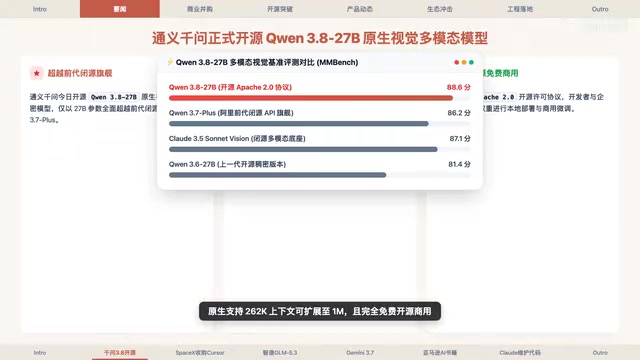
AI Daily Briefing: Alibaba Open-Sources Qwen3.8 Vision Flagship, Zhipu's GLM-5.3 Tops Coding Benchmarks, SpaceX Acquires Cursor
Alibaba open-sources Qwen3.8-27B vision model surpassing its closed-source predecessor; Zhipu GLM-5.3 tops open-source coding with 50% gains; SpaceX acquires Cursor; Google Gemini 3.7 Flash debuts.