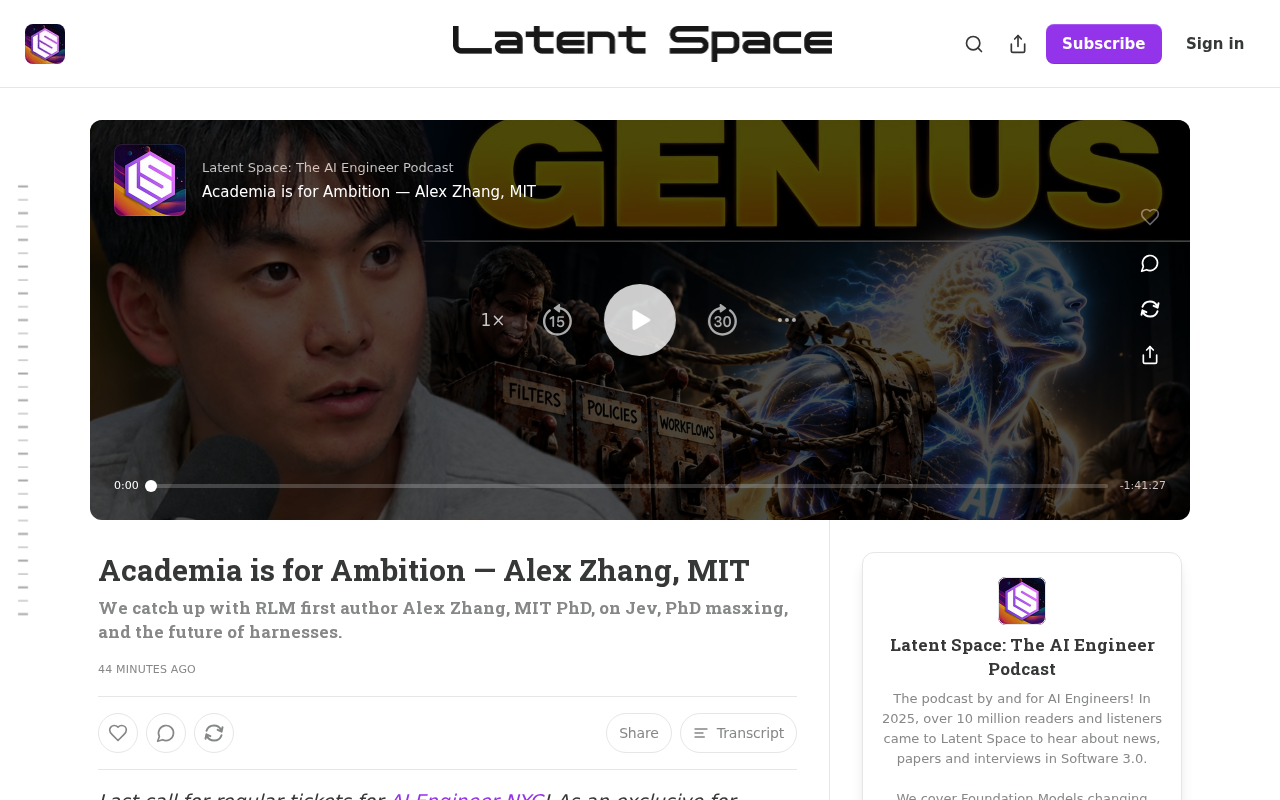
Academia is for Ambition: MIT PhD Alex Zhang on RLM and the Future of AI Research

MIT PhD Alex Zhang argues academia's value lies in ambition-driven research, and that harness frameworks are becoming AI's next competitive frontier.
This article summarizes key insights from an interview with Alex Zhang, MIT PhD student and first author of the RLM paper. He argues that academia's irreplaceable value lies not in competing with industry for resources, but in supporting long-horizon, high-risk research with no immediate payoff. The interview also covers PhD output strategy ("PhD maxxing") and the growing importance of harness frameworks — the toolchains and scaffolding built around large models — as raw model capabilities plateau and system-level design becomes the new competitive edge.
A Conversation About Ambition and Research
A recent interview with Alex Zhang — MIT PhD student and first author of the RLM paper — has been generating attention in the AI research community. The conversation centered on several key themes: the role of academia in today's AI landscape, the personal motivations of researchers, and the future significance of what he calls "harness" (frameworks/scaffolding) in AI development.
The interview's central thesis — "Academia is for Ambition" — is itself a thought-provoking claim. At a time when industrial labs with massive funding and compute are driving frontier research, what value does academia still offer? Alex Zhang's answer points to a dimension that's often overlooked: exploration driven by ambition.
Academia's Unique Value: Ambition Over Resources
As AI research increasingly consolidates around big tech companies, academia is often questioned about whether it can still compete at the frontier. Industry has vast data, top-tier compute, and generous compensation — advantages that traditional university labs simply can't match.
Yet Alex Zhang offers a different lens. The real advantage of academia may not lie in the scale of its resources, but in its capacity to support longer-horizon, higher-risk, more ambitious research directions. Industrial research is often accountable to product roadmaps, whereas academic research can chase ideas that show no near-term payoff but might open entirely new paradigms. This culture of "research for ambition" is precisely the irreplaceable niche that academia occupies.
For young researchers weighing a PhD against industry, this framing carries practical weight. Choosing academia means choosing a path driven by intellectual ambition.
The Weight of the RLM Research
As first author of the RLM paper, Alex Zhang's credentials lend authority to the conversation. First authorship typically signals the primary contributor to the research vision and the core executor of experiments — a role that gives him firsthand, ground-level insight into what AI research actually looks like in practice.
Topics mentioned in the interview, such as "Jev" and "PhD maxxing," reflect the survival strategies and mindset of PhD researchers operating in a hyper-competitive environment. The term "PhD maxxing" implies optimizing for output and impact during the doctoral years — navigating the trade-offs between paper publications, project visibility, and career development has become a real challenge that young researchers must confront.
RLM (Reinforcement Learning from Models, or the specific method proposed in the paper) represents an important paradigm in current AI training research. Conceptually, it shares lineage with RLHF (Reinforcement Learning from Human Feedback) in applying reinforcement learning to language model alignment — the key difference being that the feedback signal comes from another model rather than human annotators. The appeal of this approach lies in scalability: human annotation is expensive and hard to scale, whereas using a model as a judge can dramatically improve training efficiency. Recent methods such as Constitutional AI and Self-Play Fine-Tuning (SPIN) follow a similar trajectory. If Alex Zhang's RLM work belongs to this category, its academic contribution likely lies in designing more stable and accurate model feedback mechanisms and addressing core challenges like reward hacking. Since the full paper was not disclosed in the original source, the above represents an informed inference based on domain context — the specific technical contributions should be verified against the original paper.
Harness: The Future Infrastructure of AI Development
One of the more forward-looking topics in the interview is the future of "harness" (frameworks/scaffolding). In modern AI systems — especially agent-based development built on large models — a harness refers to the toolchain, evaluation systems, and interaction frameworks built around a model. It determines how model capabilities are invoked, combined, and amplified.
As the raw capabilities of models themselves begin to plateau, the engineering frameworks surrounding them are becoming increasingly critical. A well-designed harness can make the same underlying model perform dramatically differently in practice. Alex Zhang's exploration of harness futures touches on a core trend in AI engineering: shifting from simply chasing larger models toward building smarter system-level frameworks.
This trend carries implications for both researchers and developers — future competitive advantage may lie not just in having the most powerful model, but in designing efficient, flexible, and scalable harnesses that unlock its full potential.
In AI agent development, the concept of a harness or scaffold traces back to early chain-of-thought (CoT) prompt engineering and was progressively systematized with the rise of frameworks like ReAct, AutoGPT, and LangChain. A complete harness typically operates across several layers: prompt templates and context management, tool-calling interfaces (e.g., code execution, search, database queries), multi-step reasoning orchestration, and evaluation and feedback loops. Benchmarks like SWE-bench for coding ability have shown that the same underlying model can differ by tens of percentage points in performance depending on the harness — directly demonstrating that framework design has itself become a meaningful component of capability, not merely "packaging." Academia holds a natural advantage in harness innovation: it can design highly task-specific frameworks without the constraints of building general-purpose products. This aligns naturally with the "ambition-driven" research culture described throughout this piece.
Takeaways for Young Researchers
Pulling together the key messages from this conversation, a few insights stand out for AI practitioners. Academia and industry are not simply better or worse than each other — they serve different types of research ambition. Researchers need a clear strategy for output during their PhD years. And on the technical side, the framework layer built around models is emerging as the new frontier of value creation.
It's worth noting that this article is based on summarized interview content. The full technical details, the complete scope of the RLM method, and additional arguments await the full interview. But even these highlights are enough to sketch out the clear-eyed perspective of a frontline AI researcher on where the field stands — and where it's headed.
Related articles
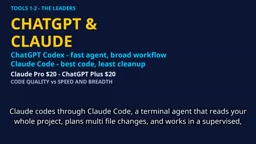
2026 AI Coding Tools Comparison: Claude, ChatGPT, Gemini — Which Is the Best?
A 2026 comparison of five mainstream AI coding tools — Claude Code, ChatGPT Codex, Gemini, DeepSeek, and GitHub Copilot — on real projects, pricing, and code quality, to help you decide where that $20/month should go.

ChatGPT Codex Can Clone Any Software? Testing the Risks and the Truth
YouTube shorts claim ChatGPT Codex or Claude Code can clone Adobe, Excel, and Figma for lifelong free use. We break down the feasibility, legal risks, and DM-funnel tactics—and explain what AI coding tools are truly good for.

Kilo Code Is Free to Install but Charges for API: Cost Estimation and Configuration Guide
Kilo Code is free to install, but connected AI models are billed per token. This guide covers VS Code extension and CLI setup and shows how to estimate API costs.