Actually Asked: A Self-Evolving Brand AI FAQ Page

Actually Asked turns AI Q&A into a native FAQ section, answering from page content and automatically distilling high-frequency questions.
Actually Asked is a brand AI FAQ tool launched on Product Hunt. It abandons the common floating chat bubble format and turns AI Q&A into a native FAQ section using the brand's fonts and colors, allowing visitors to naturally reach answers while browsing. It supports highlighting a sentence to ask a follow-up question, promises answers only from the site's own page content to reduce hallucination risk, and automatically adds high-frequency questions to the FAQ. It currently ranks No. 17 with 85 votes and targets e-commerce, SaaS support, and independent site operators.
In e-commerce and independent site operations, customer service Q&A has always been an awkward presence: users want instant answers, but traditional FAQ pages are both static and hard to maintain. A product called Actually Asked has appeared on Product Hunt. Instead of building yet another generic chat bubble, it turns AI Q&A directly into a FAQ section on the website that "looks native."
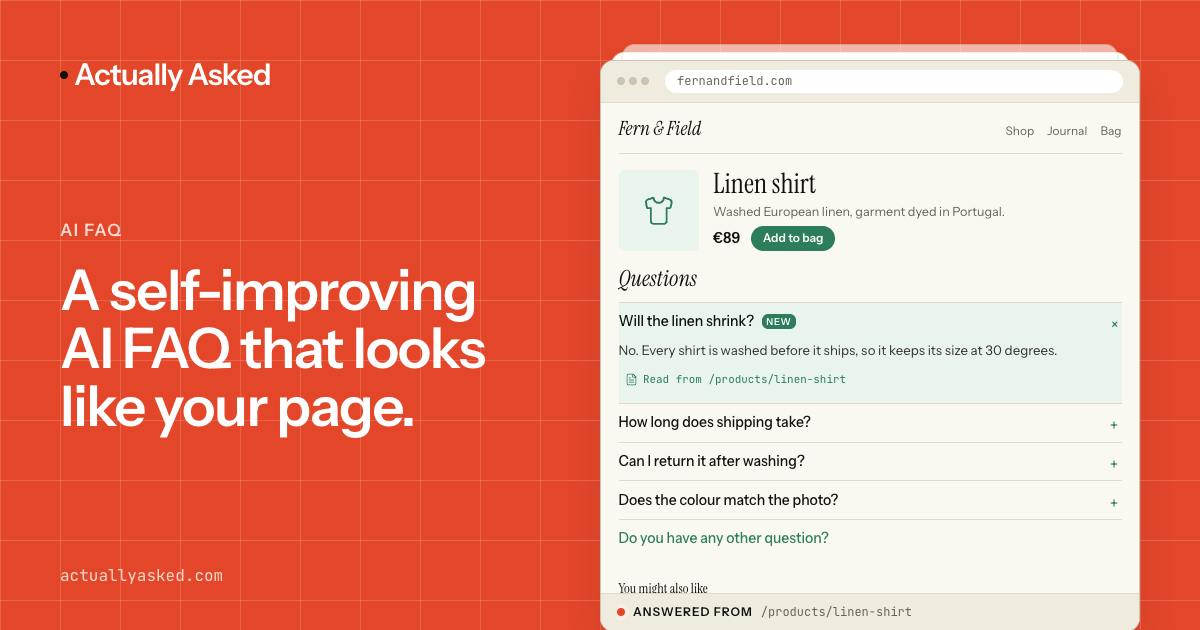
Not a Chat Window, but a Brand-Integrated FAQ Module
According to its Product Hunt page, Actually Asked has a fairly clear positioning: "Place a FAQ section on your website, using your fonts and colors, instead of a chat bubble."
This positioning hits a pain point for many brands. Chatbots often float in the corner of a page, visually out of place, and distract users from the core content. Actually Asked chooses to embed Q&A into the page flow, letting visitors naturally reach it while browsing content.
At a time when similar products generally pursue "conversational AI," abandoning the chat window is a counterintuitive product decision, but it is closer to real browsing behavior—most visitors do not want to "open a conversation"; they just want to get answers along the way while browsing.
Ask Questions by Highlighting, Lowering the Barrier to Asking
Actually Asked offers two ways to ask questions: visitors can directly type their own question, or highlight a sentence on the page and then ask about the highlighted content.
The second interaction deserves special mention. Traditional AI Q&A requires an input box and a clear question description, while "highlight to ask" compresses the operation into a single gesture. When users read an uncertain sentence, they do not need to reorganize their language—they can simply select it and follow up.
From a product design perspective, this reduces the psychological and operational cost between "having a question" and "asking the question," and it is also what distinguishes this tool from ordinary FAQ plugins.
Answers Come Only from Your Pages, Reducing Hallucination Risk
The page information clearly states: "Answers come only from your pages."
This statement is Actually Asked's core promise regarding credibility. The hidden danger of many current AI customer service tools is that the model uses general knowledge to "supplement" answers, causing output to conflict with the brand's actual policies and product specifications, which instead creates complaints. Limiting the answer scope to the site's own page content means results are more controllable and better suited to scenarios sensitive to accuracy, such as return policies, delivery times, and warranty terms.
This also means a lower barrier to use—no need to organize a knowledge base or train a dedicated model. As long as the website content itself is clear enough, the AI has usable material.
High-Frequency Questions Automatically Enter the FAQ, Enabling Self-Evolution
Actually Asked's full name is "a self-evolving brand AI FAQ page," and its self-evolution mechanism is reflected here: "The most frequently asked questions get added to your FAQ."
This means the FAQ page is not a static document, but a collection that continuously updates with real user behavior. The more users ask a question, the more likely it becomes a permanently displayed item on the page. For operators, this is equivalent to directly converting users' actual concerns into page structure, eliminating the step of guessing "what users actually want to ask."
From an SEO perspective, this mechanism also has a hidden benefit: the wording users use in real questions is often closer to search language than the headings operators write themselves. Once high-frequency questions settle into FAQ items, the page content becomes more aligned with actual search intent.
Who It's For, and What to Watch Out For
From its category tags (Customer Success, Artificial Intelligence, E-Commerce), it is clear that the target users are mainly e-commerce teams, SaaS customer service leads, and independent site operators who need to reduce repetitive inquiries.
A result of 85 votes, 8 comments, and a rank of No. 17 shows that it has received initial attention, but it is not yet a breakout hit. For teams evaluating this kind of tool, questions worth watching include: the controllable granularity of answer sources, multilingual support, and whether manual review is allowed after high-frequency questions enter the FAQ. These have not yet been fully addressed in the currently available public information.
If you are tired of chat bubbles but still want your FAQ page to truly "feel alive," Actually Asked offers a somewhat different technical path.
One-line Summary
Actually Asked turns AI Q&A into a native FAQ section, answering from page content and automatically distilling high-frequency questions.
Paragraph Summary
Actually Asked is a brand AI FAQ tool launched on Product Hunt. It abandons the common floating chat bubble format and turns AI Q&A into a native FAQ section using the brand's fonts and colors, allowing visitors to naturally reach answers while browsing the page. In terms of interaction, besides directly typing questions, it also supports highlighting a sentence on the page to ask a follow-up question, greatly reducing the operational cost from having a question to asking it. On credibility, it clearly promises that answers come only from the website's own page content, reducing the risk of AI hallucination and therefore eliminating the need to build a knowledge base or train a model. Its self-evolution mechanism is reflected in high-frequency questions automatically being added to the FAQ page, allowing content to continuously update with real user behavior while also bringing hidden SEO benefits aligned with search intent. The product currently has 85 votes and ranks No. 17, mainly targeting e-commerce, SaaS customer service, and independent site operators.
Related articles

DeepSeek V4.1 Pro Enters Testing, Gemini 4 Pro Benchmark Leaked
DeepSeek V4.1 Pro enters early per-account testing and is hidden from the public selector; MiniMax M3.1 Flash preview hits TokenPlan; Gemini 4 Pro benchmarks leak with 2M token context and pricing.

Qwen 4 First Test Leaks: Performance Rivals Opus 5.5, DeepSeek V4 Series Surfaces
Early Qwen 4 test outputs leak, with front-end generation said to rival Opus 5.5; DeepSeek V4 Mini, Flash, and Pro names appear in a code repo; Ant Group's Ling-3.1-flash surfaces too. Here's the latest on model tiering and on-device lightweight models.

OpenCode Makes DeepSeek V4.1 Flash Free, AI Daily Roundup
AI daily roundup: OpenCode makes DeepSeek V4.1 Flash free, StepFun Step5 Preview and Ling 3.1 Flash open-sourced, Grok Voice 3.0 tops speech leaderboard, Matrix Game 4.0 open-sourced, and the EU opens its first AI Act enforcement probe into OpenAI and Anthropic.