Adding a "Sense of Time" to AI: Temporal Conditioning Improves Chess Behavioral Cloning
Time pressure is a key missing signal in behavioral cloning; a temporally conditioned Transformer can more faithfully reproduce human strength degradation.
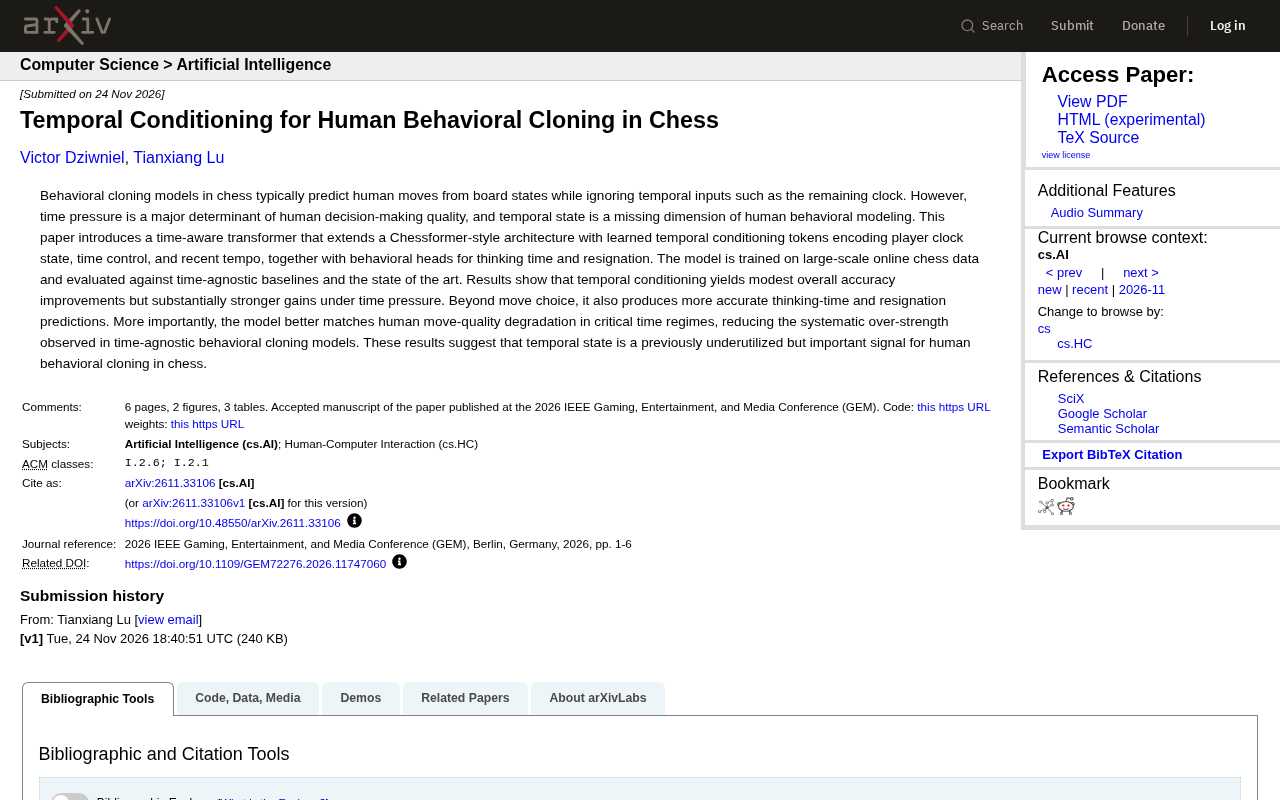
This article introduces a study on temporally conditioned behavioral cloning, noting that conventional models ignore remaining thinking time and thus systematically overestimate human performance under time pressure. The authors add learnable temporal conditioning tokens to Chessformer, encoding the player clock, time control, and recent pace, plus thinking-time and resignation prediction heads. Experiments show modest overall accuracy gains but significant improvements under time pressure, with the model better matching the human strength degradation curve. The work suggests behavioral cloning should move toward multimodal contextual modeling, offering insights for time-constrained decision scenarios like esports and real-time strategy.
Why Time Pressure Is the Missing Piece in Behavioral Cloning
When building models that clone human behavior, researchers typically focus only on the board state and the move selected, while overlooking a critical variable: remaining thinking time. Under time pressure, human decision quality drops significantly—error rates rise, and players even make irrational piece sacrifices or resign. A paper titled Temporal Conditioning for Human Behavioral Cloning in Chess points out that conventional behavioral cloning models are missing exactly this dimension of "time," causing a systematic strength bias when simulating human players: the model always plays better than humans, especially when time is tight.
The paper's core insight is that temporal state is not an auxiliary feature but an indispensable signal for modeling human decision-making. Ignoring it leads behavioral cloning to overestimate human performance under pressure and to fail to reproduce real fluctuations in play quality.
Method: Extending Chessformer with Temporal Conditioning Tokens
The authors propose a time-aware Transformer that builds on the Chessformer architecture by introducing learned "temporal conditioning tokens" that encode three types of temporal information:
- Player clock state: current remaining time
- Time control: the game's base time and increment
- Recent pace: the time-usage pattern over the last few moves
In addition to the main model, the paper adds two behavioral prediction heads: one for predicting thinking time and another for predicting resignation behavior. The model is trained on large-scale online chess game data and compared against time-agnostic baselines and current state-of-the-art methods.
The cleverness of this design lies in the fact that it does not crudely concatenate time as a numerical feature onto the input; instead, learnable tokens allow the model to discover the complex interactions between time and move decisions on its own.
Chessformer is a Transformer variant designed specifically for chess. It represents the board as a sequence of 64 squares, where each square's token encodes the piece type, color, and possibly additional information (such as whether the square is attacked). Similar to how a general-purpose Transformer processes text sequences, Chessformer captures long-range dependencies between pieces through self-attention. Its key advantage is directly modeling the spatial structure of the board rather than compressing the position into handcrafted features. In behavioral cloning tasks, Chessformer typically takes the current position as input and outputs the move a human player is most likely to choose. This paper builds on it by introducing temporal conditioning tokens, enabling the model to dynamically adjust its prediction strategy based on remaining time.
Behavioral Cloning is an imitation learning technique that directly fits state-action pairs of an expert (here, human players) via supervised learning—that is, predicting the move given a position. Unlike reinforcement learning, behavioral cloning does not rely on environmental reward signals but attempts to replicate the expert's policy. However, standard behavioral cloning assumes that expert behavior is deterministic and optimal in the same state, ignoring fluctuations in human decisions caused by situational factors such as time pressure and fatigue. The "missing time" identified in this paper is a typical flaw of this assumption: the model learns human performance under average time conditions rather than the degraded behavior under time pressure, leading the model to systematically overestimate human playing strength.
Results: Modest Overall Gains, Large Improvements Under Time Pressure
Experimental results show that temporal conditioning yields a relatively modest improvement in overall accuracy, but significant gains under time-pressure scenarios. Specifically:
- The model's move predictions under time pressure are closer to humans' actual choices;
- Both thinking-time prediction and resignation prediction outperform the baselines in accuracy;
- More importantly, the model better matches the strength degradation curve of humans within critical time intervals, reducing the systematic "overly strong" bias of conventional behavioral cloning models.
The authors conclude: "These results indicate that temporal state is a previously underutilized but crucial signal for human behavioral cloning." This finding applies not only to chess but also offers modeling ideas for other time-pressured decision scenarios (such as esports, real-time strategy games, and financial trading).
Strength degradation curve refers to the trajectory of declining performance as a human player's remaining time decreases. In online chess, this is typically measured by engine-evaluated move quality (such as centipawn loss). Research shows that players' moves approach optimality when time is abundant, but as the clock approaches zero, error rates rise significantly, and even blunders occur. Conventional behavioral cloning models, lacking time modeling, tend to predict moves of higher average quality and cannot reproduce this dynamic degradation. Through temporal conditioning tokens, this paper enables the model to adjust its prediction distribution based on remaining time, thereby more accurately matching humans' actual performance under different time pressures and reducing the "overly strong" bias.
Implications for AI Behavior Modeling
This research points to a broader trend: behavioral cloning is moving from "state-action" mapping toward multimodal contextual modeling. Latent factors such as time, emotion, and fatigue often explain human mistakes and style better than the explicit state on the board. For AI systems that need to simulate human decision-making (such as game coaching, educational AI, and human-AI collaboration), introducing temporal conditioning can significantly enhance anthropomorphism and credibility.
Of course, the paper also acknowledges that overall accuracy gains are limited, indicating that the time signal is not a panacea. But its targeted improvement in pressure scenarios is exactly what many applications need most—after all, the most authentic side of humans is often revealed in the final seconds of a countdown.
One-line Summary
Time pressure is a key missing signal in behavioral cloning; a temporally conditioned Transformer can more faithfully reproduce human strength degradation.
Paragraph Summary
This article introduces a study on temporally conditioned behavioral cloning, pointing out that conventional behavioral cloning models ignore remaining thinking time, leading to systematic overestimation of human players' performance under time pressure. The authors introduce learnable temporal conditioning tokens into the Chessformer architecture, encoding the player clock, time control, and recent pace, and add thinking-time and resignation prediction heads. Experiments show that overall accuracy gains are modest, but improvements under time-pressure scenarios are significant, with the model more faithfully matching the human strength degradation curve. This work suggests that behavioral cloning should evolve toward multimodal contextual modeling, offering insights for time-constrained decision scenarios such as esports and real-time strategy.
Related articles

Pure-Code Video Generation Tested: Which AI Model Actually Follows Instructions?
A Bilibili creator tested three AI models' pure-code video generation with unified prompts and three revisions each: Xiaonaomao has a high ceiling but lacks stability, GPT 6.2 Extra models well but only follows half the instructions, and OPAS 5.5 remains the benchmark.

GPT-6 Six-Tier Hands-On Test: Astra Ultra Dominates but Bills Double
GPT-6 six-tier test: Astra Ultra sweeps 3:0 in 3D tasks thanks to sub-agents and runs 14% faster, but hidden backend bills make its real cost 2.6x single-threaded.

GPT-6.2 Astra vs Fable 5.2: Huge Cost-Efficiency Gap Across 12 Real-World Tests
Bilibili creator tests GPT-6.2 Astra vs Fable 5.2 across 12 real tasks: Fable wins 7-5 but costs 7.2x more and takes nearly 5x longer. Token efficiency emerges as the key selection metric.