GPT-6 Six-Tier Hands-On Test: Astra Ultra Dominates but Bills Double

GPT-6 six-tier test: Astra Ultra sweeps 3:0 via sub-agents, but real cost is 2.64x High.
Bilibili creator "回到Axton" tested six GPT-6 tiers on three hard 3D tasks and one lightweight image task. Astra Ultra swept single-threaded Astra High 3:0 and finished 14% faster thanks to sub-agents, but backend logs reveal 12 sub-agents cost an extra $15.93, making the real $27.18 total 2.64x High. On the lightweight task all tiers tied at full marks, yet Ultra spent $0.91—15x Terra and 91x Luna. Recommendation: use Terra or Soul as a baseline and enable Ultra only for complex heavy work.
OpenAI's GPT-6 series launched several tiers at once, from Luna to Astra, and added a top-end Ultra thinking mode for each tier in Codex. Intuitively, enabling Ultra simply lets the model think a bit longer, so you might as well set it as the default and be done with it. But Bilibili creator "回到Axton" put six tiers—Luna, Terra, Soul, and Astra—through the same test suite and found that both assumptions can lead you astray.
Test Design and a Quick Look at Six-Tier Performance
The creator designed four tasks: three high-difficulty 3D tasks (an off-road vehicle crossing a speed bump, a mechanical butterfly transmission, and converting a five-page English wooden table blueprint into a 3D tutorial) and one lightweight image-viewing task. All costs were calculated by converting the measured Token consumption at OpenAI's official short-context API prices.
Low-tier performance differed markedly: Luna took 16.9 minutes and cost $0.05 on the off-road vehicle task, but the model looked like a box built from blocks, with the springs positioned crookedly. Terra took only 4.6 minutes and cost $0.12—the fastest overall—but was similarly rough. The Soul tier could produce a rugged SUV exterior, but in slow-motion replay the rear wheel went straight through the speed bump, and the higher-end version's spring pierced through the front wheel housing in the wheel-well close-up.
Token billing and short-context API pricing: Large-model APIs typically bill input and output Tokens separately, and the "short-context API price" in this article refers to the lower unit-price tier that applies when a single request's context length stays below the threshold. In the test, the creator converted the input and output Tokens consumed per task into USD using the official price list, so cost differences directly reflect the computation each model actually needed to finish the task, rather than the fixed charge of a subscription plan. This also explains why the same task can differ in cost by a hundredfold across tiers—the higher the tier, the more internal reasoning steps and derived subtasks, and Token consumption rises by orders of magnitude.
High / Ultra thinking modes: The thinking mode in Codex controls how much reasoning depth the model invests before producing the final output. High is single-threaded deep reasoning; Ultra additionally allows the main Agent to split subtasks and dispatch multiple sub-agents to work in parallel, then aggregate and review. Their official unit prices are the same, but Ultra incurs extra Tokens by invoking more Agent instances—a cost difference only visible in the backend logs.
Flagship Showdown: Astra Ultra Wins 3:0
Single-threaded Astra High ran 21.2 minutes on the off-road vehicle task, equivalent to $3.55. The atmosphere was on point, but the orange spring in the wheel well was completely hollow in the middle, with no shock absorber cylinder or telescoping metal rod. Astra Ultra took only 18.1 minutes and cost $9.67, completing the entire suspension structure—yellow spring over black shock absorber cylinder, silver telescoping rod, and base with hex screws—and even added a dedicated button to switch to an inner view, taking the first point.
The gap on the mechanical butterfly in the second round was even more decisive. Astra High's wings flapped beautifully from the front, but zooming in on the transmission structure in the middle of the body gave it away: multiple silver push rods and bracket ends hung in mid-air, not connected to the drive shaft at all—completely fake linkage.

The only entry whose physical structure was truly connected was Astra Ultra: the two brass main gears, top and bottom, each had a small pin offset from the center; as the gears turned, they symmetrically pushed and pulled four dark connecting rods, directly driving the pivot at the base of the wings, with no parts floating or broken. It ran for only 11.9 minutes—faster than single-threaded Astra High and Soul X-High—taking it to 2:0.
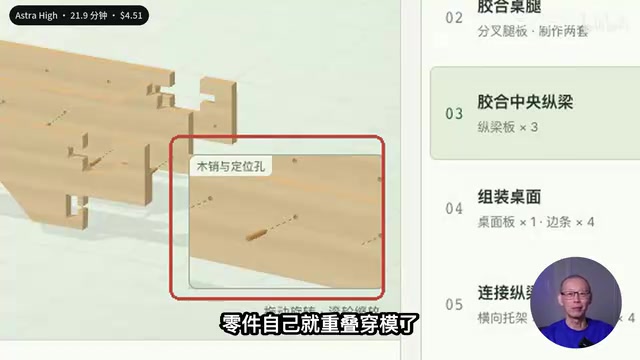
In the third round, the wooden table blueprint, Astra Ultra generated a single-file offline version over 1MB, complete with layered wood grain on the board sides, a 3D white glue extrusion animation, and a sidebar corresponding to the instruction sheet line drawings. It took 18.9 minutes and cost $9.93, again faster than single-threaded, locking in a 3:0 sweep. The three 3D tasks totaled 48.9 minutes, 14% faster than Astra High's 56.9 minutes.
The Hidden Bill: Sub-agents Inflate Costs 2.6x
Since Astra High and Astra Ultra have identical official unit prices, and Ultra swept the board while being faster, is locking Ultra on all the time the most worry-free approach? Checking the Codex backend logs reveals the bill is buried deep.
On the wooden table task, Astra Ultra dispatched a dedicated quality-review sub-agent in the backend, and this single submodule alone spent $2.7—more than Soul X-High spent running the entire task from start to finish. Across the four tasks, Astra Ultra automatically dispatched three dedicated sub-agents to work simultaneously on each one, 12 in total: the off-road vehicle task split into body exterior, surrounding scene, and physical bouncing; the butterfly task split into wings, internal mechanical transmission, and independent testing; the wooden table task split into glue application and pressing, assembly logic, and quality review. Specialists handling their own domains kept it stable and error-free on complex structures, and parallel branches also shortened total time.
But adding up all four tasks: the main interface log shows only $11.25, which looks roughly comparable to single-threaded Astra High's $10.3. Yet the 12 sub-agents in the backend spent an additional $15.93, accounting for 58% of the $27.18 total. The real total price is fully 2.64 times that of Astra High.
Sub-agent architecture: In agentic workflows, the main Agent can break a complex goal into sub-goals, launch independent sub-agents to execute them in parallel, each with its own context and tool calls, and finally return results to the main Agent for integration. This "divide and conquer" shortens wall-clock time and gives each subtask more focused handling, but each sub-agent is a complete model invocation loop, and accumulated Token consumption can far exceed single-threaded operation. The "quality-review sub-agent" in this article is an independent instance specifically responsible for checking the output of other sub-agents; its cost is not aggregated into the main interface display and must be reconciled item by item in the Codex backend logs.
The Cost-Effectiveness Trap of Lightweight Tasks
This automatic dispatch mechanism does not distinguish between light and heavy tasks. In the fourth task—a five-question quick image quiz (recognizing a Roman numeral clock, counting eggs, identifying Lisbon's Tram 28 in Portugal, spotting differences in tomatoes, and finding line breaks in Lincoln's handwritten letter)—all six tiers scored full marks and tied. Terra took only 42 seconds and cost $0.06, Luna cost about one cent; while Astra Ultra still dispatched three sub-agents, ran 1.6 minutes, and spent $0.91—15 times Terra and 91 times Luna.

Single-file offline delivery: This refers to the model generating a self-contained HTML file with all scripts, styles, and resources embedded, runnable by double-clicking while offline, with no build tools or server. For 3D demo tasks, this means libraries like Three.js must be inlined or bundled via local references, and file sizes often exceed 1MB. The single-file format facilitates acceptance and distribution, but it also places higher demands on the model's code organization and resource management—a practical indicator of a tier's engineering capability.
Selection Recommendations by Task
- Luna / Terra: Everyday image viewing, screenshot information extraction, and large-scale high-concurrency lightweight tasks. Luna is cheapest, Terra is fastest, but complex 3D structures will deform and distort.
- Soul Medium / Soul X-High: Main workhorse for writing code, routine web interaction, and document organization, with the highest price only one-third of Astra High. Soul X-High can produce a single-file offline version, but it is the slowest overall, and complex mechanical structures still have flaws.
- Astra High: Heavy 3D modeling and large projects with multi-part interlocking linkages; all three 3D tasks can be delivered offline, at less than 40% of the top tier's cost. But single-threaded work easily neglects one thing while focusing on another, so you must carefully review it yourself before delivery.
- Astra Ultra: The capability ceiling, with sub-agents working separately plus independent oversight, a 3:0 sweep and faster. But the real cost balloons to 2.6 times single-threaded, so it is only suitable for the toughest problems—switch back to a cheaper tier immediately after use.
In one sentence: use Terra or Soul as your baseline, and temporarily enable Astra Ultra when you hit complex heavy work—that dividing line is already clear. The creator also turned the 18 3D outputs into an online showroom where you can rotate and disassemble them 360 degrees to compare details.
One-line Summary
GPT-6 six-tier hands-on test: Astra Ultra sweeps 3:0 thanks to sub-agents, but its real cost is 2.64x that of High.
Paragraph Summary
Bilibili creator "回到Axton" tested six GPT-6 tiers—Luna, Terra, Soul, and Astra—with three high-difficulty 3D tasks and one lightweight image task. Astra Ultra, relying on automatically dispatched sub-agents handling exterior, structure, and quality review separately, swept single-threaded Astra High 3:0 on the three 3D tasks, finishing 14% faster overall, and its mechanical transmission structure was the only one truly physically connected. But backend logs show Ultra dispatched three sub-agents per task, with 12 sub-agents costing an extra $15.93, making the real total of $27.18 2.64 times that of Astra High. On the lightweight image task all six tiers scored full marks, yet Ultra spent $0.91—15 times Terra and 91 times Luna. The conclusion: choose tiers by task—use Terra or Soul as a baseline, temporarily enable Ultra for complex heavy work, and switch back after use.
Related articles

Pure-Code Video Generation Tested: Which AI Model Actually Follows Instructions?
A Bilibili creator tested three AI models' pure-code video generation with unified prompts and three revisions each: Xiaonaomao has a high ceiling but lacks stability, GPT 6.2 Extra models well but only follows half the instructions, and OPAS 5.5 remains the benchmark.

GPT-6.2 Astra vs Fable 5.2: Huge Cost-Efficiency Gap Across 12 Real-World Tests
Bilibili creator tests GPT-6.2 Astra vs Fable 5.2 across 12 real tasks: Fable wins 7-5 but costs 7.2x more and takes nearly 5x longer. Token efficiency emerges as the key selection metric.

GPT 6.2 Unlimited Quota Tested: Can Plus Accounts Really Use It for Free?
A Bilibili video claims ChatGPT Plus accounts can use GPT 6.2 and Codex with unlimited quota. This article restores its demonstration process, breaks down the evidence chain showing the quota did not change, analyzes the security and compliance risks behind key circulation and configuration scripts, and points out that a valid demonstration does not mean a trustworthy method.