Pure-Code Video Generation Tested: Which AI Model Actually Follows Instructions?

A Bilibili creator compared three video generation models under unified prompts and three revisions, with clearly divergent results.
The article documents a Bilibili creator's head-to-head test of the "Hakimi" Xiaonaomao model, GPT 6.2 Extra, and OPAS 5.5 on video generation. Using unified prompts and three revision rounds per model to eliminate prompt-engineering variables, the results show: Xiaonaomao has a high ceiling with some clips approaching the top tier, but overall completeness and stability still trail OPAS 5.5; GPT 6.2 Extra has strong modeling capability but frequently responds to only half of instructions due to excessive per-instruction weighting, requiring three or four repetitions even on the Ultra tier to stay on topic. The article concludes that the bottleneck in pure-code video generation has shifted from image generation to instruction consistency across multiple revisions, and that tool selection should prioritize stable instruction responsiveness.
Does generating video from code alone actually work? A Bilibili creator put several leading models to the same test using three unified prompts and three revision rounds each. The results were more split than expected: some models hit astonishing ceilings but stumble on details, while others simply retreat into their own artistic world.
Test Rules: Unified Prompts and Three Revision Rounds
The creator's test design was notably restrained: each model had to make a video introducing itself, with three revision opportunities per model. The advantage of this setup is that it eliminates the massive variable introduced by prompt engineering—everyone starts from the same point, and what's being compared is the model's understanding of instructions, its responsiveness to revision feedback, and the completeness of the final output.
The lineup included what the creator calls the new-generation "Hakimi" Xiaonaomao model, GPT 6.2 Extra, and OPAS 5.5 as the reference point. It's worth noting that because the account had previously been banned, and after reopening and paying for a Pro membership only kept running for a very short time, the test itself had a race-against-the-clock feel—making "hurry up and finish while the account still works" the practical backdrop of this episode.
Prompt Engineering refers to a whole set of techniques for carefully designing input prompts to guide a large model toward more desirable outputs, including role setting, step-by-step instructions, example injection, and format constraints. In video generation tasks, the wording, structure, and level of detail in a prompt can have an enormous impact on the final output—different people writing prompts could make the same model perform at wildly different levels. So if each model were allowed to use its own optimal prompt, a head-to-head comparison would be contaminated by countless human variables, making it hard to judge differences in the models themselves. Using unified prompts and a unified number of revision rounds is essentially a controlled-variable experimental design, narrowing the focus of comparison to the model's comprehension of instructions, responsiveness to feedback, and stability across multiple iterations.
Xiaonaomao: High Ceiling, But Not Quite God-Tier
The creator's assessment of the new "Hakimi" model was quite positive: its performance is already very good, and its ceiling is high. That's no small statement—in a comparison benchmarked against OPAS 5.5, being described as having a "high ceiling" means that in certain clips or certain processing aspects, it has already touched the top tier.
But the problems are equally obvious: it still falls short of OPAS 5.5 by a noticeable margin. This gap isn't a catastrophic failure but a shortfall in overall completeness and stability. The creator also mentioned that "anti-gravity" still doesn't seem to work very well—though the original text doesn't elaborate on the technical details of this specific capability, from context it's one of the weaknesses affecting practical usability.
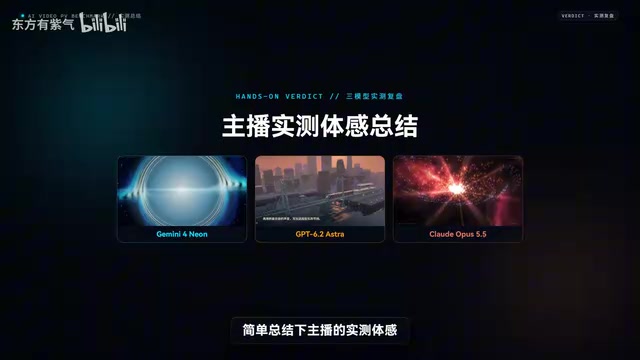
GPT 6.2 Extra: Strong Modeling, But Only Half the Instructions Land
The sharpest criticism in this episode went to GPT 6.2 Extra. The creator's exact words were that it had "completely gone off the rails," essentially lost in its own artistic world. The specific behavior is a strange state of partial compliance: it can follow instructions, but often only half of them—the other half gets completely ignored.
The creator offered an interesting explanation: OpenAI seems to have weighted single instructions too heavily, to the point of completely ignoring other context. In other words, the model's obedience to the latest instruction has been pushed to an extreme, at the cost of grasping the overall task objective. This explains why even with the Ultra tier enabled, each piece of content had to be repeated three or four times just to barely get it to produce a video that stayed on topic.

It must be acknowledged that GPT 6.2 Extra's modeling capability is genuinely strong—the creator didn't deny that. But video generation isn't a contest of single-point capabilities. No matter how good the modeling is, if instruction responsiveness and context retention don't pass muster, the final output can only be "for reference only."

Instruction Weight is a colloquial way of describing how a model allocates attention and obedience priority during generation. In multi-turn conversations or multi-revision scenarios, a model needs to simultaneously balance historical context, the overall task objective, and the latest revision suggestion. If training or alignment over-strengthens immediate obedience to the latest instruction, the model may exhibit "recency bias": treating the most recent sentence as the only valid signal while ignoring previously accumulated task constraints. This design manifests as fast, obedient responses on simple single-turn tasks, but on complex tasks requiring long-term consistency, it instead leads to going off-topic, omissions, and repeated rework.
Pure-Code Video Generation: Where's the Real Barrier?
Stringing the three models' test results together reveals a common conclusion: the bottleneck in pure-code video generation has shifted from "can it generate images at all" to "can it reliably understand and remember complex instructions."
OPAS 5.5 is treated as the benchmark precisely because it maintains task consistency across multiple revision rounds; Xiaonaomao's ceiling proves the potential of this approach, but stability still falls a layer short; and GPT 6.2 Extra provides a counterexample—strong single-point capability doesn't equal overall usability, and the design trade-offs in instruction weighting directly reflect in output quality.
For actual users, this carries several practical takeaways: First, don't expect video tasks to be one-shot—budgeting for multiple iterations is necessary. Second, if a model shows "only-half-listening" symptoms, rather than repeatedly stacking prompts, check whether the task description contains conflicting instructions. Third, evaluating a model can't rely only on its best single output—you need to see whether it can converge on the target across multiple revision rounds.
There's no absolute winner in this comparison. Xiaonaomao is worth anticipating but not yet mature, GPT 6.2 Extra is lopsided in capability and behaves oddly, and OPAS 5.5 remains the one being chased. For developers following AI-generated video, this set of tests provides a clear coordinate: when choosing tools at this stage, the ability to respond stably to instructions should weigh more heavily than single-point showmanship.
Instruction Consistency Across Multi-Round Revisions refers to a model's ability to retain and comply with the original task objective and all constraints after multiple rounds of feedback and revision. It differs from single-generation quality: what's being examined is whether the model can converge rather than drift during iteration—each revision should change only the parts requested to change, with all other settings remaining unchanged. For video generation, this means character appearance, camera language, narrative pacing, and other elements must remain stable across multiple revision rounds. Models with poor instruction consistency tend to drift further from the target with each revision, forcing users to repeat descriptions or even start over—dramatically reducing real-world production efficiency.
Related articles

GPT-6 Six-Tier Hands-On Test: Astra Ultra Dominates but Bills Double
GPT-6 six-tier test: Astra Ultra sweeps 3:0 in 3D tasks thanks to sub-agents and runs 14% faster, but hidden backend bills make its real cost 2.6x single-threaded.

GPT-6.2 Astra vs Fable 5.2: Huge Cost-Efficiency Gap Across 12 Real-World Tests
Bilibili creator tests GPT-6.2 Astra vs Fable 5.2 across 12 real tasks: Fable wins 7-5 but costs 7.2x more and takes nearly 5x longer. Token efficiency emerges as the key selection metric.

GPT 6.2 Unlimited Quota Tested: Can Plus Accounts Really Use It for Free?
A Bilibili video claims ChatGPT Plus accounts can use GPT 6.2 and Codex with unlimited quota. This article restores its demonstration process, breaks down the evidence chain showing the quota did not change, analyzes the security and compliance risks behind key circulation and configuration scripts, and points out that a valid demonstration does not mean a trustworthy method.