GPT-6.2 Astra vs Fable 5.2: Huge Cost-Efficiency Gap Across 12 Real-World Tests

12-round test: Fable 5.2 beats Astra 7-5 but costs 7.2x more — token efficiency is the key selection metric.
A Bilibili creator compared GPT-6.2 Astra and Fable 5.2 across 12 real-world tasks using identical prompts and high-effort mode, tracking time, tokens, and API cost. Fable won 7 to 5, but its total API cost was 7.2x higher and runtime nearly 5x longer. With identical token unit prices, the entire cost gap comes from token efficiency. Fable led in logical detail, skill invocation accuracy, and complex interaction; Astra held its own in visual intuition, conciseness, and adaptable problem-solving. The creator advises building skills around Astra to cut costs and notes skill invocation errors as a shared failure point — model choice should match task type, not chase an absolute winner.
A Head-to-Head Clash on Efficiency and Capability
When two top-tier models are run through the same set of real-world tasks, the results are often more convincing than benchmarks. A Bilibili creator put GPT-6.2 Astra and Fable 5.2 through 12 everyday scenarios — web design, professional slides, travel planning, 3D games, financial dashboards, video editing, and more — using identical prompts, the same high-effort mode, and independent work branches, recording time, token consumption, and API costs for each.
According to the creator's tests, the final score was Fable 7 to Astra 5, but the cost ledger tells the opposite story: Fable's total API cost was about 7.2x that of Astra, and its runtime was nearly 5x longer. These numbers reveal a key dividing line in today's model competition — token efficiency is becoming a more important selection metric than single-point capability.
Token Efficiency refers to a model's ability to complete the same task using fewer input/output tokens. Under API billing, cost = number of input tokens × input unit price + number of output tokens × output unit price. When two models have identical unit prices, the cost gap is entirely determined by token consumption. Models with high token efficiency tend to reason more directly, produce less redundant output, or plan internally more precisely, thereby consuming fewer tokens on the same task. For teams making high-frequency API calls, differences in token efficiency can directly amplify into multiple-fold cost gaps, making it a core selection metric alongside output quality.
Round 1: Web Design — Astra's Clean Efficiency
The first task was designing a page for a brand coffee website. The creator deliberately did not reveal which site was generated by which model, letting viewers guess first.
Astra's version was overall very clean, with a dynamic effect on the navigation bar during scrolling and mostly well-cropped images, with only a minor flaw where images in the flavor selection area were partially cropped. Fable's version was livelier — text typing animations, a rotating ring around the jars, parallax effects on scroll — with noticeably higher visual richness, though some cropping issues were also present.
Ultimately, the creator cast this vote for Astra for a simple reason: the page was cleaner, and the cost was only a fraction of Fable's. Fable ran for 56 minutes while Astra ran for only 12, with large differences in both input and output tokens.
Round 2: Slides — The Tradeoff Between Simplicity and Richness
The task was to turn simulated survey data into a brand presentation. Astra's output was more concise with fewer distractions, suitable for projection; Fable's content was richer, retaining the brand logo at the top of each slide with more column and layout variations, better suited for email distribution for self-reading.
The creator considered both templates good, but the core judgment this round came down to cost-effectiveness: Fable's price was 4.8x that of Astra. For a task that could be completed with a lightweight tool like SoulTerrorSonic, Astra's low-cost advantage was amplified.
Round 3: Canva Drawing — Astra Unexpectedly Shows Problem-Solving Ability
The model was given a real photo and asked to draw it in Canva. Fable's result had obvious gaps and stroke marks, while Astra's output was noticeably better in shadows, light and dark, and facial similarity.
More interesting was the difference in process. Canva triggered a stroke limit. Astra's approach was to export the result, re-import it, create a new canvas, and redraw, bypassing the limit; Fable got stuck on the stroke limit the whole time without taking action. The creator's assessment: Astra demonstrated adaptability that Fable lacked, while Fable instead showed a tendency toward over-engineering and overthinking.
The time difference this round was likewise stark: Fable ran for three hours, Astra about one and a half. In terms of API cost, Fable was about $63 and Astra about $7.5.

Stroke limits are technical constraints set by online design tools like Canva to prevent abuse, typically limiting the number of strokes or path complexity that can be drawn in a single operation. When an AI agent tries to simulate the shadows and light and dark of a real photo with a large number of short strokes, it easily triggers this limit. Bypassing the limit requires the agent to have "metacognitive" ability — identifying the cause of failure and adjusting strategy (e.g., exporting and re-importing, drawing in chunks) rather than repeatedly retrying the same operation. In this round, Astra demonstrated this adaptability, while Fable fell into a fixed behavior pattern.
Round 4: Event Recap Video — Neither Was Satisfying
The creator gave the models a batch of real event video footage and asked them to cut an energetic recap short. Both outputs disappointed the creator — no energy, no proper dialogue, poor output quality.
Between two less-than-ideal results, the creator considered Fable's version slightly better and was willing to give the vote to Fable, even though Astra cost about $4 and Fable $15. The creator also mentioned that a previous attempt with Opus 5.5 using just one prompt had produced a much better version, suggesting that prompt design may have influenced this round's results.
Round 5: Virtual Summit World — A Divergence in Experience and Aesthetics
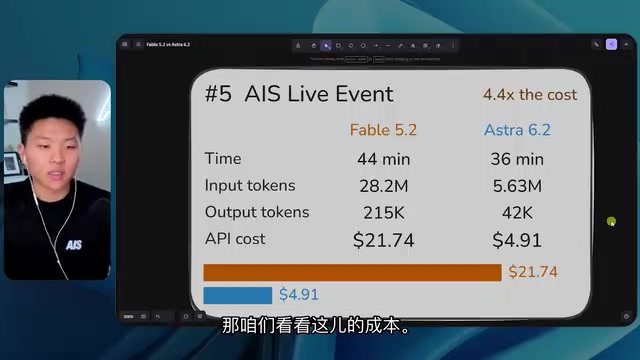
The models were given event recordings and assets to generate an interactive virtual summit world. Fable's version required entering a name to enter, with a first-person view allowing you to walk around the venue, see speakers on the walls, sit down to watch sessions, with an agenda generated in real time and a strong brand feel. Astra's version looked more like a concert, with better-looking avatars and shadows, but the actual operating experience was judged by the creator as less fitting the AIS Live style than Fable's.
The creator voted for Fable this round. Interestingly, the prices of the two models were exactly the same here — identical billing standards for input and output tokens, with all differences coming from token efficiency. The creator explicitly pointed out: Astra and Fable's token billing is actually the same; Astra is simply far more efficient.
Rounds 6-8: The Watershed of Video Editing
In the Instagram short video segment, both outputs were good, but Fable was more appealing in sound design and B-roll selection. The creator acknowledged that Fable was about 4x more expensive but still considered it worth the price.
The YouTube long-form video editing segment revealed a key difference. Astra did not use the creator's existing editing skills at all, creating a cheap style out of thin air; Fable correctly invoked the skills, producing animations and color tones that matched the channel's tone. The creator later checked and found that Astra had invoked an old skill that should have been deleted. Fable won this round, but at the cost of running for over five hours and a considerable expense.
In the study guide segment, Fable turned the tutorial into a playable video, a clickable-timestamp HTML page with screenshot annotations, while Astra was more concise but had a weaker interactive experience. The creator cast the vote for Astra, again for price — Astra about $3 and Fable around $17.

Skill invocation refers to a model's ability to actively identify and invoke preset tools, templates, or domain knowledge packages during a task. In video editing scenarios, skills may include channel-specific transition styles, color presets, B-roll selection rules, etc. The model must first determine whether the current task matches a skill, then correctly load and apply it. Astra invoking an old skill suggests its skill retrieval mechanism may over-rely on similarity matching without version/validity checks; Fable's correct invocation indicates more precise skill routing. Incorrect skill invocation is one of the main failure modes for AI agents in deployment today, because models' understanding and selection of skills involves uncertainty.
Rounds 9-12: A Division of Labor Between Logic and Aesthetics
The travel planning segment exposed the different strengths of the two models. Astra's interface was more attractive but only gave a rough overview, with no hotels or flights that could be booked directly; Fable's design sense was weaker but provided clickable links and more detailed itinerary arrangements. The creator chose Fable because itinerary planning values details over appearance.
In the Instagram carousel segment, both models failed — neither invoked the brand guidelines, and the outputs did not match the account's style at all. The creator saw this as a skill adaptation issue, reminding developers to ensure skills can adapt to different models. If forced to choose, Astra's design was less眼花缭乱.
In the financial dashboard and spreadsheet segment, Astra's visuals were more intuitive, while Fable's tables had richer color, clearer structure, and more complete formula references, performing better on tasks like financial forecasting and modeling. The creator voted for Fable, even though its runtime and cost were much higher.
In the final 3D browser game, Fable's version had physics, cats, and save points, with clearly stronger playability; Astra's version was 2D, slow-paced, and monotonous in gameplay. Fable won this round at a cost of $19 versus $2.
The Bottom Line: Efficiency Crushes, Capability Close
After twelve rounds, the creator's conclusions are worth examining closely.
Cost dimension: Fable's total API cost was a full 7.2x higher, runtime nearly 5x longer, with significantly more input and output tokens. The two models have the same token billing standard; all the difference comes from token efficiency.
Capability dimension: Fable won 7 rounds, Astra won 5. Fable was superior in logic, richness of detail, and correctness of skill invocation; Astra was not outmatched in visual intuition, conciseness, and adaptability in problem-solving.
Selection advice: The creator's real view is that rather than building skills around Fable, it would be better to build skills around Astra — because it can accomplish the same work at far lower cost, and especially after giving more specific prompts and skills, it is likely to produce comparable results. The creator also admitted that the tasks in this test were not hardcore programming, involving no software refactoring or large codebases, so the conclusions cannot be directly extrapolated to programming scenarios.

Implications for Developers
The most memorable point from this set of tests is the business value of token efficiency. When two models have exactly the same per-token price, the efficiency gap translates directly into a multiple-fold cost gap. For teams making high-frequency API calls, this means selection decisions cannot rely solely on output quality; token consumption must also be included as a core metric.
Another implication concerns skill design. Astra invoked the wrong skill in the video editing segment, and Fable ignored the brand guidelines in the carousel segment, showing that models' understanding and invocation of skills still involves uncertainty. The creator's advice is practical: ensure skills can adapt to all models, because their ways of understanding always differ.
Finally, task type determines model selection. When detailed logic and complex interaction are needed, Fable's premium may be worth it; when pursuing visual intuition and cost control, Astra is the more pragmatic choice. There is no absolute winner, only answers that match the scenario.
Skill Portability refers to whether the same set of skill definitions can be correctly understood and invoked by different models. Because models differ in their understanding of tool descriptions, parameter formats, and timing of invocation, a skill carefully designed for one model may completely fail when transferred to another. The creator found in the carousel segment that both models ignored the brand guidelines, suggesting that the skill itself may not be described clearly enough or may not match the model's task-planning logic. Developers should ensure skill documentation includes clear trigger conditions, input/output examples, and failure fallback strategies, and should conduct compatibility tests across multiple models rather than assuming skills can be seamlessly reused across models.
One-line Summary
12 rounds of testing: Fable 5.2 beats Astra 7 to 5, but at 7.2x the cost — token efficiency becomes the key selection metric.
Paragraph Summary
A Bilibili creator compared GPT-6.2 Astra and Fable 5.2 across 12 real-world tasks, recording time, token consumption, and API cost under identical prompts and high-effort mode. Fable ultimately won 7 to 5, but its total API cost was 7.2x that of Astra and its runtime nearly 5x longer. Both models have the same token unit price, so the entire cost gap comes from token efficiency. Fable was superior in logical detail, correct skill invocation, and complex interaction; Astra was not outmatched in visual intuition, conciseness, and adaptable problem-solving. The creator recommends building skills around Astra to reduce costs and notes that incorrect skill invocation is a common failure point for both, with model selection matching task type rather than pursuing an absolute winner.
Related articles

Pure-Code Video Generation Tested: Which AI Model Actually Follows Instructions?
A Bilibili creator tested three AI models' pure-code video generation with unified prompts and three revisions each: Xiaonaomao has a high ceiling but lacks stability, GPT 6.2 Extra models well but only follows half the instructions, and OPAS 5.5 remains the benchmark.

GPT-6 Six-Tier Hands-On Test: Astra Ultra Dominates but Bills Double
GPT-6 six-tier test: Astra Ultra sweeps 3:0 in 3D tasks thanks to sub-agents and runs 14% faster, but hidden backend bills make its real cost 2.6x single-threaded.

GPT 6.2 Unlimited Quota Tested: Can Plus Accounts Really Use It for Free?
A Bilibili video claims ChatGPT Plus accounts can use GPT 6.2 and Codex with unlimited quota. This article restores its demonstration process, breaks down the evidence chain showing the quota did not change, analyzes the security and compliance risks behind key circulation and configuration scripts, and points out that a valid demonstration does not mean a trustworthy method.