Adobe's Experimental AI: Step Into Photos, Chat with Characters, Creative Tools Evolve Again

Adobe unveils three AI experiments pointing to a restructuring of creative workflows, not isolated features.
At its annual Max conference, Adobe announced three experimental AI features: converting images into explorable 3D scenes, designing AI characters through conversation, and turning photo editing into copy-paste. None are productized yet, but together they signal AI shifting from "assisting operations" to "restructuring workflows." Image-to-3D moves spatial concept exploration's starting point from modeling software to a single image; conversational character design turns creators from configurers into conversationalists; copy-paste editing compresses the repetitive select—adjust—apply flow into one action. The article argues these experiments show Adobe embedding AI across spatial construction, character design, and image editing, with future tool competition likely shifting from feature quantity to workflow coherence.
Adobe's experimental features unveiled at its annual Max conference often foreshadow the future direction of creative tools better than officially released products. This year's three AI experiments—turning images into explorable 3D scenes, designing AI characters through conversation, and turning photo editing into copy-paste—once again put the word "experimental" front and center. They aren't mature products yet, but each points to the same trend: AI is moving from "assisting operations" to "restructuring workflows."
From Flat to Spatial: Turning Photos into Walkable 3D Scenes
The first experiment targets the gap between static images and three-dimensional space. According to Adobe's description, this tool can convert images into explorable 3D scenes that users can walk through as if in a real space. This means a photo is no longer a flat record from a fixed viewpoint, but an environment you can enter and look around.
For creators who need to quickly build scene concepts, the value of this capability lies in lowering the barrier. Traditional 3D scene construction relies on modeling software and asset libraries, whereas image-to-3D-scene moves the starting point forward to "a single image." It may not replace fine-grained modeling, but in concept exploration, atmosphere preview, and spatial storytelling, it offers a shorter path.
Converting images to 3D scenes isn't a single technology but a multi-step pipeline: first estimating depth and camera pose from one or more images to infer the scene's geometric structure; then using diffusion models or inpainting algorithms to "hallucinate" occluded regions; finally generating a textured mesh or point cloud for users to roam in real time. The difficulty lies in the fact that a single view lacks sufficient information—side and rear views rely entirely on the generative model's priors, so results tend to be closer to "plausible atmospheric reconstruction" than precise measurement. This is also why such tools are mostly used for concept exploration and virtual production previews rather than engineering-grade modeling.
Chatting with Characters: Turning "Design" into "Conversation"
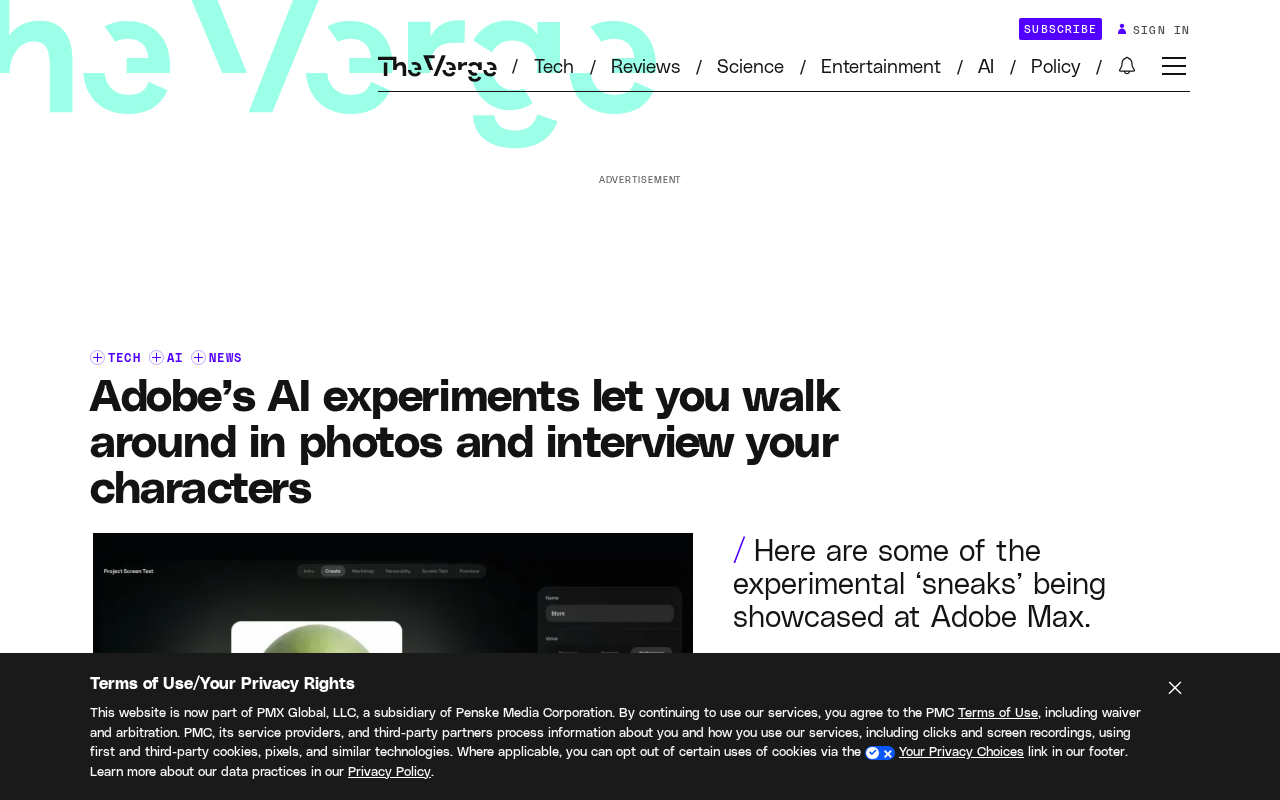
The second experiment turns the process of designing AI characters into a conversation. Users no longer need to adjust parameters item by item or manually write personas; instead, they complete the design by talking with the AI character. This shift in interaction is noteworthy: it turns creators from "configurers" into "conversationalists," with the character's personality, tone, and behavioral logic taking shape gradually through dialogue.
The thinking behind this aligns with a major trend in current AI applications—replacing complex interfaces with natural language. For narrative creation, game prototyping, virtual companionship, and similar scenarios, this "talk it out first, then lock it in" approach may be closer to creative intuition than form-based character editors.
The technical foundation of conversational character design typically includes structured representations of personas and system prompt engineering. A persona is broken down into backstory, personality traits, language style, knowledge, and behavioral constraints, then gradually extracted, refined, and solidified through LLM-driven dialogue into reusable configuration files. Compared with form-based editors, the advantage of conversational interaction is that it can surface settings the creator hasn't yet fully thought through—the model proactively asks follow-up questions, fills gaps, and maintains consistency. The challenge is that implicit settings generated during conversation are hard to manage and version, so productization usually requires an additional visual configuration layer as a fallback.
Copy-Paste Photo Editing: Reconstructing the Photo Editing Interaction
The third experiment turns photo editing into a copy-paste process. Adobe hasn't disclosed specific technical details, but from the description, it attempts to compress repetitive operations like "select—adjust—apply" into a single paste action. Creators can transfer an editing effect from one image directly to another without re-running the parameter workflow.
The potential of such a feature lies in batching and consistency. When a set of images needs unified stylistic treatment, copy-paste editing can significantly reduce repetitive work. It also continues Adobe's consistent approach in recent years: hiding AI behind operations so users perceive a smoother flow rather than more complex tools.
Technically, "copy-paste photo editing" usually corresponds to two types of methods: first, extracting an effect representation of the editing operation from the source image (such as tone mapping curves, local adjustment masks, or style embedding vectors) and applying it to the corresponding region of the target image; second, using an image-to-image diffusion model conditioned on the before-and-after difference of the source image to perform the transfer. The core problem it must solve is "consistency"—keeping a set of images unified in tone, lighting, and texture while avoiding erroneously carrying content details from the source image into the target. This is also the key challenge for landing the feature: fine-grained boundary control is needed between effect transfer and content leakage.
The Signal Value of Experimental Features
The experimental projects Adobe unveils at Max each year don't all become official products, but they serve as pathfinders. This year's three experiments collectively send a signal: Adobe is embedding AI capabilities into multiple stages of the creative workflow—spatial construction, character design, image editing—rather than just building a standalone generative tool.
For creators, this means future tool competition may no longer revolve around "who has more features" but around "whose workflow is more coherent." From photos stepping into 3D scenes, to characters generated through conversation, to photo editing completed by pasting, all three paths ultimately point to the same goal: keeping creators' attention on the creative work itself rather than consumed by operations.
These features are still experimental, and their usability and final form remain to be seen. But they already outline Adobe's understanding of creative tools in the AI era clearly enough.
The "Sneaks" tradition at Adobe Max has long been a showcase for cutting-edge research, with projects mostly appearing as tech demos; audience voting and feedback influence their subsequent direction, and whether they ultimately become products depends on feasibility, user demand, and commercial value. This mechanism makes experimental projects a window into the company's technology roadmap: they often reveal strategic priorities earlier than officially released products. In recent years, Adobe's generative AI efforts have centered on the Firefly model family, with an emphasis on licensing compliance of training data—which also explains why its experimental features mostly focus on embedding generative capabilities into existing workflows rather than starting from scratch with standalone tools.
Related articles

Zed Editor Releases v1.29.2: Observations on a Routine Version Iteration
Zed editor releases patch v1.29.2, version bump by @JosephTLyons, commit verified via GitHub signature. This article covers the release's basic info, what a patch version means, and practical upgrade advice for users.

Anthropic IPO Questioned: Hacker News Debates Timing of Going Public
A Hacker News post titled "Just say no to Anthropic's IPO" sparks debate on the timing of Anthropic's public listing and AI capitalization, touching on valuation bubbles and mission independence.

Hands-On with the Genie 4 World Model: Directing Worlds in Real Time Like a Puppeteer
Google DeepMind's Genie 4 world model in depth: Special Guest X's hands-on demo of real-time scene direction via prompts, custom interactive apps in Project Genie, and prompts-as-seeds reproducibility.