Anthropic IPO Questioned: Hacker News Debates Timing of Going Public

An HN post opposing Anthropic's IPO sparks debate on balancing AI company capitalization with safety mission.
A Hacker News post titled "Just say no to Anthropic's IPO" received 19 upvotes and 5 comments but offered no detailed reasoning. The article speculates community concerns center on valuation bubbles, mission-capital tension, and premature timing. With sparse discussion, HN users reached no consensus and the poster's full argument remains unclear. This reflects the tech world's sensitivity to AI capitalization paths—Anthropic, as Claude's developer, is seen as a reference sample for AI safety lab commercialization and worth continued observation.
Background: A HN Post Sparks Discussion
A post titled "Just say no to Anthropic's IPO" appeared on Hacker News, quickly garnering 19 upvotes and 5 comments. The title bluntly expresses opposition to Anthropic's IPO plans, though the original content did not elaborate on specific reasons.
This brief title drew attention within the HN community, reflecting the tech world's sensitivity to the capitalization paths of AI companies. As the developer of the Claude series of models, Anthropic's IPO moves naturally strike a nerve among developers, researchers, and investors.
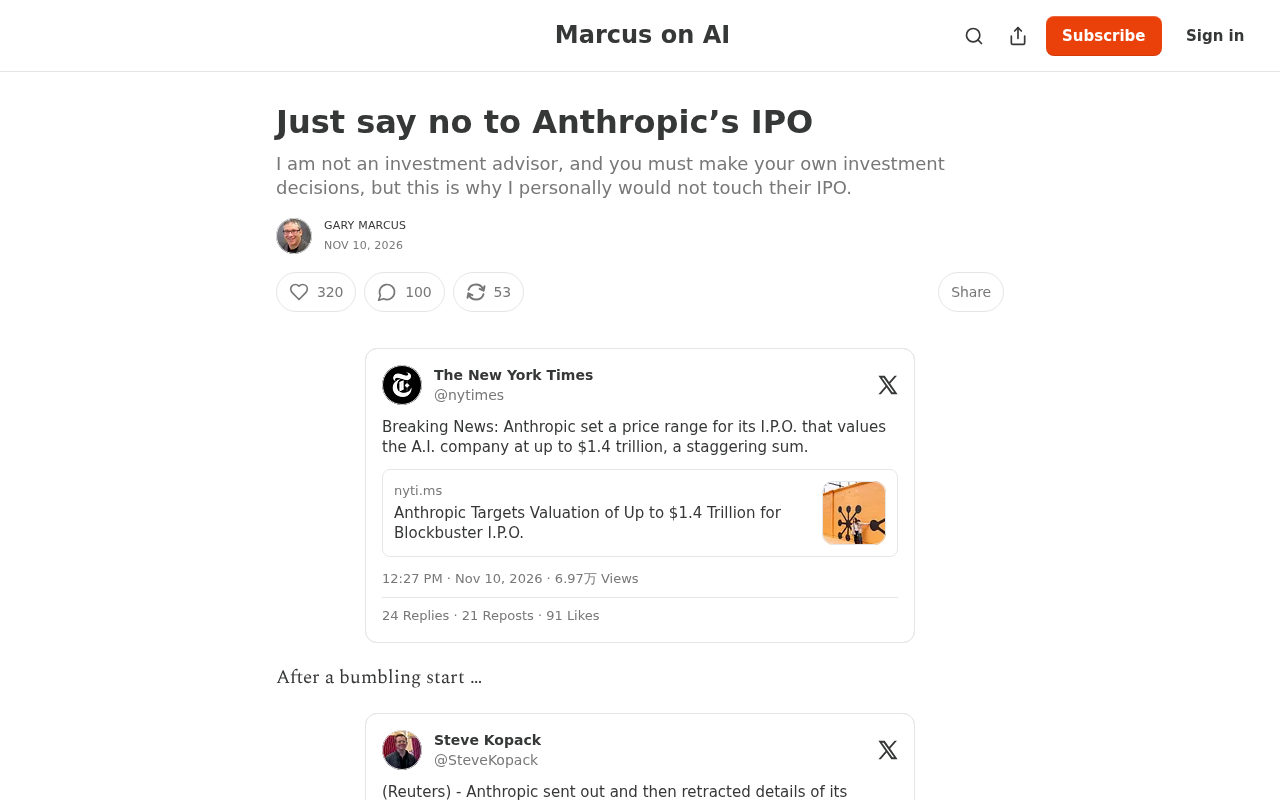
Anthropic's IPO Background: Anthropic is an AI safety company founded in 2021 by former OpenAI VP of Research Dario Amodei and others, with its core product being the Claude series of large language models. The company is known for safety alignment research such as "Constitutional AI" and has received billions of dollars in investment from giants like Google and Amazon. As of 2024, its valuation has exceeded $18 billion. Among AI startups, Anthropic is regarded as one of the few labs combining frontier model capabilities with a clear safety mission, so any capitalization move (such as an IPO) would be seen as an industry bellwether. An IPO—initial public offering—means the company shifts from private markets to public capital markets, taking on obligations like quarterly financial disclosure and shareholder return pressure, which may create tension with the patient capital needed for long-term safety research.
Why "Just say no"?
The phrase "Just say no" in the title carries an evident dissuasive tone, suggesting the poster believes Anthropic should not pursue an IPO at this time. Although the original text provides no detailed argument, several possible concerns can be inferred from the discussion context on HN:
- Valuation bubble risk: AI sector valuations are lofty, and going public could amplify market volatility
- Mission-capital tension: Anthropic has always emphasized its AI safety mission, and post-IPO shareholder pressure could affect decision-making independence
- Premature timing: The commercialization path has not been fully validated, and going public too early could harm long-term development
These speculations are not unfounded. The HN community has historically maintained a cautious attitude toward the commercialization pace of AI companies, particularly concerning how safety-oriented labs can stay true to their original mission in capital markets.
AI Valuation Bubbles and IPO Timing: In 2023-2024, the generative AI sector experienced a surge in valuations, with private valuations of leading companies like OpenAI and Anthropic repeatedly hitting new highs, though whether commercialization revenue can support these valuations remains disputed. Historical experience shows that high-valuation tech companies often face stock price volatility and short-selling pressure after going public—for example, many SPAC-listed tech companies saw significant market cap drawdowns in 2021-2022. For AI labs like Anthropic that are still in a high-investment phase, the public market's short-term demands for profitability could force the company to adjust its R&D pace or safety investments. Moreover, AI safety research itself has public-good attributes, and its benefits are difficult for any single company to fully capture—a natural contradiction with the logic of maximizing shareholder value. The HN community's wariness of "premature IPOs" stems precisely from this potential conflict between capital logic and mission logic.
Community Divergence and Information Gaps
You might not have noticed that this post has only 5 comments, with limited depth of discussion. Based on available information, HN users have not formed a consensus on this topic—some may agree with the judgment to "hold off on the IPO," while others believe going public is a natural stage of company development.
Because the original content is extremely brief, it is impossible to confirm the poster's complete argument or determine the community's prevailing sentiment. This information gap is itself worth noting: such an important topic has received surprisingly sparse public discussion on HN.
Implications for AI Industry Capitalization
Regardless of whether Anthropic ultimately proceeds with an IPO, this discussion touches on a proposition that AI companies universally face: how to strike a balance between capital returns and mission adherence.
For readers concerned with AI governance, Anthropic's IPO moves are worth continued observation. It is not merely a company's financing decision but may also become a reference sample for the commercialization model of AI safety labs. This brief "Just say no" on HN may be precisely a microcosm of the community's cautious sentiment.
Related articles

Zed Editor Releases v1.29.2: Observations on a Routine Version Iteration
Zed editor releases patch v1.29.2, version bump by @JosephTLyons, commit verified via GitHub signature. This article covers the release's basic info, what a patch version means, and practical upgrade advice for users.

Hands-On with the Genie 4 World Model: Directing Worlds in Real Time Like a Puppeteer
Google DeepMind's Genie 4 world model in depth: Special Guest X's hands-on demo of real-time scene direction via prompts, custom interactive apps in Project Genie, and prompts-as-seeds reproducibility.

Nvidia RTX Spark Mini PCs Go on Sale, Asus, Dell, and MSI Lead the Launch
Nvidia's RTX Spark N1X chip expands to desktops, with Asus, Dell, and MSI launching the first mini PCs, followed by Acer, Gigabyte, HP, and Microsoft's Surface Dev Box, accelerating the desktop AI PC ecosystem.