Zed Editor Releases v1.29.2: Observations on a Routine Version Iteration

Zed releases v1.29.2 patch with no detailed changelog and low upgrade risk.
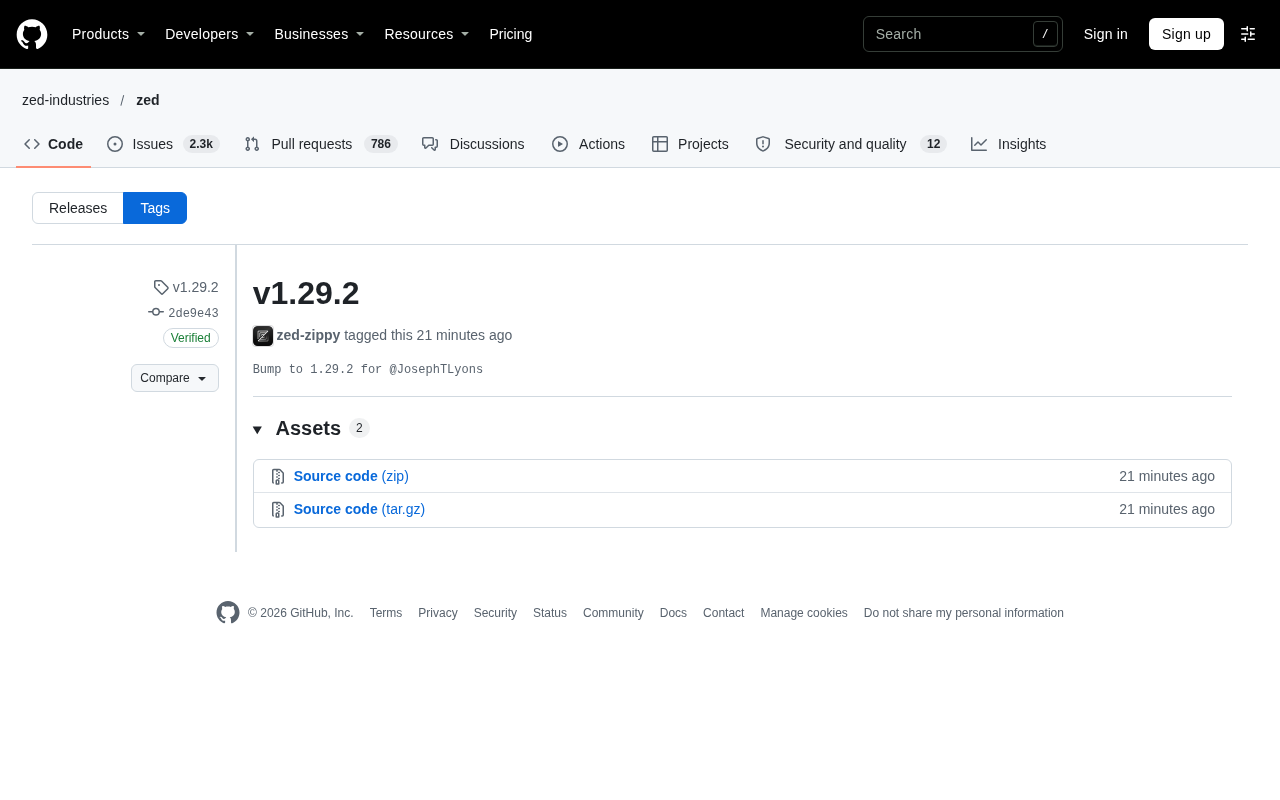
Zed editor released version v1.29.2, with developer @JosephTLyons driving the version bump; zed-zippy applied the tag at 18:48 on the 18th, corresponding to commit hash 2de9e43, verified via GitHub's official GPG signature. Based on the commit message "Bump to 1.29.2 for @JosephTLyons," this is a routine maintenance release without a detailed changelog or feature description, and asset loading on the release page also showed errors. Given the convention of incrementing the last digit of the three-part version number, this release is likely a patch-level fix over v1.29.1 involving bug fixes, minor performance tweaks, or dependency updates. The article suggests developers already using Zed who have encountered known issues can follow up with a low-risk upgrade, while users who have not migrated need not switch editors over a single patch release.
Zed editor recently released version v1.29.2, with developer @JosephTLyons completing the version bump and tagging the release. Judging from the commit records in the GitHub repository, this update is a routine maintenance release without a detailed changelog or feature description.
Basic Information About the Release
According to the tag page on GitHub, v1.29.2 corresponds to commit hash 2de9e43, which is signed and verified by GitHub with GPG key ID B5690EEEBB952194. The tag was applied by zed-zippy at 18:48 on the 18th, and the commit message explicitly states "Bump to 1.29.2 for @JosephTLyons," indicating this is a routine version number advancement.
The release page includes two asset files, but an error message appeared during page loading, so the specific asset contents could not be fully displayed. Judging from the magnitude of the version number jump, v1.29.2 is likely a patch-level fix over v1.29.1 rather than a release introducing major new features.
Commit hash and GPG signature verification are two fundamental mechanisms in open-source project management. A commit hash is a SHA-1 (or SHA-256) digest value that Git calculates for each commit's contents. It is unique, and anyone who pulls the repository can use it to locate the exact same code snapshot, thereby ensuring that the released version matches the source code and cannot be quietly tampered with. GPG signing, meanwhile, means the developer digitally signs the tag or commit with a private key, and verifiers can use the corresponding public key to confirm that the commit was indeed created by the person holding the private key. GitHub displays a "Verified" marker for the signature status, and the key ID B5690EEEBB952194 mentioned in the article is used to identify the signer. Together, the two form the basic trust chain of "traceability and verifiability" in the open-source software supply chain.
What a Patch Version Usually Means
In Zed's version management cadence, an increment of the last digit in the three-part version number typically corresponds to bug fixes, minor performance tweaks, or dependency updates. Such releases have limited direct impact on daily use, but are worth following for users who prioritize stability.
Since this release did not publish a detailed change description, it is difficult for outsiders to determine which issues were specifically fixed. Users in the developer community have already been discussing whether this version deserves attention, with some arguing that in the absence of a clear changelog, one can wait for a subsequent larger release before making an upgrade decision.
Semantic Versioning (SemVer) is a version numbering convention commonly followed by projects such as Zed, in the format "major.minor.patch." Under this specification, a major version increment indicates incompatible API changes, a minor version increment indicates new functionality added in a backward-compatible manner, and a patch increment indicates only backward-compatible bug fixes. Therefore, seeing a change such as 1.29.1 to 1.29.2 makes it fairly safe to conclude that this release does not involve breaking changes or major new features. It should be noted, however, that SemVer primarily targets the API contracts of library-type projects; for an end-user application like Zed, adopting it is more of a release-cadence convention, and the actual contents should still be determined by the changelog.
Practical Advice for Zed Users
For developers already using Zed, v1.29.2 as a patch version carries low upgrade risk. If your current version has encountered known issues, you can try updating to this version to see whether they improve. For users who have not yet migrated to Zed, a single patch release is not a reason to switch editors; what is more worth watching is Zed's continued evolution in collaborative editing, AI-assisted programming, and other areas.
Version iteration itself is a sign of a healthy open-source project. The release of v1.29.2 shows that the Zed team is still maintaining a steady maintenance cadence, but this single commit alone is not enough to draw further conclusions about the product's direction.
Related articles

Anthropic IPO Questioned: Hacker News Debates Timing of Going Public
A Hacker News post titled "Just say no to Anthropic's IPO" sparks debate on the timing of Anthropic's public listing and AI capitalization, touching on valuation bubbles and mission independence.

Hands-On with the Genie 4 World Model: Directing Worlds in Real Time Like a Puppeteer
Google DeepMind's Genie 4 world model in depth: Special Guest X's hands-on demo of real-time scene direction via prompts, custom interactive apps in Project Genie, and prompts-as-seeds reproducibility.

Nvidia RTX Spark Mini PCs Go on Sale, Asus, Dell, and MSI Lead the Launch
Nvidia's RTX Spark N1X chip expands to desktops, with Asus, Dell, and MSI launching the first mini PCs, followed by Acer, Gigabyte, HP, and Microsoft's Surface Dev Box, accelerating the desktop AI PC ecosystem.