Advanced AI Agent Development: A Complete Practical Guide to Three Major Frameworks

A practical guide to AI Agent development covering three major frameworks: LangChain, LangGraph, and CrewAI.
This article provides a comprehensive guide to AI Agent development, covering the progressive learning path from foundational concepts to advanced multi-agent systems. It compares three major frameworks — LangChain for chain orchestration, LangGraph for state-graph workflows, and CrewAI for multi-agent collaboration — and offers practical insights on building production-ready Agent applications.
Why AI Agents Are Reshaping Application Development
AI Agents have become one of the hottest technology trends today. What distinguishes AI Agents from traditional chatbots is their closed-loop capability of perception-reasoning-action. Traditional AI applications are essentially "question and answer" systems, while Agents can decompose complex tasks into multiple sub-steps, autonomously invoke external tools (such as search engines, databases, APIs, etc.), and dynamically adjust execution strategies based on intermediate results. This capability is known as Tool Use or Function Calling — the key technical breakthrough that transforms large language models from "dialogue engines" into "task execution engines."
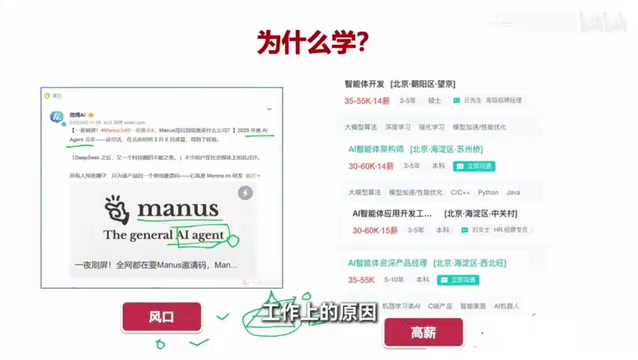
With the emergence of products like Manus, which claims to be a "general-purpose AI Agent," the entire industry has been ignited. Released in early 2025, Manus positions itself as a general-purpose AI Agent whose core selling point is the ability to autonomously complete complex task chains in a browser environment — from information retrieval and data analysis to file generation in one seamless flow. The excitement it generated fundamentally reflects the industry's expectations for how AGI (Artificial General Intelligence) might materialize: people want AI not just to answer questions, but to truly replace humans in completing end-to-end workflows. According to Tommy, a content creator on Bilibili, invitation codes for a certain general Agent product were being resold for as high as 100,000 yuan on secondary markets, demonstrating the extraordinary market enthusiasm.
This reflects a genuine industry trend: AI Agents are fundamentally restructuring the entire internet application landscape from the ground up. If past software passively responded to user operations, then the core value of Agents lies in autonomous decision-making and full-process automated execution — which is precisely why so many people feel excited after watching demos.
From a career development perspective, this is also a pragmatic choice. Data from recruitment platforms shows that AI Agent-related positions offer considerable salary levels, with demand growing rapidly. As Agents extend from pure software into robotics, embedded systems, and other physical-world directions (i.e., Embodied AI), demand for talent in this field is expected to continue expanding.
The Application Layer Is Where Most Developers Should Focus
A noteworthy perspective is the so-called "triangle theory." In the AI industry, model training and development at the top belongs to only a handful of capable large companies, while the vast majority of practitioners are concentrated in the middle and lower layers — namely the application development level.
Specifically, this "triangle" can be understood as the layered structure of the AI industry: the top layer is the foundation model layer (such as OpenAI's GPT series, Meta's LLaMA, DeepSeek, etc.), requiring hundreds of millions of dollars in compute investment and top-tier research teams; the middle layer is the framework and middleware layer (such as LangChain, vector databases, etc.), responsible for engineering model capabilities; the bottom and broadest layer is the application development layer, directly solving specific problems for end users. This layering is highly analogous to the IaaS-PaaS-SaaS three-tier architecture of the internet era.
This assessment carries significant practical implications. For average developers, training a large model from scratch is neither realistic nor necessary, while application development offers a moderate entry barrier with enormous market potential. And virtually all AI application development is tied to the Agent paradigm as its core pattern.
In other words, rather than competing in the unreachable model layer, it's better to seize the application layer — the real opportunity for ordinary developers. Whether you're employed or starting a business, Agent development is a direction worth long-term investment.
A Step-by-Step Learning Path from Beginner to Advanced
A complete Agent development curriculum typically follows a progressive logic. Using Tommy's course structure as an example, the content is divided into four progressive stages:
Beginner Stage: Prerequisite Knowledge
The first stage (approximately 4 chapters) focuses on foundational concepts: what is AI, what are large models, what are Agents, and how to use AI programming tools, how to call large model APIs, and how to use DeepSeek. DeepSeek is a large language model series from the Chinese AI company DeepSeek, whose DeepSeek-V3 and DeepSeek-R1 models demonstrate performance comparable to GPT-4 across multiple benchmarks, offered via open-source or low-cost API access. For developers in China, using domestic model APIs like DeepSeek offers advantages such as low latency, low cost, and better regulatory compliance — making it a very pragmatic choice for Agent development practice. The goal of this stage is to help learners build a clear cognitive framework of the entire technology stack.
Intermediate Stage: Deep Dive into LangChain
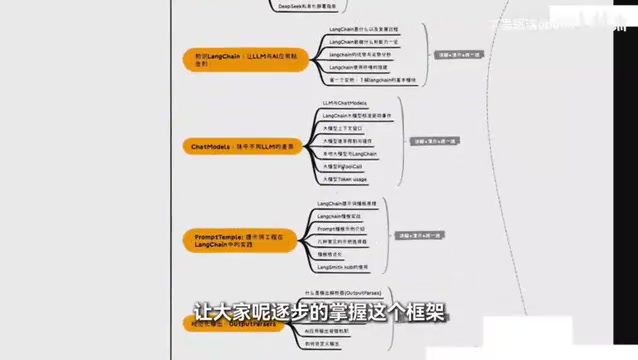
The second stage (approximately 6 chapters) introduces LangChain, the mainstream framework. Created by Harrison Chase in 2022, LangChain is currently the most popular framework for large model application development. Its core design philosophy is "chain orchestration" (Chain) — connecting prompt templates, model calls, output parsing, and tool invocation into reusable chains. LangChain's ecosystem includes document loaders, vector stores, retrievers, memory modules, and other rich components, enabling developers to quickly build RAG (Retrieval-Augmented Generation), dialogue systems, data analysis applications, and more.
As a framework with a vast ecosystem and extensive content, learning requires distilling and extracting only the parts most relevant to application development. Due to its frequent API changes and multiple abstraction layers, learners indeed need to selectively focus on core modules. Through a combination of explanation, demonstration, and exercises, one gradually masters the framework's core capabilities, laying the foundation for real-world projects.
Hands-On Stage: Complete Agent Project Implementation
The third stage involves complete case studies, such as building an intelligent customer service system called "Xiaolang Assistant." This is a full-process hands-on project from requirement decomposition to environment setup to feature implementation — first implementing a single Agent custom Bot, then evolving toward multi-agent systems. A single Agent typically refers to one intelligent entity with a specific role and toolset that independently completes tasks, while multi-agent systems simulate team collaboration, handling more complex business scenarios through the division of labor among multiple specialized Agents.
Advanced Stage: Multi-Agent Frameworks and Collaboration
The final stage introduces more advanced encapsulation frameworks (such as CrewAI), covering advanced topics like multi-agent collaboration, optimization, deployment, and observability. CrewAI's design is inspired by real-world team collaboration patterns — developers can define multiple Agent roles (such as researcher, writer, reviewer), assign specific backgrounds, goals, and tools to each role, then orchestrate their collaboration through Task and Process mechanisms. This "role-playing + task assignment" paradigm allows complex tasks to be decomposed into multiple specialized subtasks, completed collaboratively by different Agents. Similar multi-agent frameworks include AutoGen (Microsoft) and MetaGPT.
Agent frameworks are iterating rapidly, and systematically mastering one framework enables you to intuitively understand the design philosophy of others.
Comparing Three Major Frameworks: LangChain, LangGraph, and CrewAI

Systematic Agent development learning typically needs to cover multiple mainstream frameworks. Here's a comparison of three major frameworks and their use cases:
-
LangChain: The foundational chain orchestration framework for application development, suitable for building single-agent applications and standardized LLM call flows. Its core value lies in providing unified model interface abstractions and rich ecosystem components, allowing developers to quickly prototype ideas.
-
LangGraph: A state-graph-based process control framework, suitable for AI workflows requiring complex conditional branching and loop logic. LangGraph models AI workflows as directed graphs, where each node represents a processing step (such as calling an LLM, executing a tool, human review, etc.), and edges represent state transition conditions. Compared to linear Chains, the Graph model naturally supports conditional branching (if-else logic), loops (letting Agents retry until successful), and parallel execution — making it ideal for building Agent applications requiring complex decision logic, such as multi-step planning, self-correction, and human-AI collaboration workflows.
-
CrewAI: An advanced encapsulation framework for multi-agent collaboration, suitable for complex scenarios requiring multiple Agent roles working together. Its out-of-the-box role definition and task orchestration capabilities significantly lower the development barrier for multi-agent systems.
Together, these three cover the three major directions in current AI application development: single-agent, multi-agent, and AI workflows. Compared to fragmented tutorials available online, systematically mastering multiple frameworks helps developers build a more complete technical perspective and maintain competitiveness in a rapidly evolving framework landscape.
Tooling Solutions to Lower the Learning Barrier
For beginners, environment configuration and API key acquisition are often the first major obstacles. Many people get stuck during development environment setup and lose their motivation to learn. Python environment management (virtual environments, package dependencies), API Key application and configuration, network proxy settings — these seemingly simple steps actually consume enormous amounts of beginners' time and patience.

To address this pain point, courses can provide companion online IDE tools that enable zero-configuration environments and offer a certain number of free API call credits. Additionally, all course code is open-source, study notes are publicly available, and a built-in testing Agent tracks learning progress — to proceed to the next chapter, you must first pass the Agent's test questions. This "using Agents to learn Agents" design is itself a clever practical demonstration, allowing learners to intuitively experience the capabilities and boundaries of Agents during the learning process.
Who Should Learn AI Agent Development?
The core requirement for the AI Agent direction is having a certain programming foundation, as this is a development course rather than a pure tool usage course. Specifically, you need to master Python's basic syntax (variables, functions, classes, asynchronous programming, etc.), have a basic understanding of HTTP requests and JSON data formats, and be able to read and understand API documentation. The following groups are especially well-suited:
- Junior developers with Python experience who want to break into the AI application space
- Mid-to-senior developers who want to systematically master the Agent development paradigm and integrate AI capabilities into existing products
- Tech enthusiasts interested in AI Agents who are looking for career transition opportunities
We are currently in the window period of AI Agent technology explosion. From the technology maturity curve perspective, the reasoning capabilities of large language models, tool-calling stability, and context window lengths have all reached levels that support production-grade Agents, while the application ecosystem is still in its early stages — which means enormous opportunity windows. AI Agents are likely to be a direction worth serious attention in the coming years, whether for entrepreneurship or employment. Seizing this window period and systematically building complete capabilities from beginner to advanced is the key to avoiding detours.
Key Takeaways
Related articles

Deep Dive into Kimi K3 Architecture: KDA, Stable Latent MoE, and Attention Residuals — Three Core Technologies Explained
Deep dive into Kimi K3's three core architecture technologies: KDA memory management, Stable Latent MoE with 896 experts activating only 16, and Attention Residuals — from math to implementation.

Complete Guide to Building and Installing Python 3.14 from Source (Ubuntu)
A complete guide to building Python 3.14 from source on Ubuntu, covering dependency installation, optimization flags, altinstall safety, and troubleshooting.

Customizing Open-Source Software with AI Coding Agents: No Programming Skills Required
Use AI coding Agents like Claude Code to add custom features to open-source software like Shotcut and OBS—no C++ skills needed. A complete guide from forking code to building and installing.