Advanced AI Programming: The Complete Path from Vibe Coding to Engineering-Grade Development

A complete guide to evolving from casual Vibe Coding to engineering-grade AI-assisted development.
This article explores the full progression from Vibe Coding to engineering-grade AI development, covering three core skills—Brainstorming, SubAgent collaboration, and custom plugin building. It emphasizes that the real competitive advantage in AI programming lies not in writing code, but in mastering human-AI collaboration workflows, from requirements decomposition and task orchestration to one-click deployment of real products.
Why Does Your AI Programming Keep Getting Stuck?
Many people share a similar experience when first encountering AI programming: watching others write code effortlessly with AI, only to find themselves trapped in endless errors and loops when it's their turn. Bilibili creator Bai Li hits the nail on the head in his AI programming course series — what's holding you back isn't your coding fundamentals, but a lack of methodology for human-AI collaboration.
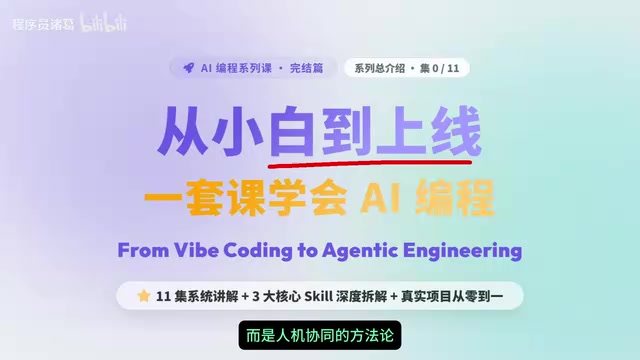
This observation deserves serious consideration. The barrier to entry for AI programming tools has dropped dramatically — even users with zero technical background can generate code by describing requirements in natural language. But what truly determines success or failure is whether you can establish an efficient collaborative workflow with AI: how to break down tasks, how to structure prompts, how to validate outputs, and how to iterate on corrections. This is essentially a mindset shift from "having AI write code for me" to "building software together with AI."
A 2024 McKinsey research report found that AI programming tools have improved code-writing efficiency in software development by 35-45%, yet overall project delivery efficiency has only improved by 10-15%. This gap illustrates precisely that code generation is just one link in the software engineering chain — requirements understanding, architecture design, quality assurance, and project management are the real efficiency bottlenecks. Prompt Engineering is evolving into an independent engineering discipline, and the core competency of the emerging "AI-native developer" role is the ability to transform complex business problems into structured, AI-executable task sequences.
From Vibe Coding to Engineering-Grade Development
Vibe Coding refers to the beginner approach of generating code through natural language conversations with AI and rapid trial-and-error. It's quick to pick up and low-barrier, making it especially suitable for zero-experience users implementing simple ideas. But this approach quickly reveals its limitations when facing real projects: code lacks standards, structure becomes unmaintainable, and reuse or extension becomes difficult.
The concept of Vibe Coding was first coined by Andrej Karpathy — Tesla co-founder and early OpenAI core member — in early 2025. On social media, he described a completely new programming paradigm: developers fully immerse themselves in the "vibe," embrace exponentially growing codebases, forget the specific form code takes, and simply express intent in natural language while letting AI handle all implementation details. The concept quickly sparked heated discussion in the developer community because it fundamentally challenges traditional software engineering's pursuit of code quality, readability, and maintainability. Vibe Coding works well for quickly validating ideas, but once a project exceeds a few hundred lines of code, the lack of architectural planning and coding standards amplifies dramatically, ultimately rendering the project unmaintainable.
The course's core philosophy guides learners through a complete transition — from casual Vibe Coding to standardized, engineering-grade AI development workflows. This path covers the current mainstream AI programming tool matrix, including Claude Code, Codex, and engineering platforms like Harness.
Claude Code is a command-line AI programming tool from Anthropic that allows developers to interact directly with the Claude model in a terminal environment, performing code writing, debugging, refactoring, and other tasks. Its advantage lies in its ability to perceive the entire project's file structure and context. Codex is OpenAI's code generation engine, originally released as a code-specific fine-tuned version of GPT-3, which later evolved into the underlying capability powering products like GitHub Copilot. Harness, as an AI engineering platform, focuses on embedding AI capabilities into DevOps pipelines to achieve end-to-end intelligent automation from development to deployment. These three tool categories represent the interaction layer, generation layer, and engineering layer of the AI programming ecosystem respectively — mastering their combined usage is foundational to engineering-grade AI development.
Three Core Collaboration Skills
The course breaks down AI programming's core competencies into three key dimensions:
-
Brainstorming: Guiding AI to participate in requirements analysis and solution design, rather than just passively receiving instructions. Through structured questioning and guidance, you turn AI into your product thinking partner. Specifically, this requires developers to master a systematic questioning framework: start with open-ended questions to help AI map the problem space, then use constraining questions to narrow the solution scope, and finally use confirmatory questions to validate solution feasibility. This aligns with traditional requirements analysis methodology — the only difference is that the conversation partner has changed from a human to an AI.
-
Random Player and SubAgent Collaboration: Division of labor and cooperation between multiple AI roles or sub-agents — a critical mechanism for building complex applications. Understanding how to orchestrate different AI Agents to handle their respective responsibilities is a core engineering-grade development skill. An AI Agent refers to an AI system with autonomous planning, tool-calling, and memory capabilities that can independently complete complex tasks. A SubAgent is a subordinate agent that executes specific subtasks under the coordination of a main Agent. This multi-Agent architecture borrows from microservices design philosophy — decomposing complex tasks into independently executable subtasks, with each Agent focusing on a specific capability domain (such as code generation, test writing, documentation, security review), coordinated through an orchestration layer managing their inputs and outputs. Current mainstream multi-Agent frameworks include LangGraph, CrewAI, AutoGen, and others, all attempting to solve inter-Agent communication protocols, task allocation strategies, and result integration challenges.
-
Building Custom Plugins: Going beyond off-the-shelf tools to deeply understand underlying principles and create your own AI programming plugins, building a personalized development toolchain. This means developers need to understand the extension mechanisms of AI programming tools — such as VS Code's Extension API, MCP (Model Context Protocol), and similar protocols — enabling them to build custom AI-assisted features for specific business scenarios rather than being limited to generic tools' default behaviors.
These three capabilities form the dividing line between "toy demos" and "real products."
Real-World Implementation: Building a Deployable Complete Project
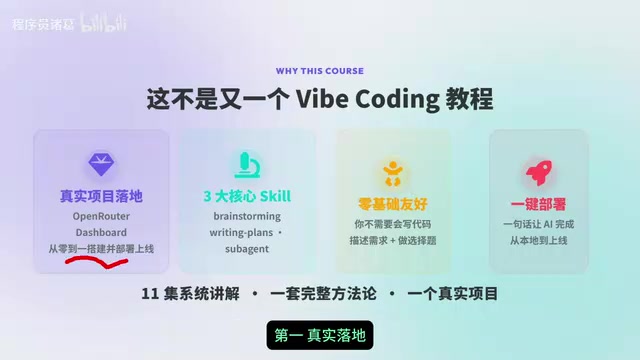
The most commendable aspect of this course is its refusal to stay at the demo level. The creator explicitly emphasizes "no Snake games or toy demos" — instead, learners build a complete, real, deployable OpenRoot project.
This "build real products" teaching philosophy is critically important. The vast majority of AI programming tutorials on the market stop at a small example that runs locally, but between local execution and online deployment lies a series of real engineering challenges: environment configuration, dependency management, service deployment, and more. Only by completing the entire pipeline can learners develop a comprehensive understanding of engineering-grade AI development.
Software development has a classic "last mile" problem: code runs perfectly on the developer's machine but encounters numerous unexpected challenges when deployed to production. These include environment differences (OS versions, inconsistent dependency library versions), network configuration (domain DNS resolution, SSL certificate application and configuration, Nginx reverse proxy setup), CI/CD pipeline construction, containerization (Docker image building and orchestration), and cloud service selection (Vercel for frontend projects, Railway for full-stack applications, Anthropic/Alibaba Cloud for scenarios requiring fine-grained control). Traditionally, this work is handled by dedicated DevOps or SRE engineers and often requires months of specialized training to master.
AI-Assisted One-Click Deployment
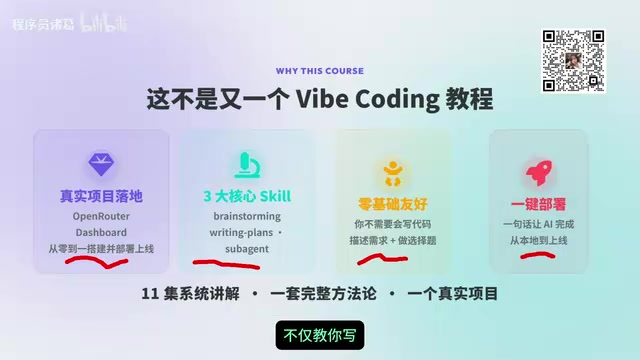
Another major highlight of the course is "AI one-click deployment." Traditionally, the deployment phase is a nightmare for beginners — various server configurations, domain resolution, and CI/CD workflows can be intimidating. With AI assistance, this process is dramatically simplified: AI not only helps you write code but also helps you complete deployment, truly achieving a complete loop from idea to product.
The working principle behind AI-assisted deployment is: AI automatically infers an appropriate deployment plan based on the project's tech stack and structure, generates corresponding configuration files (such as Dockerfile, docker-compose.yml, Vercel config, GitHub Actions workflows, etc.), and guides users through necessary environment variable setup and service provider account linking. For simple frontend or full-stack projects, the entire deployment process can be completed in minutes, whereas traditional approaches might require hours or even days of effort.
For zero-experience users, this means they have the opportunity for the first time to independently complete a publicly accessible product without needing to assemble a team or rely on professional operations personnel.
Who Is This Course For?
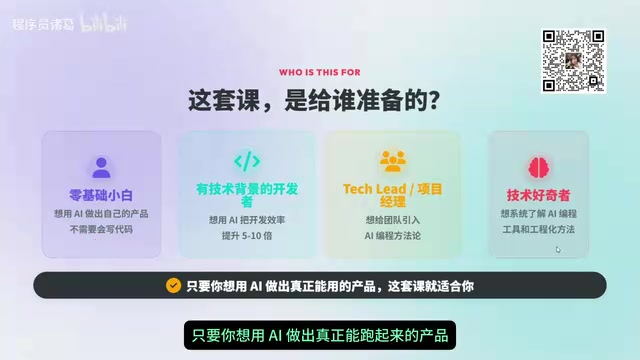
According to the course description, it primarily targets four groups:
- Complete beginners with zero technical background: Want to use AI to build their own products — just describe requirements and make choices, no coding required.
- Experienced developers: Looking to boost development efficiency 5-10x with AI programming tools and optimize existing workflows.
- Tech leads and project managers: Want to introduce AI programming workflows to their teams and improve overall R&D collaboration efficiency.
- Technology enthusiasts: Want to systematically understand the most cutting-edge AI programming tools and methodologies to maintain technical awareness.
The complete course spans 11 episodes, divided into four stages: "Foundational Knowledge," "Core Skills," "Hands-On Advanced," and "Deployment & Wrap-Up," forming a complete AI programming skill progression curve.
The Essence of AI Programming Is Collaboration
Setting aside specific tools, the core message this course conveys deserves attention from all practitioners: The competitive advantage in AI programming is shifting from "whether you can write code" to "whether you can collaborate with AI."
When code generation becomes cheap, the truly scarce capabilities become requirements decomposition, task orchestration, result validation, and system design. Concepts like Brainstorming and SubAgent collaboration are fundamentally training people to become AI "conductors" rather than mere "users."
This trend already has clear signals across the software industry. GitHub data shows that over 40% of code in newly created repositories in 2024 was AI-assisted, and top technology companies have begun incorporating "AI collaboration capability" into core developer evaluation criteria. The future software engineer role is transforming from "code implementer" to "system architect + AI orchestrator" — you no longer need to memorize every API's parameter signature, but you must possess the ability to transform ambiguous business requirements into clear, executable task decomposition plans.
For developers and product creators who want to maintain long-term competitiveness, establishing this collaborative mindset early may be more important than mastering any specific tool. Tools will continuously iterate and be replaced, but the methodology of human-AI collaboration will remain effective.
Key Takeaways
Related articles

FDE Forward Deployment Engineer: A New Species in the AI Era and Practical Implementation Analysis
What is an FDE Forward Deployment Engineer? This article analyzes FDE's Palantir origins, why it became popular in the AI era, learning paths for fine-tuning and Agent development, and practical pitfalls in enterprise deployment such as verifying fine-tuning value and changing requirements.

OpenCode Complete Beginner's Guide: From Installation to Hands-On Practice
OpenCode complete beginner's guide: detailed walkthrough of desktop, command-line, and WSL installation methods, analysis of its dual role as Agent coding assistant and chat assistant, plus core configuration, model selection, and real user experience review.

FDE Forward Deployed Engineer: A Complete Guide to AI's Hottest New Role
A complete guide to FDE (Forward Deployed Engineer): from Palantir's origins to OpenAI and Anthropic practices, core differences from regular engineers, skill requirements, and career transition advice.