AfD Leak: 420,000 Emails Exposed — Hacker Data Reveals Inner Workings of Germany's Far-Right Party
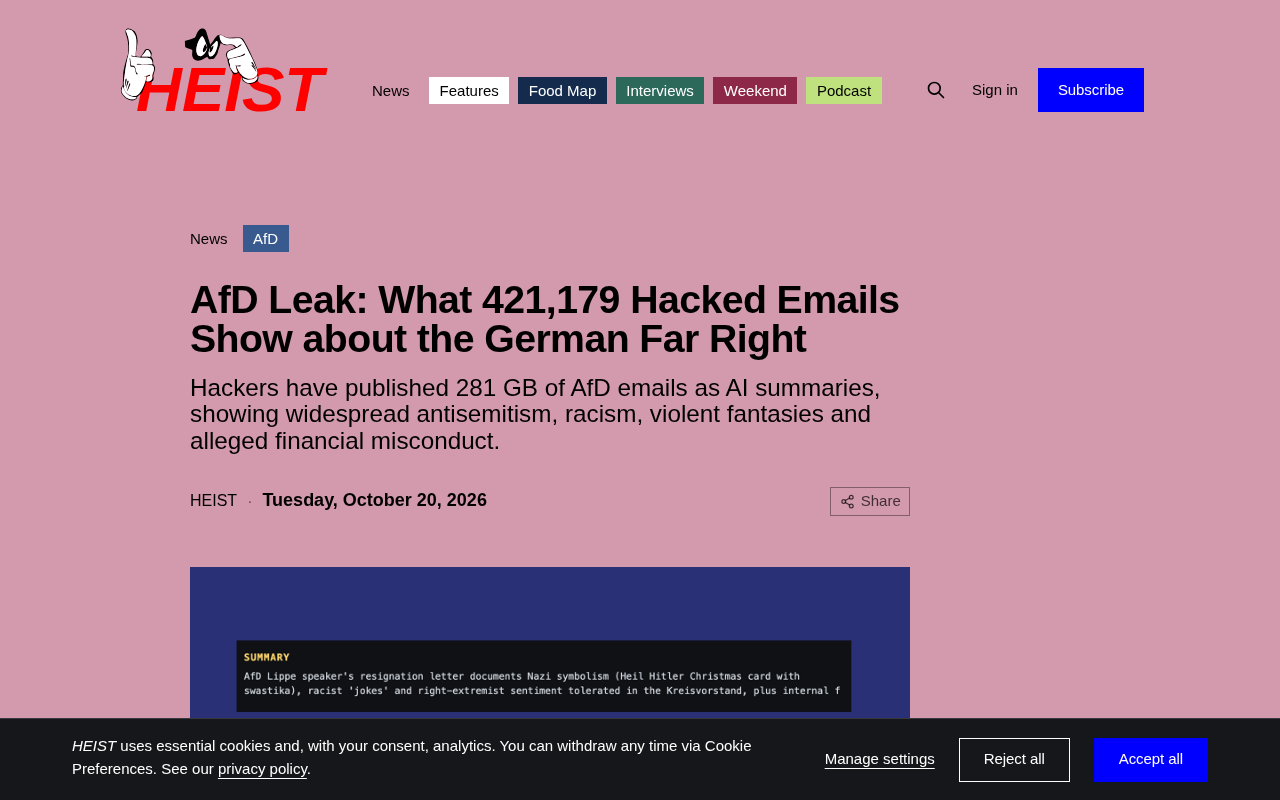
Over 420,000 AfD internal emails leaked, igniting debate on data security and political transparency.
Germany's far-right AfD party was hacked, with 421,179 internal emails leaked, sparking discussion on Hacker News. The article reviews the scale and likely source, noting that such a bulk export usually means long-term mail server access or backup system exploitation. Leaked content may involve immigration policy and EU stance discussions, with community comments divided between whether hacking interferes with democracy and the public's right to know. On security, the article outlines common party IT weaknesses—lack of MFA, exposed mail servers, unencrypted backups, inadequate log auditing—and offers actionable advice: encrypted archives, MFA, log alerts, and staff training, stressing that a data breach is both a security and political event.
Germany's far-right party AfD (Alternative für Deutschland) has been hacked, with more than 420,000 internal emails leaked. The incident has sparked dual discussions in the Hacker News tech community about data security and political transparency.
Incident Overview: Scale and Source of the 420,000 Emails
According to information shared on Hacker News, the leak involves 421,179 internal AfD emails — a scale that is quite rare among political party data breaches. The leaked content is said to cover internal party communications, strategy discussions, and potentially personal data.
The core question for the tech community is: how were these emails obtained? Was it an external hack, an insider leak, or a system misconfiguration? The original report does not detail the attack vector, but an email export of this magnitude typically means the attacker gained long-term access to the mail server or exploited vulnerabilities in the backup system.
For those focused on cybersecurity, this incident is another reminder: political parties' IT infrastructure is often less robust than enterprise-grade systems, yet the data they hold is highly sensitive.
Attack vector refers to the specific path or weakness an attacker exploits to enter a target system. Common types include phishing for credentials, unpatched services exposed to the public internet, supply chain vulnerabilities, and insider assistance. In email system breaches, attackers typically first gain initial access through credential theft, then move laterally to the mail server or backup storage, and finally bulk-export email archives. Distinguishing the attack vector is critical for post-incident response: if it was an external intrusion, systems need patching and persistence backdoors must be hunted down; if it was an insider leak, the focus shifts to access management and behavioral auditing. The original report notes that "the attack vector was not detailed," meaning the nature of the incident cannot yet be determined — which also affects assessment of AfD's security responsibility.
What the Leaked Content Reveals
Although the original report does not list email details one by one, given AfD's political positioning and past controversies, the leaked material likely involves internal party discussions on immigration policy, EU stance, and far-right rhetoric.
The Hacker News discussion (17 comments in total) presented two perspectives: some focused on the legitimacy of the data breach itself — whether hacking constitutes interference with the democratic process; others emphasized that the public has the right to know how a party actually operates, especially when the party itself campaigns on "transparency."
This tension recurs in similar incidents: a data breach is both a security event and a political event.
Security Lessons: The Fragility of Political Party IT Systems
From a technical standpoint, the leak of 421,179 emails means the attacker likely obtained the complete email archive. Common causes include: multi-factor authentication not enabled, mail servers exposed to the public internet, employee credentials phished, or internal backups unencrypted.
For any organization, this incident offers several actionable lessons:
- Email archives should be stored encrypted, with strictly tiered access permissions
- Multi-factor authentication is the first line of defense against credential theft
- Log auditing can help detect anomalous bulk data exports early
- Employee security awareness training remains the lowest-cost defense
What makes political parties unique is that they need to communicate with the public (increasing the attack surface) while often lacking enterprise-grade security budgets. The AfD leak is not the first, and it won't be the last.
Multi-factor authentication (MFA) requires users to provide an additional verification factor beyond a password, such as a mobile push confirmation, a hardware security key, or a one-time code. Even if an attacker obtains a password through phishing or credential stuffing, logging in without the second factor remains difficult. For high-value targets like email systems, MFA can significantly reduce the risk of account takeover caused by credential theft. However, MFA is not a silver bullet: attacks using real-time phishing proxies (such as Evilginx) can intercept session tokens, so a more complete defense requires combining conditional access policies, anomalous login detection, and hardware keys (FIDO2). Party staff often work remotely on personal devices, making MFA deployment coverage and enforcement a common weak point.
Log auditing refers to systems continuously recording logins, permission changes, data access, and exports, with correlation analysis through centralized platforms (such as SIEM). Bulk email exports typically leave identifiable patterns in mail gateways, file servers, or backup systems — for example, a single account accessing far more emails than usual in a short period, large downloads outside business hours, or logins from never-before-seen IP ranges. If log retention periods are too short or key audit items are not enabled, post-incident forensics becomes extremely difficult. For resource-constrained organizations, prioritizing identity authentication logs and data export logs with threshold alerts is one of the most cost-effective detection measures.
Conclusion
The sheer volume of 420,000 emails is itself a warning signal. In an environment of increasing political polarization, the boundaries between hacking, data breaches, and information warfare are becoming increasingly blurred. The Hacker News discussion, though small in scale, touched on the core question: when data security and political transparency conflict, how should the public weigh them? There is no simple answer, but the AfD leak provides a case worth analyzing in depth.
Related articles

LLaMA-Factory in Practice: A Complete No-Code Guide to Fine-Tuning Large Models
An introduction to LLaMA-Factory, the open-source fine-tuning tool: its 60.1K-star background, supported models and algorithms, local vs. cloud deployment, and CUDA setup steps.

Zeng Ming's Deep Retrospective: Why OpenAI May Not Be the Ultimate Winner — and Why the Corporate System Will Disappear
Zeng Ming's deep retrospective on the AI endgame: model companies are just infrastructure, OpenAI and Anthropic won't be the final winners; the next battle is the Agent entry point standard; the corporate system will disappear as AI restructures collaboration, and only mission-driven companies can survive the cycle.

OpenHands v1.28.0: OpenCode and PI Added as Built-in Agents, API Keys Requestable In-Conversation
OpenHands ships 5 releases in 21 days: v1.27.0 adds OpenCode and PI as built-in agents, v1.28.0 enables in-chat key requests. ACP integration, credential reuse, model list changes, and upgrade advice.