Zeng Ming's Deep Retrospective: Why OpenAI May Not Be the Ultimate Winner — and Why the Corporate System Will Disappear

Zeng Ming maps the AI endgame: model companies become oligopolistic infrastructure, the Agent entry point decides the winner, and the corporate system disappears.
In the interview, Zeng Ming proposes a counter-consensus framework for the AI endgame. He divides industry into three stages — infrastructure popularization, mass application explosion, and native applications — arguing that cross-stage survival is extremely hard. Today's model companies are essentially AOL-style access providers whose endgame is oligopolistic AI cloud infrastructure, and OpenAI and Anthropic are likely not the ultimate winners. The next core battle is Agent standards and the user entry point, and new platforms won't grow out of old giants. AI will also restructure collaboration, dissolving bureaucratic corporate systems; only mission-driven companies can survive the cycle, and no giant is safe before the era's giant waves.
Former Alibaba Group Chief Strategy Officer and co-founder of Cheung Kong Graduate School of Business and Hupan University, Zeng Ming, delivered a series of counter-consensus judgments in the Zhang Xiaojun Business Interview: OpenAI and Anthropic most likely will not become the final big winners, the corporate system we know will disappear in the future, and new platforms will not grow out of the old giants. This two-and-a-half-hour in-depth conversation uses decades of business history as a lens for today's AI, offering a complete framework for reasoning about the endgame.
Three Stages of Industry: The Endgame of Infrastructure Is Oligopoly
Zeng Ming divides industry development into a strict three-stage syllogism. The first stage is the infrastructure popularization period, when technology becomes a public foundation — today's compute and foundation models sit in this position. The second stage is the mass application explosion period, when the market blooms with a hundred flowers. The third stage is the native application period, when society needs an entirely new underlying mechanism to carry AI. He emphasizes in particular that companies from the first stage find it extremely hard to survive into the second stage, and companies from the second stage find it equally hard to survive into the third — this is a basic law of business dynamics that is nearly impossible to cross.
Looking at today's model companies through this framework, Zeng Ming's analogy is razor-sharp: they are like AOL in the early internet era. AOL got everyone onto dial-up internet — a massive contribution — but it was only an access service provider. Today's large models are essentially also getting everyone connected to intelligence; they too are infrastructure providers. According to the interview, the endgame of model companies is to become the AI cloud companies of the future — when people buy models, what they are really buying is token invocation capability.
Here Zeng Ming points out an economic fact: for public infrastructure, ultimately only one business model survives — oligopoly plus strong government regulation. As long as homogeneous supply exists in the market, companies cannot capture excess profits. So OpenAI and Anthropic are excellent infrastructure pioneers, but by the time the native application era arrives, they most likely will not be the endgame winners.
Oligopoly is an economics term describing a market structure in which an industry is dominated by a few large firms that both compete with and depend on one another, while new entrants face extremely high capital, technological, and regulatory barriers. The "oligopoly plus strong government regulation" model that Zeng Ming emphasizes corresponds in reality to public utilities such as electricity, water, and telecommunications: because infrastructure has high fixed costs, low marginal costs, strong network effects, and universal service obligations, free competition leads to duplicated construction and wasted resources, ultimately forming a natural monopoly or oligopoly. Government regulation then balances public interest and corporate returns through price controls, entry licensing, and service standards. For AI foundation models, compute clusters and model training costs are extremely high, scale effects are significant, and data security and content compliance are involved, so their endgame form will likely replicate this path — a few AI cloud companies providing standardized token invocation services, with profits compressed by regulation and homogeneous competition, and excess profits achievable only by extending into the application layer or vertical scenarios.
The Agent Entry Point Is the Next Core Battle
If model companies are only infrastructure, where is the real battle? Zeng Ming's answer: whoever establishes the standard for Agents, whoever seizes the Agent user entry point, will be the next giant. He predicts that within the next three years, the real Agent entry point will emerge.
Can the old internet giants transform into this new platform? Zeng Ming's judgment is clear: the new platform most likely will not grow out of the old platform. The underlying reason lies in the generational gap in system complexity — the old platforms did simple information matching: search matched information, e-commerce matched goods; the future AI platform does real-time matching of capabilities and needs, and the two are not on the same dimension. Add to that the enormous historical baggage the old platforms carry, and it becomes very hard for them to revolutionize themselves.
In the latter half of the interview, Zhang Xiaojun pressed on whether ByteDance's Doubao could become a super entry point, and Zeng Ming directly rejected the idea: if Doubao really were the super entry point of the future, the giant would surely pour money into it regardless of cost, and slowing investment itself shows that it has not yet reached its endgame form.

Agent refers to an AI system capable of perceiving its environment, making autonomous decisions, and executing actions to achieve goals. Unlike traditional chatbots, Agents possess planning, tool-use, memory, and reflection capabilities, and can complete multi-step tasks on a user's behalf such as booking tickets, comparing prices, managing schedules, and writing code. The "Agent entry point" Zeng Ming speaks of is similar to the app store or super app of the mobile internet era: whoever defines the standard protocol for Agent-user interaction and whoever controls the first touchpoint where users initiate tasks controls the gate for traffic distribution and commercial monetization. In the future, Agents may appear as voice assistants, browser plugins, operating-system-level services, or standalone hardware, and the competitive focus will be ecosystem integration capability — whether it can connect enough third-party services, accumulate user preference data, and establish developer standards. This also explains why old platforms find transformation difficult: the search-and-e-commerce logic of information matching and the Agent logic of real-time capability-need matching have generational gaps in data architecture, organizational capability, and business model.
The Corporate System Will Disappear, and CEOs Can No Longer Have a Boss Mentality
The more radical view Zeng Ming offers in this interview concerns organizational form. He believes the modern corporate system is a product of the Industrial Revolution, relying on hierarchical management and bureaucracy to reduce coordination costs, but the top-down structure makes people miserable — how many people who go to work at a company are truly happy?
AI will reconstruct the way people collaborate. Code, content, and even decisions can all be delivered directly by AI; the future will not need massive hierarchies or traditional departments, and people will collaborate as more flexible, freer nodes.

The direct reminder for managers is this: CEOs absolutely must not retain the boss mentality of the past. Zeng Ming observes that today's young people will not even put up with outdated rules, let alone play paternalistic management games with their boss. The change in organizational systems is not a fine-tuning of management style but a replacement of the underlying logic of collaboration.
Bureaucracy is an organizational theory proposed by German sociologist Max Weber, referring to the use of a clearly ranked position system, written rules, professional division of labor, and impersonal management to improve the efficiency of large-scale collaboration. The modern corporate system is a typical embodiment of bureaucracy: a pyramid structure from CEO to frontline employees, information transmitted level by level, and decisions concentrated at the top. Zeng Ming judges that AI will dismantle this structure, and the underlying logic is that the fundamental reason bureaucracy exists is to reduce information transmission and coordination costs, whereas AI can aggregate information in real time, automatically assign tasks, and directly deliver code and content, driving coordination costs toward zero. When collaboration no longer depends on hierarchical approval, organizations will evolve toward flattening, networking, and project-based structures, with individuals freely combining as nodes. The challenge for managers is fundamental: power will no longer come from position but from the ability to define mission, gather resources, and empower nodes, and traditional command-and-control management will lose its legitimacy.
From Execution to Mission: Who Can Survive the Cycle
Zeng Ming divides entrepreneurs into four levels: execution-driven, strategy-driven, vision-driven, and mission-driven. Companies that reach strategy-driven are already excellent — ByteDance, for example, has made its organization an extreme efficiency factory; once the strategy is clear, its execution and efficiency can crush everyone.
But excellent is not the same as great. When the wave of a new era crashes in, the old efficiency playbook is bound to fail, and only companies truly driven by mission can survive the cycle. The reference point for this judgment comes from Zeng Ming's 15 years of hands-on retrospective at Alibaba: in Alibaba's history, only three grand strategies truly determined life or death — founding Taobao, founding Alipay, and founding Alibaba Cloud. When Taobao was being built, senior executives were almost unanimously opposed, because the core business was not yet secure — who would dare take on eBay directly? Alibaba Cloud and the de-IOE effort were likewise accompanied by enormous doubt. The greatest strategies are often counter-consensus, but Zeng Ming adds one caveat: being counter-consensus does not guarantee success.

No Giant Is Safe; the Succession of Old and New Is the Healthy State
Faced with the pointed question "Is Tencent safe?" Zeng Ming answers decisively: before the giant waves of the era, no one is safe. People's social relationships will be reconstructed by AI, so Tencent will panic too; people's relationship with goods will be reconstructed, and Alibaba faces enormous challenges as well.
As for whether the giants of the previous era can smoothly transition to the next era, Zeng Ming corrects the framing of the question: it is not a matter of how many, but of whether any exist at all — historically there have been basically no such companies. But this is not despairing. People are born, age, sicken, and die, and so are companies; if old giants never exited, where would new companies find opportunity? The succession of old and new is the healthiest and most hopeful state of the business world.
The value of this reasoning is not in predicting which company will fall, but in providing an operable coordinate system: to judge an AI company, first see which of the three industry stages it stands in, then see whether it is doing homogeneous infrastructure supply or contending for high-dimensional capability-need matching such as the Agent entry point. For entrepreneurs and managers, Zeng Ming's judgments on mission-driven organizations and organizational form may be more worth planning for in advance than "who wins and who loses."
One-line Summary
Zeng Ming reasons about the AI endgame: model companies degrade into oligopolistic infrastructure, the Agent entry point decides the winner, and the corporate system disappears.
Paragraph Summary
In the interview, Zeng Ming proposes a counter-consensus framework for reasoning about the AI endgame. He divides industry into three stages — infrastructure popularization, mass application explosion, and native applications — arguing that surviving across stages is extremely difficult. Today's large-model companies are essentially AOL-style access service providers whose endgame is to become oligopolistic AI cloud infrastructure, and OpenAI and Anthropic are most likely not the ultimate winners. The next core battle is establishing Agent standards and seizing the user entry point; new platforms will not grow out of old internet giants, and Doubao, with its slowing investment, does not yet constitute a super entry point. AI will also reconstruct collaboration, causing the bureaucracy of the modern corporate system to disappear, and CEOs can no longer have a boss mentality. Companies fall into four levels — execution, strategy, vision, and mission — and only mission-driven ones can survive the cycle; Alibaba's three grand strategies were all counter-consensus decisions. No giant is safe before the giant waves of the era, and the succession of old and new is the healthy ecosystem.
Related articles

LLaMA-Factory in Practice: A Complete No-Code Guide to Fine-Tuning Large Models
An introduction to LLaMA-Factory, the open-source fine-tuning tool: its 60.1K-star background, supported models and algorithms, local vs. cloud deployment, and CUDA setup steps.

OpenHands v1.28.0: OpenCode and PI Added as Built-in Agents, API Keys Requestable In-Conversation
OpenHands ships 5 releases in 21 days: v1.27.0 adds OpenCode and PI as built-in agents, v1.28.0 enables in-chat key requests. ACP integration, credential reuse, model list changes, and upgrade advice.
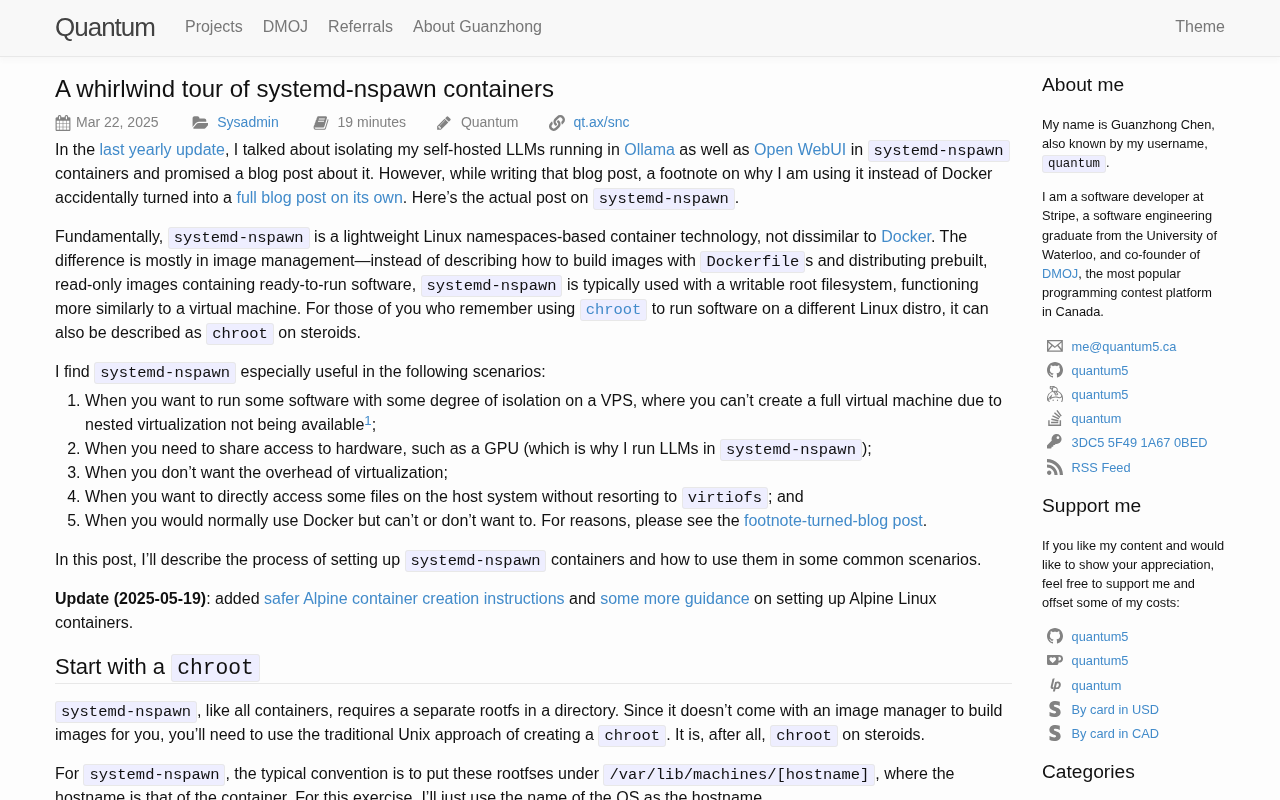
systemd-nspawn Containers at a Glance: A Lightweight Linux Container Solution
systemd-nspawn is a lightweight Linux system container tool bundled with systemd that boots isolated distribution environments without a daemon. This article covers core usage, networking and permission configuration, and compares it with Docker/Podman for suitable scenarios.