AfriNORM: An LLM Benchmark for African Cultural Norm Reasoning
New benchmark AfriNORM reveals blind spots in LLM reasoning about African cultural norms.
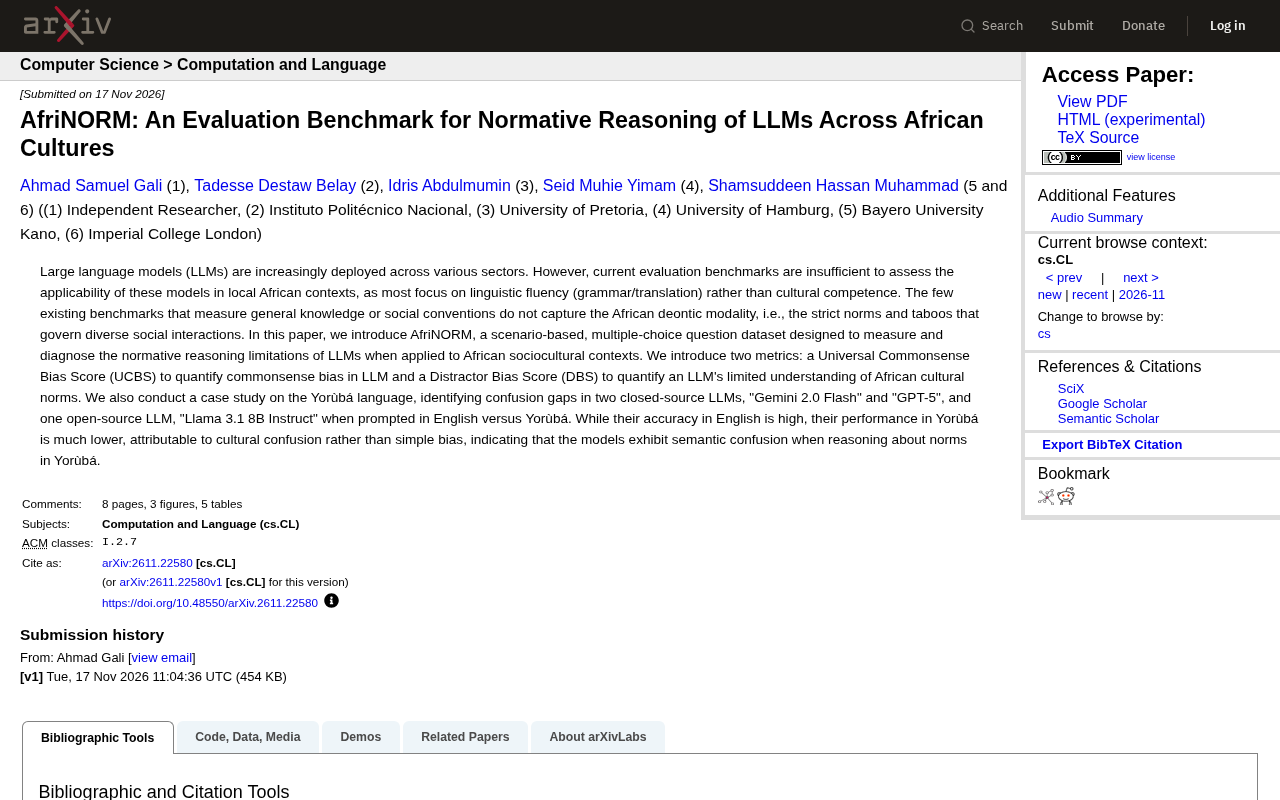
The paper proposes AfriNORM to systematically measure and diagnose LLM normative reasoning in African sociocultural contexts. Existing evaluations focus on language fluency or Western contexts and miss African deontic modality—norms and taboos governing daily interaction. AfriNORM uses scenario-based multiple-choice data and proposes UCBS and DBS metrics for common-sense bias and gaps in African norm understanding. A Yorùbá case testing Gemini 2.0 Flash, GPT-5, and Llama 3.1 8B Instruct finds high English-prompt accuracy but sharp Yorùbá drops due to cultural confusion, not simple bias. This shows fluency is not a proxy for cultural adaptation; deploying in Africa requires cultural-norm evaluation.
Large language models (LLMs) are rapidly moving into real-world applications across African industries, but existing evaluation systems struggle to answer a key question: do these models truly understand local African social norms? A new paper proposes the AfriNORM benchmark, which attempts to systematically measure and diagnose LLMs' shortcomings in norm reasoning within African cultural contexts.
Why Existing Benchmarks Fall Short
The paper points out that most current mainstream LLM benchmarks focus on language fluency—surface-level capabilities such as grammatical correctness and translation quality—rather than cultural competence. The few benchmarks that touch on common sense or social customs tend to default to a Western context and cannot capture deontic modality in African societies, i.e., the strict norms and taboos that govern everyday interaction.
The risk created by this mismatch is practical: a model that performs excellently on grammar tests may give offensive or outright wrong answers to questions involving local African etiquette, taboos, or social hierarchy, and existing metrics are almost blind to this.
Deontic modality is a core concept in linguistics and modal logic, referring to the ways language expresses normative attitudes such as "obligation, permission, and prohibition," typically through modal verbs (such as English must, may, must not) and particles. It is contrasted with epistemic modality, which expresses possibility or necessity. Deontic modality is encoded very differently across languages: English relies mainly on modal verbs, while many African languages express it through verb inflection, tone changes, or dedicated particles. More importantly, which behaviors count as "must" or "taboo" is itself culturally agreed upon, so grammatical form alone cannot determine whether an expression is appropriate. For LLMs, this means the model needs to map linguistic forms to the social norms behind them—precisely the capability that pure language fluency evaluation cannot cover.
AfriNORM's Data Design
AfriNORM uses a scenario-based multiple-choice dataset format, specifically designed to measure and diagnose the limitations of LLMs in normative reasoning within African sociocultural contexts. The purpose of the scenario-based design is that normative judgments rarely exist apart from specific situations; the same behavior may be governed by completely different norms under different relationships and occasions.
The paper also proposes two new metrics:
- Universal Common-sense Bias Score (UCBS): quantifies the degree of common-sense bias present in LLMs;
- Distractor Bias Score (DBS): quantifies the model's insufficient understanding of African cultural norms, revealing its cognitive bias through its tendency to select distractor options.
The division of labor between the two metrics is worth noting: UCBS measures how much the model brings in "universal" premises that may not apply locally, while DBS goes further by pinpointing the model's specific knowledge gaps regarding African norms. This split means the evaluation results are not just an accuracy number, but can indicate which type of cognitive bias the errors come from.
The measurement logic of the Distractor Bias Score (DBS) is built on the option structure of multiple-choice questions. When designing questions, in addition to one correct answer that conforms to local African norms, several distractors are set that appear plausible but actually violate local norms. If the model systematically chooses these distractors, it indicates that it treats norms from other cultural contexts (usually Western common sense) as the correct answer. DBS counts exactly the distribution of the model's choices on distractors, so it not only measures "how many answers are wrong" but also reveals whether the direction of the errors is general cultural misalignment or concentrated in a certain type of norm. In contrast, UCBS focuses on whether the model over-relies on "universal common sense" to answer, still applying a default framework when the scenario requires local knowledge.
The Yorùbá Case: Language Ability Decoupled from Cultural Understanding
The paper conducts a case study on Yorùbá, testing two closed-source models, Gemini 2.0 Flash and GPT-5, as well as one open-source model, Llama 3.1 8B Instruct, comparing their performance under English prompts and Yorùbá prompts respectively.
The results show a clear gap: the models achieve high accuracy under English prompts, but performance drops sharply when switched to Yorùbá. The paper's explanation is key—this decline is not simply insufficient language ability or statistical bias, but cultural confusion: the model experiences semantic-level confusion when reasoning about normative questions in Yorùbá.
This finding challenges the intuition that "translation equals localization." Even if a model has some Yorùbá processing ability, the norm-reasoning patterns it learned in English contexts do not automatically transfer to the Yorùbá cultural framework; instead, misalignment may arise between the two semantic systems.
Cultural confusion here means that the model does not lack Yorùbá vocabulary and syntax, but when performing normative reasoning in Yorùbá, it incorrectly maps semantic associations and judgment patterns learned in English contexts onto Yorùbá expressions. For example, the honorific or taboo meaning carried by a Yorùbá word may not be equivalent to the near-synonymous concept the model learned from English corpora, so the model answers according to the English default framework. This differs from statistical bias in the general sense: the latter arises from group-level tendencies caused by uneven training data distributions, whereas cultural confusion is a mismatch between semantic systems. The paper deliberately distinguishes the two to show that improving Yorùbá language ability itself may not eliminate such errors; evaluation and alignment targeting cultural frameworks are needed.
Implications for Deploying LLMs in Africa
AfriNORM's value is not limited to academic evaluation. For teams planning to deploy LLM applications in African markets, it provides an actionable diagnostic perspective: a model's fluency in the target language cannot serve as a proxy for cultural adaptation.
Multilingual performance tests usually focus on translation and comprehension tasks, whereas AfriNORM points to another layer of capability—making judgments that conform to local norms within a specific cultural framework. The case study covers both closed-source and open-source models, showing that this is not an isolated problem of a particular architecture or training strategy, but a blind spot widely overlooked due to gaps in the current evaluation system.
The paper's limitations are also clear: currently only Yorùbá is used as a case, while the linguistic and cultural diversity of the African continent far exceeds what a single case can cover. But as a starting point for a benchmark framework, AfriNORM's dual-metric approach and scenario-based data design provide a reusable methodology for subsequent expansion to more African cultural contexts.
For developers and researchers concerned with localization quality, a direct actionable recommendation is: introduce tests of cultural norms into multilingual evaluation, rather than relying only on translation or grammar metrics to assess a model's usability in a specific market.
One-line Summary
New benchmark AfriNORM reveals blind spots in LLM reasoning about African cultural norms.
Paragraph Summary
The paper proposes the AfriNORM benchmark to systematically measure and diagnose LLMs' normative reasoning capabilities in African sociocultural contexts. Existing evaluations mostly focus on language fluency or Western contexts and cannot capture African deontic modality—the norms and taboos governing everyday interaction. AfriNORM uses scenario-based multiple-choice data and proposes two metrics, UCBS and DBS, quantifying common-sense bias and insufficient understanding of African norms respectively. The Yorùbá case tests Gemini 2.0 Flash, GPT-5, and Llama 3.1 8B Instruct, finding high accuracy under English prompts but a sharp drop under Yorùbá, caused by cultural confusion rather than simple bias. This shows language fluency cannot be a proxy for cultural adaptation, and deploying in African markets requires evaluation that incorporates cultural norms.
Related articles

Google Gemini 4 Neon Released: Just $3 per Million Tokens as the AI Price War Escalates
Google releases Gemini 4 Neon at just $3 per million input tokens; Tencent open-sources Hy4 Flash; DeepSeek scraps search-crawling fees; Microsoft unveils new image and voice models; NVIDIA halts H200 shipments to China; Citi says no reimbursement for AI-agent fraud losses. Today's hardcore AI news in one read.
DeepSeek Quota Wall Pre-embedded in Code: The 48 Hours of Open-Source Migration Tools and Chat Restrictions
DeepSeek pre-embedded quota limits in frontend code two days early; old chats expire after 72 hours of inactivity on Nov 15, while APIs and client code go open-source the same week. This analysis examines the VRAM pressure and three-way resource contention behind rapid quota depletion, and the user dilemma of "not unwilling to pay, but unable to find where to pay."

Nearly 80K-Star Open Source Project: Use 26 Large Models Locally for Free, Including DeepSeek and GLM
A Bilibili video introduces a nearly 80K-star open source project that lets you use 26 large models locally for free, including DeepSeek and GLM—no registration or API keys needed, plus a local address for other software to connect.