Google Gemini 4 Neon Released: Just $3 per Million Tokens as the AI Price War Escalates
Google, Tencent, DeepSeek, and Microsoft all made moves the same day, as AI competition turns toward cost reduction and open source.
This AI daily roundup centers on "cost reduction" and "open source." Google DeepMind opened Gemini 4 Neon—third globally on the intelligence index—at $3 input and $15 output per million tokens with a 1M context. Tencent Hunyuan open-sourced Hy4 Flash with 224 billion total parameters but only 12 billion activated per token. DeepSeek scrapped search and crawling interface fees. Microsoft's Ignite introduced the Maya Image 2.7 editing model and Mafia Realtime 1 voice model at prices well below competitors, and made Copilot the main Office entry point. OpenAI disclosed its Codex sandbox strategy, Hugging Face showed streaming MoE loading, NVIDIA launched a desktop AI box and confirmed it stopped shipping H200 to China, and banks including Citi said losses from third-party AI financial-agent fraud are borne by users.
The cost-effectiveness threshold for cutting-edge large models is being pushed even lower. Google DeepMind has officially launched Gemini 4 Neon, Tencent Hunyuan has open-sourced the Hy4 Flash family, DeepSeek has scrapped search-crawling fees, and Microsoft and NVIDIA have brought a wave of major updates. Today's AI news is almost entirely about "cutting costs" and "open-sourcing."
Google Gemini 4 Neon: A Double Blow on Performance and Price
Google DeepMind has officially opened up Gemini 4 Neon, focused on fast and stable execution of complex software engineering, office analytics, and scientific research tasks. On the Artificial Analysis Intelligence Index, its highest thinking mode scored 61, ranking third globally and trailing only larger, slower flagship models. On the Wales Index it ranked second with 70.9%, and it took first place in legal research, tax agent, and automated workflow tests.
More practically, it ranked second in controllability in real-world agent evaluations, deviating from instructions less often mid-task, and in internal testing it set Google's lowest "nonsense" ratio. On price: $3 per million input tokens, $15 per million output tokens, cached input as low as $0.15, plus a 1M context window. The model is now available simultaneously to Gemini API enterprise customers and AI Pro and Ultra subscribers. For developers who write code and do document analysis heavily, this pricing is extremely attractive.
On the same day, DeepMind also rolled out a major update to its experimental Project Genie, opening the world model Genie 4 to eligible AI Ultra subscribers for the first time. Users can generate interactive digital worlds in the browser and modify the environment in real time by typing—for example, summoning weather or adding characters—with the system automatically matching adaptive native sound effects. Also launched were a dedicated agent for building scenes through chat and a community gallery supporting one-click remixing. The older Genie 3 also received upgrades including longer drawing durations, foreground anchoring, and continuous scene chaining.
The Artificial Analysis Intelligence Index is a comprehensive capability leaderboard for large models maintained by the third-party evaluation firm Artificial Analysis. It aggregates standardized scores from benchmarks spanning reasoning, coding, math, and knowledge Q&A into a single comparable score, commonly used to compare the overall strength of models from different vendors. The index ranks models in tiers by scale and inference cost, so "third globally" should be understood in light of model size—the top-ranked entries are typically flagship models with more parameters and higher per-inference cost. The Wales Index mentioned in the article is another evaluation focused on specific capability dimensions; the two complement each other and should not be directly converted.
Cached input billing refers to the practice where, when identical prefix content (such as a long system prompt or document context) repeatedly appears in requests, the provider caches that portion of tokens in GPU memory and bills subsequent calls at a steeply discounted rate. Gemini 4 Neon's cached input price is $0.15 per million tokens, just one-twentieth of the regular input price—hugely significant for agent scenarios that repeatedly carry the same long document or codebase, where the actual cost may be far below the nominal unit price.
Tencent Hunyuan Open-Sources Hy4 Flash: The Value Pick of Sparse-Activation Architecture
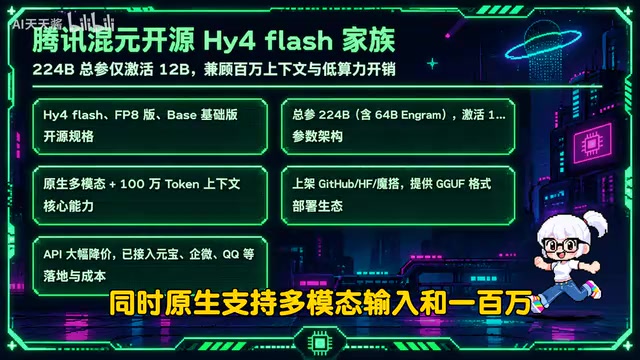
The domestic open-source community has gotten something substantial. Tencent Hunyuan has officially open-sourced the Hy4 Flash family, releasing three variants at once—Standard, FP8-quantized, and Base—all available on GitHub, Hugging Face, ModelScope (Moda), and Gitcode, complete with the community-standard GDF format and license documentation.
Architecturally it uses sparse activation: total parameters of 224 billion (10x 22.4B), including 64 billion Ingram parameters, but only 12 billion parameters are actually activated per token generated. It natively supports multimodal input and a 1M-token ultra-long context, with API pricing significantly lower than the previous Hunyuan 4, and it has already rolled out across Tencent's own products including Yuanbao, WeCom, QQ, and Tencent Cloud. For teams looking for a low-cost, long-context open-source foundation, this is a chance to pull the weights and test them directly.
Sparse activation and the MoE (Mixture of Experts) architecture are key to understanding Hy4 Flash's value. Traditional dense models activate all parameters for every token generated, whereas MoE models split the feed-forward layers into multiple "expert" sub-networks, with a routing mechanism selecting only a few experts per token to participate in computation. So "224 billion total parameters, only 12 billion activated per token" means storage is sized by total parameters, but inference compute and memory bandwidth overhead are sized by activated parameters—exactly why it can support long context at lower cost. The trade-off is that VRAM capacity requirements are still based on total parameters, so deployment still demands a fairly large amount of VRAM.
The FP8-quantized version mentioned in the article refers to compressing model weights from 16-bit floating point to 8-bit floating point, which can nearly halve VRAM usage and boost inference throughput while keeping accuracy loss as controlled as possible. It is a common approach for deploying open-source models on consumer-grade or mid-range inference cards.
DeepSeek Scraps Search-Crawling Fees: Leveling the Playing Field for Web-Enabled Agents
DeepSeekAd has handed developers building web-enabled agents a gift. According to an announcement on its official site, when developers call models through the DeepSeek API and trigger server-side search or web crawling, no separate interface fee will be charged—billing is based only on normal model token usage. Coverage includes its own web tools as well as web search tools compatible with the Anthropic API and the Responses API.
Previously, when this in-house search and crawling interface launched, it was priced at 5 yuan per thousand successful requests; now the barrier to web retrieval is effectively gone. The price war has escalated from pure inference to the toolchain layer. Developers building retrieval-augmented and web-enabled agents can now confidently turn on search, but should be careful to control the body text of crawled pages to avoid a spike in input tokens.
Microsoft Ignite: A Full Overhaul of Image, Voice, and the Office Entry Point
At Ignite, Microsoft unleashed several homegrown trump cards at once. On the image side, it officially launched its next-generation generation and editing models Maya Image 2.7 and a lighter, faster Flash version, along with an interactive canvas. The headline feature is precise local editing—"change exactly what you point at." When changing an object's color, material, or position, the rest of the image stays highly consistent, and both models natively support transparent-background output, saving most of the effort of cutouts for e-commerce product images, icons, and logos.
The benchmark numbers are solid too: Maya Image 2.7 scored 1,215 on the Artificial Analysis image editing leaderboard to take first place, 4 points ahead of GPT Image 2.6, yet costs only $35 per thousand images—about one-fifth of its competitor's cost; the Flash version is as low as $10 per thousand images. It is now in public beta on Microsoft Foundry.
In the voice arena, Microsoft launched its first in-house speech-to-speech model, Mafia Realtime 1, specifically honed for real enterprise call scenarios. It supports being interrupted at any time, waiting for the other party to finish, and accurately understanding requests in noisy environments or even when multiple people talk over each other; for complex tasks it can temporarily call a stronger reasoning engine to connect to enterprise systems for bookings and work orders.
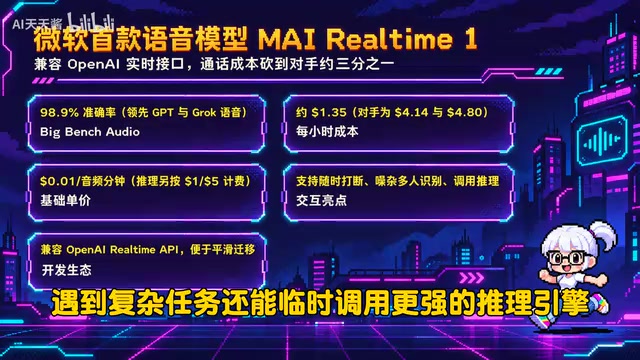
On price, basic voice interaction costs just $0.01 per minute, and it scored 98.9% accuracy on the BigBench Audio benchmark—roughly $1.35 per hour of input audio, while the GPP realtime voice model and Groker voice under the same test both cost just over $4, about two-thirds cheaper. Even better, it is directly compatible with the OpenAI Realtime API, making migration nearly frictionless.
Beyond the underlying models, Microsoft has completely turned Office inside out: previously Copilot was embedded in the software as a sidebar assistant, but now the new Copilot app serves as the main entry point, in turn packing full Word, Excel, and PowerPoint collaborative editing into Copilot. Say a sentence in the chat window and a document, spreadsheet, or presentation is generated directly and opened alongside; users can edit it by hand or keep directing the AI to make changes. All files are saved to OneDrive by default and governed by enterprise compliance controls. Also unveiled were a public preview of Copilot for sales that connects directly to business tools like HubSpot, Notion, and e-signature, and a private preview of Today's Overview that helps ordinary office workers automatically summarize emails, calendars, and meetings.
OpenAI Discloses Codex Sandbox Strategy: Security Boundaries and Coexisting Risks
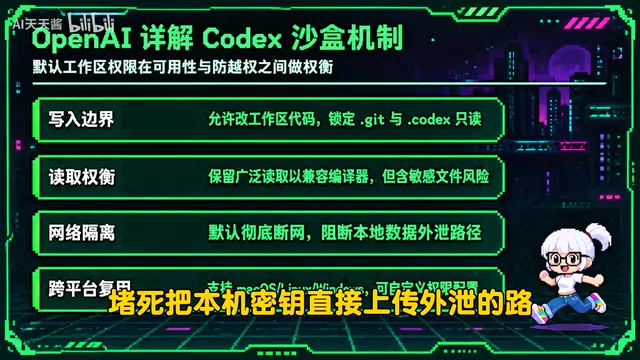
As office work and coding are increasingly handed to agents, how to prevent them from running commands recklessly on your computer has become a top priority. OpenAI published an in-depth technical article breaking down the sandbox boundaries of its coding tool Codex. Under the default workspace-wide configuration, Codex can directly modify files in the code directory, with a pop-up prompt at each step, but the Git directory and its own configuration directory are locked as read-only to prevent the agent from secretly rewriting commit hooks or tampering with its own rules.
To avoid breaking the local compiler and dependency libraries, Codex retains fairly broad read access to system files, but as a counterbalance, it is fully disconnected from the network by default, closing off the path for directly uploading and leaking local keys. This strategy covers macOS, Linux, and Windows, supports per-task custom configuration, and can even be reused in your own tools.
However, the company admits that the sandbox is not a silver bullet—malicious code can still be written into local files. When running Codex day to day, don't casually grant it full network and full-disk write permissions; you have to hold the security bottom line yourself.
An agent sandbox is an isolation mechanism that restricts process privileges at the operating system level; common techniques include file system read/write allowlists, network namespace isolation, and system call filtering (such as macOS's sandbox-exec, Linux's seccomp/landlock, and Windows's AppContainer). For coding agents, the core tension the sandbox must resolve is the "capability vs. security trade-off": too narrow permissions mean it can't compile or install dependencies, while too broad permissions may be exploited through prompt injection attacks to execute malicious commands or leak keys. The "default network disconnection" in the article is precisely the key link that cuts off data exfiltration channels, since most key leaks rely on network transmission; and the "read-only Git directory" prevents the agent from tampering with commit hooks to plant backdoors in subsequent legitimate commits.
Local Large-Model Breakthroughs: Streaming MoE Loading and NVIDIA's Desktop AI Box
The official Hugging Face blog showcased an extreme efficiency hack: using a laptop with 32GB of unified memory or a consumer-grade GPU to stream mixture-of-experts model weights directly from an SSD, running a MoE model with up to 180 billion parameters. The core idea leverages the fact that MoE uses only a small subset of experts per inference: keep hot experts in VRAM, place cold experts in system memory or even on disk, and stream them in on demand. After targeted optimization, the Transformers engine's generation speed has come within 6% of the dedicated engine Stratta, solving the problem of traditional offloading methods thrashing back and forth between disk and memory. The author is honest that a speed of a dozen or so tokens per second is still slow for running high-frequency coding agents, but for enthusiasts who want to tinker with extremely large open-source models on a thin-and-light laptop, this streaming approach is worth copying from the repo.
NVIDIA, meanwhile, has brought a ready-made desktop local AI solution to the table. Compact desktop machines powered by the RTX Spark platform go on sale first from ASUS, Dell, and MSI, with Gigabyte, HP, and a Microsoft Surface dev box to follow. This little box packs a 20-core Grace processor, a Blackwell RTX GPU with 6,144 cores, up to 128GB of unified memory, and a 10-gigabit Ethernet port, delivering up to 10 million AI operations per second. The officially pitched uses are running a personal AI agent locally around the clock, doing model fine-tuning, directly driving 120-billion-parameter large language models, and casually rendering massive 3D scenes—eliminating both the pay-as-you-go cloud bill and concerns about code leaking out.
Streaming MoE loading rests on the core premise of "access locality arising from expert sparsity": the sets of experts activated by different tokens vary widely, but under a given task distribution, a small number of experts will be hit with high frequency. The streaming approach therefore establishes a tiered caching strategy—hot experts reside permanently in VRAM (GPU/unified memory), warm experts stay in system memory, and cold experts stay on the SSD, prefetched on demand. The difficulty lies in prefetch timing and bandwidth bottlenecks: if predictions are inaccurate, "thrashing" occurs—weights being shuttled frequently back and forth between disk and memory, which actually slows things down. The "unified memory" mentioned in the article refers to an architecture where the CPU and GPU share the same address space (such as Apple's M series and some APUs); it eliminates explicit copy overhead and is one of the preconditions for streaming large models on a laptop.
NVIDIA Stops Shipping H200 to China: The Compute Supply Chain Shifts
According to The Verge, NVIDIA's interim CEO Colette Kress officially confirmed on the earnings call that the company's latest guidance no longer includes any Hopper-architecture data center products in shipment batches, and that it has stopped shipping AI chips such as the H200 to China. The report noted that former CEO Jensen Huang resigned last week after having pushed hard for U.S. export licenses. And earlier this month, foreign media reported that about 600,000 H200 chips were stranded in Hong Kong awaiting import approval. Now company executives have laid their cards on the table about the halt, without saying whether China-related business will continue to be pursued in the future.

For domestic large-model vendors and the compute rental market, this means no more counting on overseas special-edition cards to restock in the short term—domestic compute and the pace of inference adaptation for open-source models will have to keep being pushed to the max.
Citi and Other Banks Make Clear: No Reimbursement for Fraud Losses Involving AI Financial Agents
According to TechCrunch, Citibank, the third-largest U.S. commercial bank, updated its online user agreement this week, and PNC, the eighth-largest bank, along with Citizens, followed with notices making clear to customers: as soon as you hand your bank account credentials or access permissions to a third-party AI financial agent—whether the AI itself slips up and transfers the wrong amount, or the third-party tool is breached by hackers and the account is fraudulently drained—the bank will not cover it, and all losses are borne by the user. JPMorgan Chase and Bank of America had already issued similar policies, with only the banks' own AI tools exempt from additional liability. This also explains why Anthropic emphasized when it launched a personal finance tool earlier this month that it only provides guidance and never touches your money. When trying out various AI agents that claim to automatically manage money and pay bills, don't take the easy route and hand over your online banking credentials and transaction permissions—if something goes wrong, no one will pay for it.
One-line Summary
Google, Tencent, DeepSeek, and Microsoft all made moves on the same day, as AI competition shifts toward cost reduction and open source.
Paragraph Summary
This AI daily roundup focuses on two main themes: "cost reduction" and "open source." Google DeepMind opened up Gemini 4 Neon, ranked third globally on the intelligence index, at $3 input and $15 output per million tokens with a 1M context window; Tencent Hunyuan open-sourced the Hy4 Flash family, with 224 billion total parameters but only 12 billion activated per token, plus native multimodality and 1M context; DeepSeek scrapped interface fees for web search and page crawling, billing only by tokens. Microsoft's Ignite conference introduced the Maya Image 2.7 image editing model and the Mafia Realtime 1 voice model, both significantly cheaper than competitors, and upgraded Copilot into the main entry point for Office. In addition, OpenAI disclosed its Codex sandbox strategy, Hugging Face demonstrated a streaming MoE loading approach, NVIDIA launched a desktop AI box and confirmed it would stop shipping H200 to China, and banks including Citi made clear that losses from fraud involving third-party AI financial agents are borne by users.
Related articles

Gemini 4 Neon Released: Tops Coding Benchmarks, Gemini 4 World Model Opens Up
Google releases Gemini 4 Neon, topping the coding agent index with million-token context; Gemini 4 world model opens Project Genie; DeepSeek web search goes free; Microsoft unveils an on-device Windows small model; the White House discusses requiring US companies to disclose whether they use Chinese open-source models.
DeepSeek Quota Wall Pre-embedded in Code: The 48 Hours of Open-Source Migration Tools and Chat Restrictions
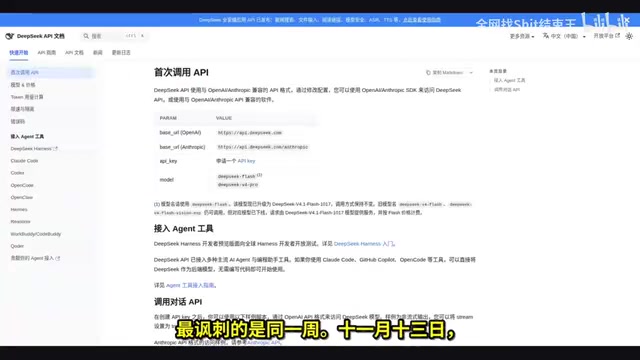
DeepSeek pre-embedded quota limits in frontend code two days early; old chats expire after 72 hours of inactivity on Nov 15, while APIs and client code go open-source the same week. This analysis examines the VRAM pressure and three-way resource contention behind rapid quota depletion, and the user dilemma of "not unwilling to pay, but unable to find where to pay."
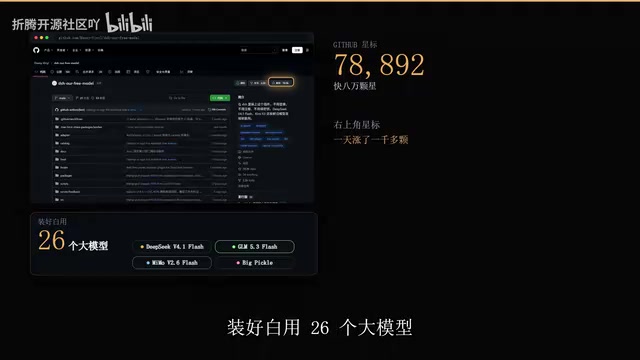
Nearly 80K-Star Open Source Project: Use 26 Large Models Locally for Free, Including DeepSeek and GLM
A Bilibili video introduces a nearly 80K-star open source project that lets you use 26 large models locally for free, including DeepSeek and GLM—no registration or API keys needed, plus a local address for other software to connect.