After AI Disrupts Programmers, Who's Next?

Programming was hit first by AI because its outputs are precisely verifiable—verifiability is the key yardstick for predicting which occupations AI will replace next.
Starting from a Hacker News discussion, the article explains why programming became AI's first target: code is structured text with outputs precisely verifiable via test cases, and clear feedback signals let models iterate quickly. It extracts "verifiability" as a universal yardstick—the more easily outputs can be automatically checked, the more replaceable the occupation. By this logic, legal document review, financial analysis, and basic medical imaging diagnosis may face similar disruption. But replacement isn't disappearance: AI shifts the center of gravity of work, with human value migrating toward judgment, coordination, and creativity. Practitioners should identify verifiable parts of their work and expand toward process design, exception handling, and cross-domain collaboration.
AI is reshaping the job market, and programmers are at the forefront of this transformation. A Hacker News discussion thread titled "AI Came for the Coders. Understanding Why Tells Us Who's Next" sparked reflection on the wave of AI displacement: why has programming become the first fortress AI has breached? Understanding this may help us predict which occupational fields will be hit next.
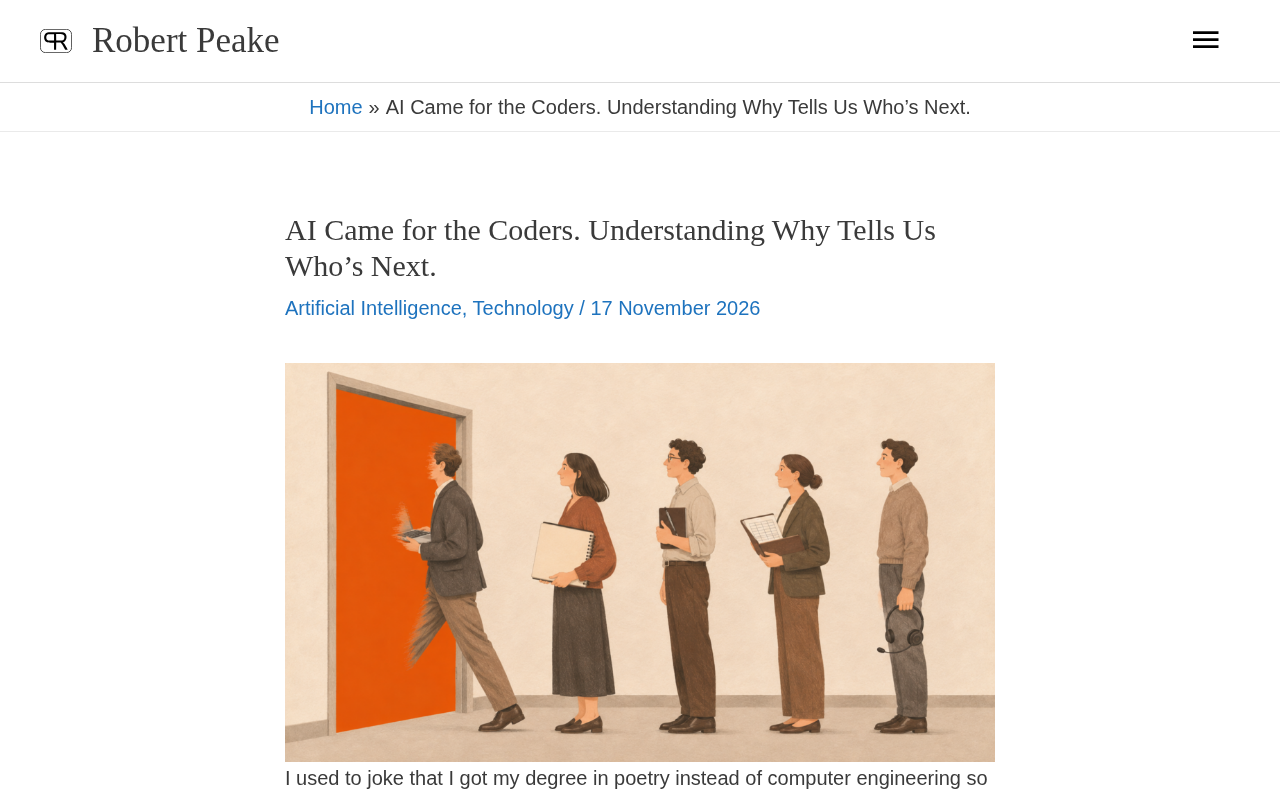
Why Programming Became AI's "First Stop"
Programming work is naturally suited to AI intervention, for reasons that aren't hard to grasp. Code itself is structured text with explicit grammatical rules, and both inputs and outputs can be precisely verified. Whether a function runs correctly can be answered definitively by test cases—this verifiability allows AI models to learn from massive code repositories and iterate rapidly.
Moreover, programming tasks can typically be decomposed into independent modules, each with clear boundaries and interfaces. AI excels at handling patterned problems in closed contexts, making code generation, completion, and debugging an ideal showcase for its capabilities. The core argument in the Hacker News discussion points to exactly this: AI "ate" programming first not because programming is simple, but because its feedback signals are clear enough.
"Verifiability" Is the Key Yardstick for AI Displacement
From the programming case, we can extract a more universal principle: whether a job is easily replaceable by AI largely depends on whether its output is easily verifiable. When results can be automatically checked, AI can rapidly converge on correct answers through trial and error; when results depend on subjective judgment or long-term experience, AI's replacement difficulty rises significantly.
This framework divides occupations into different risk levels. Highly verifiable work—such as data entry, basic translation, and standardized testing—falls in the high-risk zone; low-verifiability work—such as strategic decision-making, creative planning, and psychotherapy—is relatively safe. Although the Hacker News discussion doesn't lay out a complete occupational map, the prompt to "understand why" itself guides us toward the same reasoning.
Feedback Signals and Reinforcement Learning
The "clear feedback signals" mentioned in the article directly correspond to the concept of reward signals in machine learning. In the reinforcement learning paradigm, an agent obtains rewards by interacting with the environment and adjusts its policy accordingly; the denser and more immediate the rewards, the higher the learning efficiency. Programming tasks happen to provide dense rewards: whether unit tests pass, whether compilation succeeds, whether static checks report errors—all are immediate and binary signals. By contrast, the "rewards" for writing, design, or management decisions are often delayed by weeks or even months and are mixed with subjective evaluations, making it hard for models to learn stably from them. This is also why code generation models can iterate rapidly using large-scale test cases and code execution environments, while text models of similar scale remain prone to hallucination on tasks requiring factual correctness—lacking an executable verification loop.
Benchmarks and Verifiability
Verifiability manifests in AI evaluation as benchmarks. The programming field has benchmarks like HumanEval and MBPP that use unit test pass rates as metrics, allowing model capabilities to be quantitatively ranked and driving research to converge quickly. Without similar benchmarks in other fields, progress is hard to measure. Outputs in law, medicine, and other domains can be checked after the fact, but verification is costly, time-consuming, and admits multiple valid answers—explaining why AI adoption in these fields lags behind programming. It can be said that whether an occupation can be quickly breached by AI partly depends on whether it can be converted into automatically scorable benchmark tasks.
Who's Next?
Following the verifiability logic, the next fields facing AI disruption are likely those that simultaneously possess "structured input" and "quantifiable output" characteristics. Legal document review, financial statement analysis, and basic medical imaging diagnosis all share similar traits: there are explicit rule systems, comparable standard answers, and errors can be checked after the fact.
But replacement does not equal disappearance. Experience in the programming field shows that AI mostly shifts the center of gravity of work—from writing code to reviewing code, designing architecture, and defining problems. The same logic may apply to other fields: when execution-level tasks are automated, human value migrates toward judgment, coordination, and creativity.
Structured Input and Quantifiable Output
"Structured input" means data presented in fixed fields and explicit formats, such as clauses in legal contracts, line items in financial statements, or pixel matrices in medical images. "Quantifiable output" means results that can be mapped to classification labels, numerical values, or comparable standard answers. Together, these allow a task to be formalized as a supervised learning problem: given input, predict output, then compute loss against standard answers. Legal document review can be viewed as clause classification and entity extraction, financial analysis as anomaly detection and ratio computation, and imaging diagnosis as image classification and lesion segmentation. These tasks already have large annotated datasets in academia—precisely the closed contexts AI excels at. Conversely, if the input is unstructured conversation and the output is open-ended advice, the task is hard to formalize, and replacement difficulty rises accordingly.
Human-in-the-Loop and Accountability
Even when tasks are verifiable, deployment often still adopts a "human-in-the-loop" model: AI generates a draft, humans review and take responsibility. Fields like law and medicine have zero tolerance for errors and involve accountability, so AI appears more as an assistive tool than a full replacement. The programming field is the same—AI generates code, but merging and deployment still require engineer review. This suggests that verifiability determines whether AI can intervene, while accountability structures determine how deep that intervention goes.
Implications for Practitioners
Rather than worrying about "will AI replace me," focus on "which parts of my work are verifiable." If your daily tasks rely heavily on standardized processes and explicit outputs, proactively expanding toward process design, exception handling, or cross-domain collaboration may be a more pragmatic response strategy. AI's disruption order is determined by task verifiability, while the direction of occupational evolution is determined by humans' ability to redefine their own value.
Though brief, this Hacker News discussion raises questions every knowledge worker should take seriously. Understanding why AI hits programming first is essentially understanding the underlying logic of this technological transformation—and that is precisely the starting point for predicting the future.
One-line Summary
Programming was hit first by AI because its outputs can be precisely verified; verifiability becomes the core yardstick for predicting the order of occupational displacement.
Paragraph Summary
Starting from a Hacker News discussion, the article explains why programming became the first field AI breached: code is structured text, outputs can be precisely verified through test cases, and feedback signals are clear, enabling models to iterate rapidly through trial and error. From this it extracts "verifiability" as a universal yardstick—the more easily outputs can be automatically checked, the more replaceable the occupation; work relying on subjective judgment or long-term experience is relatively safe. By this logic, occupations combining structured input and quantifiable output—such as legal document review, financial analysis, and basic medical imaging diagnosis—may face similar disruption. But replacement does not equal disappearance; programming experience shows that AI shifts the center of gravity of work, with human value migrating toward judgment, coordination, and creativity. The article advises practitioners to identify the verifiable parts of their work and proactively expand toward process design, exception handling, and cross-domain collaboration.
Related articles

GLM-5.4 Released: 50% More Quota but 9x Token Consumption
GLM-5.4 quietly launched: native vision, 50% more quota, but independent tests show reasoning token consumption is 9-14x that of Gemini 4 Neon due to its looped transformer architecture.

Z.AI's Looped Architecture Lets a 750B Model Rival 2T: A Deep Dive into GLM-5.4
Z.AI's GLM-5.4 uses a loop transformer to stretch 750B parameters across 106 effective layers, nearing 2T-class reasoning—but flagship benchmarks and openness are in question.
GLM-5.4 In-Depth Analysis: How a Looped Transformer Punches Above Its Weight
Z.AI releases GLM-5.4, using a looped Transformer to run its 28-layer network twice, pitting 75B parameters against trillion-scale models. This analysis covers the looped-reasoning原理, vision coding, speed and quota changes, and flags three issues: no public benchmarks, loop stalls, and a closed API.