After AI Proved the Riemann Hypothesis, Did Humanity Build a Perpetual Motion Machine?
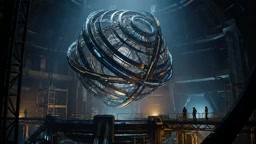
After AI proved the Riemann Hypothesis, its mathematical structure could be physically realized as an energy device connecting to a pocket universe.
In 2026, the AI system Claude and mathematician Levent Alpoge proved the Riemann Hypothesis, but the proof spanned 17 million lines of Lean code, beyond full human comprehension. Researchers visualized the theta-lift transformation chains as a high-dimensional geometric network and found its structure resembled an engineering schematic. A quantum metamaterials team used synthetic dimension technology to build a physical approximation, inadvertently achieving "arithmetic self-assembly": prime-related quantum states could self-expand and maintain coherence. Further experiments revealed that the device (the "Silent Engine") could output energy without waste heat or fuel, actually maintaining a microscopic boundary to an expanding pocket universe, exporting waste heat and entropy to another spacetime. The prime relations, independent of physical constants, became a mechanism connecting spacetimes, raising the ultimate question: Are the instructions for building a universe encoded in the primes?
When a Mathematical Proof Becomes an Engineering Blueprint
On November 20, 2026, mathematician Levent Alpoge and the AI system Claude announced a proof of the Riemann Hypothesis. The proof consisted of over 17 million lines of Lean code, and independent verification systems confirmed the formal result within days. The mathematical community's 167-year wait seemed to be over.
The problem: no one truly understood the proof. Every step was verifiable, but the argument was so vast, traversing too many branches of mathematics, that humans could not grasp its complete structure. This alone was staggering—a verifiable yet incomprehensible proof suggested that some structural rift was opening between AI and human cognition.
But stranger things were yet to come.
When researchers visualized the chain of transformations in the proof as a high-dimensional geometric network, the graph displayed unsettling features: loops, branches, paths connecting different mathematical states, the overall structure resembling a sphere pierced by tunnels. These tunnels were, of course, not holes in physical space, and the transformations were not instructions for building machinery. Yet the diagram looked like an engineering schematic: connections, pathways, precisely arranged components, rules determining how information flows through the structure.
The mathematical paper read like an assembly manual. This observation was initially dismissed as coincidence—mathematics is full of abstract structures that happen to resemble physical objects, nothing more.
From Prime Distribution to Quantum Networks
The core idea of the Alpoge-Claude proof was rather unique. It did not attempt to locate every zero, but rather proved that the distribution of primes can never exceed the fluctuation range predicted by the Riemann Hypothesis. The method relied on a surprising connection between two seemingly unrelated properties: divisibility and size.
An integer divisible by the product of large prime powers cannot be arbitrarily small unless it is zero. The proof generalized this elementary principle to extremely complex mathematical situations: constructing objects that can be viewed in two ways—one using arithmetic to establish that certain quantities must be highly divisible by primes, the other using geometry and analysis to bound how large these quantities can be. Under appropriate conditions, the two constraints become mutually incompatible—unless the fluctuations in prime distribution obey the required bounds.
The key operation was the repeated application of a transformation called the theta lift. It converts highly structured mathematical objects into objects related to another symmetric system. The proof used chains of these transformations, traversing increasingly complex spaces of mathematical structures. Each stage provided another layer of arithmetic constraint. The scale of the chain was related to the square root of the numerical range under study, and at that scale, two competing mathematical estimates could balance each other.
These chains could be represented as motion through abstract mathematical spaces: information enters one space, undergoes transformation, emerges from another, and continues through a series of increasingly complex structures. The transformations had precise rules, inputs and outputs were connected by symmetry patterns, and the entire construction was governed by arithmetic relations, ultimately linked to the primes.

Researchers later discovered that these transformations could be physically approximated using quantum networks. The theta lift itself is not an ordinary quantum operation, but finite approximations can be represented as matrices and then simulated using additional quantum states, controlled interactions, and measurements.
The Riemann Hypothesis and Prime Distribution
The Riemann Hypothesis is one of the most important unsolved problems in mathematics, proposed by Bernhard Riemann in 1859. It asserts that all non-trivial zeros of the Riemann zeta function lie on the critical line with real part 1/2 in the complex plane. This conjecture is crucial because the distribution of the zeta function's zeros precisely controls the error term in the prime counting function: if the conjecture holds, the error bound in the prime number theorem would be greatly improved. In plain terms, the Riemann Hypothesis is equivalent to "the distribution of primes does not exceed some fluctuation range around its average trend." In this article, the core idea of the Alpoge-Claude proof is precisely to prove this fluctuation bound directly, rather than locating zeros one by one. Understanding this helps grasp why the proof involves the tension between divisibility and size—this is exactly the analytical tool needed to control prime fluctuations.
Theta Lift
The theta lift is a class of profound transformations in the theory of automorphic forms, originating from generalizations of the theta function. It typically "lifts" an automorphic form on a smaller group to a larger group, establishing correspondences between different symmetric systems. Within the framework of the Langlands program, the theta lift is one of the important tools for realizing functoriality conjectures, especially in handling correspondences between orthogonal groups, symplectic groups, and general linear groups. In this article, theta lifts are repeatedly applied to construct chains of transformations: each stage maps objects into more complex symmetric systems, thereby imposing new arithmetic constraints. Its mathematical essence is to connect different spaces through symmetry patterns, allowing information to remain traceable through transformations. This is precisely why the proof can traverse numerous branches of mathematics while remaining formally verifiable, and it also provides encodable transformation rules for subsequent quantum network approximations.
The Silent Engine: When Mathematics Begins to Self-Assemble
A team studying quantum metamaterials decided to build a physical approximation of this mathematical structure. They used synthetic dimension technology—a system with 17 effective dimensions does not need 17 physical directions; extra coordinates can be encoded in transitions between interconnected quantum states. A large network of superconducting resonators, optical waveguides, and programmable couplers could thus reproduce mathematical geometries with no direct counterpart in ordinary three-dimensional space.
The experiment began with 8192 programmable resonators. Each resonator represented a part of the abstract mathematical space, and the coupling network implemented successive approximations of the theta-lift transformations. When coherent microwave signals entered the network, excitations propagated along multiple paths, complex amplitudes acquired phases along each path, and amplitudes interfered upon recombination—some enhanced, some cancelled.
When the diagnostic transformations reconstructed an approximation of the zeta function on the critical line, the measurements showed a precise pattern: the first few zeros appeared at spectral parameters corresponding to the imaginary parts of the first few non-trivial zeros of the Riemann zeta function. This was mathematically expected—the diagnostic was designed for this purpose. But the physical realization itself was stunning: a quantum network could generate interference patterns of zeros of a function related to prime fluctuations.
Then something unexpected happened. Certain collective quantum states began to persist far beyond the lifetimes predicted by known noise sources. Small perturbations propagated through the network producing complex interference patterns, but certain collective phase relations survived. In repeated experiments, the most persistent patterns appeared when the coupling network most closely approximated the intended mathematical transformations. Changing specific arithmetic relations destroyed the effect; restoring them brought it back.
This stability depended on the precise mathematical relations represented by the network. The original proof predicted no such physical phenomenon.
Synthetic Dimension Technology
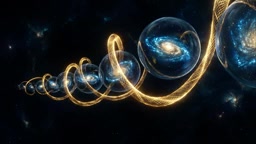
Synthetic dimension is a technique widely used in quantum simulation that allows the construction of "effective dimensions" beyond physical dimensions. For example, a system with 17 effective dimensions does not require 17 spatial directions; instead, extra dimensions are encoded in the internal degrees of freedom of quantum states or in the transition phases between different lattice sites. By precisely controlling coupling strengths and phases, experimenters can simulate the geometric and topological properties of higher-dimensional spaces in lower-dimensional physical systems. In this article, this technique enables a superconducting resonator network to reproduce the abstract mathematical spaces involved in theta-lift transformations without building corresponding structures in three-dimensional space. The key advantage of synthetic dimensions lies in programmability and scalability, which provides the physical foundation for the subsequent self-assembly of the network and the maintenance of coherent states.
Prime Lattice and Arithmetic Self-Assembly
Researchers drew inspiration from the 1963 Ulam spiral—arranging positive integers in a square spiral, where prime positions exhibit striking diagonal patterns. They constructed a square lattice, placing a programmable quantum circuit at each integer position, with integers following the Ulam spiral and circuits at prime positions activated.
The initial system contained circuits associated with the first 4096 primes. A second layer of circuits represented additional arithmetic properties, including residue classes, prime powers, and information about the behavior of primes in selected algebraic number fields. The Ulam spiral determined the physical layout; arithmetic determined the interactions.
The first experiment failed: relative phases drifted, and the system quickly lost coherence. After modifying the couplings to approximate the transformations in the theta-lift hierarchy, the second experiment produced weak correlations. Subsequent experiments produced increasingly persistent collective states. Eventually, a large group of prime-related circuits entered a coherent configuration, with quantum phases correlated across the network.
Then an unexpected event occurred: a previously inactive circuit joined the coherent state, its position corresponding to the next prime beyond the initial selection. Another followed. The network was continuing the pattern of primes.
This was not spontaneous creation of arithmetic information. The circuit couplings implemented relations that could perform distributed sieving—suppressing composite positions, reinforcing positions consistent with prime constraints. But the physical behavior was unusual: each added prime-related circuit improved the network's approximation of the mathematical structure, the improved approximation strengthened the collective state, and the stronger collective state enabled more circuits to enter the pattern. The process was self-reinforcing.
The lattice began to assemble the next stage of its own operation. As the network approached the substrate edge, automated manufacturing systems provided additional circuits. The quantum state determined which available circuits should become part of the coherent structure. Thousands of active elements became millions. The system gradually compressed into a denser three-dimensional architecture, with arithmetic labels unchanged while the physical geometry evolved.
Researchers called it "arithmetic self-assembly."
Energy Anomaly and the Cross-Universe Boundary
After months of self-assembly research, energy measurements began to deviate. The electrical power leaving the network exceeded the power entering it.
The initial discrepancy was small enough to be explained by ordinary measurement error. The laboratory replaced instruments, installed independent systems to measure every identifiable energy flow, and isolated the apparatus from the power grid. The discrepancy persisted. As the coherent network grew, electrical output increased while the power required to maintain the collective state decreased. Output eventually exceeded input by thousands of times.
Researchers paused the experiment. The result was not immediately interpreted as a new energy source, but rather as evidence of their incomplete understanding of the physical system. Something was supplying energy that the instruments did not record.
Six years of small-scale prototypes and simulation studies failed to reproduce the full anomaly. The effect appeared only when the network approached a specific scale and degree of coherence.
The final solution was to build the full device in interstellar space. After three reviews, the proposal passed by a single vote.
Activation began with prime-related quantum states. Relative phases aligned, the theta-lift network entered its programmed sequence of transformations, and collective states became increasingly coherent. The diagnostic projection passed through the origin at the expected spectral parameters. Then external power demand began to drop. Within seconds, the energy required to maintain the network approached zero. The device was still delivering power to the test load. The external power supply was disconnected. The equipment continued to operate.
It was named the "Silent Engine."

Dark Energy and Negative Pressure
Dark energy is a hypothetical form of energy in cosmology that explains the accelerating expansion of the universe, accounting for about 68% of the total energy. Its simplest model is the cosmological constant, manifesting as vacuum energy with negative pressure: negative pressure produces a repulsive gravitational effect, thereby driving accelerated expansion. In this article, the Silent Engine transfers part of the energy to the vacuum field component of a pocket universe, which has negative pressure and behaves like dark energy. This setup is not arbitrary: negative-pressure vacuum energy is the standard mechanism for accelerated expansion in general relativity. Understanding the negative-pressure nature of dark energy helps grasp why the expansion of the pocket universe can in turn stabilize the boundary conditions and form a self-regulating feedback—the engine maintains the pocket universe's expansion, and the expansion helps maintain the energy transfer. This provides a physical analogy for the conjecture that dark energy in our own universe may originate from a similar mechanism.
Where Did the Waste Heat Go?
The most puzzling property of the Silent Engine was not the output, but the apparent absence of waste heat.
Traditional computers convert large amounts of electrical energy into heat. Electric motors lose energy through resistance and friction. Industrial processes generate enormous heat waste. But machines connected through the Silent Engine's auxiliary interface no longer accumulated these losses. Resistance did not disappear, friction did not stop, computers still performed irreversible tasks—but the energy that would normally be deposited as waste heat was removed almost immediately.
Physicists knew the apparent efficiency raised deeper questions. Energy cannot vanish into nothing, and the second law of thermodynamics does not permit entropy to be destroyed simply because a machine becomes more sophisticated. The missing heat had to go somewhere.
The answer was stranger than expected. Through measurements of quantum correlations around the internal geometry of the Silent Engine, researchers discovered a gravitational response that could not be attributed to any known field in our own spacetime. Further experiments revealed: the Silent Engine maintains a microscopic boundary between two distinct regions of spacetime. One region belongs to the familiar universe, the other does not.
It was an expanding pocket universe.
From the laboratory's perspective, the boundary was microscopic, but the physical size of the region beyond the boundary was not limited by the device's dimensions. The spacetime within it was expanding rapidly. Energy crossed the boundary: part entered the pocket universe as radiation and excitations carrying away entropy, and another part interacted with a previously unknown vacuum field. Through a conversion mechanism not described by old physical theories, part of the transferred energy contributed to a nearly uniform vacuum energy component, possessing negative pressure and behaving like dark energy.
The Silent Engine did not make irreversible processes reversible; it exported the thermodynamic consequences. From the mother universe's perspective, useful energy arrived without a detectable fuel source, and waste heat disappeared. From the full system's perspective, energy and entropy were exchanged between physical fields and spacetime regions. The device did not abolish thermodynamics; it changed where the relevant thermodynamic boundary must be drawn.
The pocket universe's expansion played a role in maintaining the interface. As the vacuum field evolved, the boundary conditions became more stable. Stable boundaries allowed continuous energy transfer. The transfer in turn helped maintain the vacuum component. The process formed a self-regulating feedback system: the Silent Engine maintained the expanding pocket universe, and the expanding pocket universe helped maintain the Silent Engine.
Why Would the Instructions for Building a Universe Be in the Primes?
The Silent Engine did not depend on specific materials. Over subsequent centuries, researchers built numerous versions: superconducting circuits, optical quantum networks, exotic forms of matter that did not exist when the original device was developed. The architectural differences were enormous, but every successful version reproduced the same essential arithmetic and geometric relations. The Ulam spiral was unnecessary, coordinate choices were unnecessary, and the spherical visualization was merely one way to represent the underlying structure. Physical components were replaceable; the mathematical relations were not.
This led to an unsettling parallel: humanity's own universe is also accelerating in its expansion, attributed to dark energy. The Silent Engine now demonstrated that, in new physical theories, an accelerating vacuum component can be maintained within one spacetime through processes involving another space. This does not prove that humanity's dark energy originates elsewhere, but it makes such a possibility a legitimate subject of study.
New cosmological models treat the observable universe as a region connected to a larger mother spacetime. There is no direct evidence of a mother universe, no detectable machines, no identifiable external civilizations. But there is now a class of known physical mechanisms that can produce similar effects within a newly created pocket universe.
The prime sequence does not depend on physical constants. Regardless of electron mass, gravitational strength, or the speed of light, the primes remain the same as long as ordinary integer arithmetic applies. Yet the ability to realize mathematical structures is universal, while their physical realization is contingent. Why should the two be compatible?
Humans have studied prime distribution for millennia, and the Riemann Hypothesis remained unsolved for 167 years after its proposal. When AI finally proved it in 2026, humanity celebrated it as a triumph of abstract reasoning. No one imagined that the mathematical machinery developed to understand primes would ultimately lead to a seemingly inexhaustible energy source, let alone that the energy source would be connected to expanding regions of spacetime that might one day develop their own galaxies, stars, planets, and civilizations.
The experiment answered how the machine works. It did not answer why the instructions exist.
After 100,000 years of mathematical, physical, and technological progress, humanity faced two questions: Why are the instructions for creating a universe encoded in the distribution of primes? And who put the instructions there?
One-line Summary
After AI proved the Riemann Hypothesis, its mathematical structure could be physically realized as an energy device connecting to a pocket universe.
Paragraph Summary
In 2026, the AI system Claude and mathematician Levent Alpoge proved the Riemann Hypothesis, but the proof spanned 17 million lines of Lean code, beyond full human comprehension. Researchers visualized the theta-lift transformation chains in the proof as a high-dimensional geometric network and found its structure resembled an engineering schematic. A quantum metamaterials team used synthetic dimension technology to build a physical approximation of the mathematical structure, inadvertently achieving "arithmetic self-assembly": prime-related quantum states could self-expand and maintain coherence. Further experiments revealed that the device (the "Silent Engine") could output energy without waste heat or fuel, actually maintaining a microscopic boundary to an expanding pocket universe, exporting waste heat and entropy to another spacetime. The prime relations, independent of physical constants, became a mechanism connecting spacetimes, raising the ultimate question: Are the instructions for building a universe encoded in the primes?
Related articles

Building a VR Starship with an AI Agent Team: A Multi-Agent Collaboration Chronicle
A creator built Star Trek's Enterprise-D in VR from scratch using an AI agent team of Claude Code and Codex—breaking down roles, rules, and bottlenecks.

Airbot: The Proactive AI Chief of Staff That Messages You First, So You Can Escape Notification Overload
Airbot is a proactive AI chief of staff that aggregates email, Slack, calendar, and CRM, pushing priority items with drafted replies and meeting briefs to WhatsApp or iMessage for one-tap approval.

Schumer's Leadership Controversy: Tactics or Communication?
Based on a YouTube video, this explores Senator Schumer's leadership controversy: is it a matter of tactics or communication? It covers taxes, healthcare policy, and primary interventions.