Building a VR Starship with an AI Agent Team: A Multi-Agent Collaboration Chronicle
An AI agent team built the Enterprise-D in VR, revealing multi-agent engineering details and bottlenecks.
A creator used multiple AI agents to build Star Trek's Enterprise-D in VR from scratch, no manual modeling or coding. Because a single agent loses the thread in long conversations, tasks were split among a coordinator, room-based workers, and an image-only reviewer, governed by three hard rules: blind review with a double-eight threshold, locked serial heavy tasks, and human-only merging. The creator found the reviewer's checklist more actionable than scores. Context fragmentation forced the human to act as a message bus, prompting a move to shared room context. The bridge remains on hold at 5 and 3. Agents are replaceable; context is not.
Title
Building a VR Starship with an AI Agent Team: A Multi-Agent Collaboration Chronicle
Meta Description
A creator used an AI agent team of Claude Code and Codex to build the Enterprise-D from Star Trek in VR from scratch. This article breaks down the coordinator, worker, and blind reviewer roles, three hard rules, and the real bottleneck of context fragmentation that forces humans to act as a message bus—plus solutions.
Article Content
A creator built the Enterprise-D from Star Trek: The Next Generation in VR from scratch using a team of AI agents. No manual modeling, no line-by-line coding—the entire project was divided among multiple AI agents. According to the full build process shared on a YouTube channel, this workflow showcases the potential of multi-agent collaboration while also exposing the real bottleneck caused by context fragmentation.
Why a Team, Not a Single Agent
VR rooms have extremely high detail density: furniture, materials, lighting—every element must run within the strict performance budget of a standalone headset. Handing this task to a single agent in one super-long conversation results in "it losing the thread." According to the creator, a single agent gradually drifts from the goal in long conversations and struggles to maintain a grasp of the overall plan.
So the task was split into three roles: a coordinator agent responsible for the overall plan and main branch; each room gets a worker agent with its own branch, its own folder, and a single task—build this room; plus a reviewer agent. The reviewer never looks at code, only images. The entire process runs simultaneously on both Claude Code and Codex agents.
"Context window" refers to the upper limit of all text a large language model can "see" in a single inference (system prompt, conversation history, tool return results, etc.), typically measured in tokens. Once the window is filled with long conversations and large amounts of tool output, early goals, constraints, and established decisions get diluted or even truncated, manifesting as the model forgetting the main thread, repeating trial and error, and contradicting itself—this is precisely the mechanism behind the single agent "losing the thread" described in the article. There are two engineering approaches to address this: first, compression and summarization, folding history into key points; second, splitting tasks among multiple sub-agents each with short, focused contexts, then passing key state through shared storage. The article's approach of splitting workers by room and having the reviewer look only at images rather than code essentially controls each agent's context load.
Three Rules Hold the Entire Process Together
The team didn't descend into chaos thanks to three hard rules.
The review is "blind." The reviewer agent receives real on-set frames and screenshots produced by the agents, and scores only two things: match and completion, each out of ten. Both must reach eight to pass; otherwise it never reaches the creator. The creator made it clear that no agent is allowed to lower this threshold.
Heavy tasks run one at a time. Light baking consumes the entire machine's compute, so each agent must acquire a lock before executing such tasks.
Merge authority belongs to the human. Nothing merges automatically; the creator himself must accept it.
The effect of these rules was directly visible in the iteration of the "ready room" (the captain's study). The first attempt scored 5 for match and 5 for completion—a clear gap. The second scored 7 and 6.5—progress. The third scored 8 for match and 7.5 for completion—the creator himself felt it "looked done," but half a point short, the reviewer still rejected it.
The key turning point: the reviewer doesn't just give numbers, it gives a checklist: the leather on the chair, the stitching on the sofa, the etching on the glass ship model, the upholstery on the wall, the monitor frame—five small issues. The agent fixed them one by one, and the fourth attempt passed and merged. The creator concluded: the score itself isn't the most useful part—the checklist is. The number tells the agent it failed; the checklist tells it what to do next.
"Light baking" is a common optimization in real-time rendering: precomputing the diffuse reflection, shadows, ambient occlusion, and other calculations of static light sources on the scene and writing them into lightmaps or probes, so at runtime they can be sampled directly without computing light rays every frame. The cost is that the baking process occupies CPU/GPU and VRAM for extended periods, and any change to the scene or lighting requires re-baking. The article's rule of "heavy tasks run one at a time, acquire a lock before executing" directly addresses this characteristic: multiple agents triggering baking in parallel would compete for resources, drag down the whole machine, and even fail due to insufficient VRAM. The lock (mutex) here serves both as performance protection and to prevent two agents from writing the same lighting data simultaneously and overwriting each other's results.
The Breakpoint in Collaboration: Humans Become the Message Bus
Once the process was running, new problems emerged. One agent handles one room, another handles a second room, a third handles coordination—but each agent only knows what's in its own conversation. Every time the creator switched, he had to manually copy notes between them—he himself became the message bus.
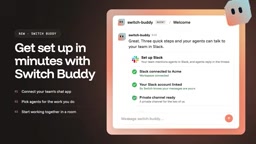
This segment is the video's sponsored portion; the creator migrated the project to the open-source tool Switch AI, which can be self-hosted. Its positioning isn't to replace agents but to give agents a "room": Claude Code and Codex connect to the same room, and build rules exist as room instructions. When the creator asks for status, both agents answer in the same conversation, history stays in the room, and newcomers can scroll up to see decisions already made without needing to be briefed again.
The creator specifically clarified the boundary: this is shared room context, not one agent reading another agent's private memory. Agents can be swapped, models can be swapped, but the context the team accumulates should belong to the team.
"Message bus" is a classic pattern in distributed systems: components don't call each other directly but send messages to a common channel, and the bus handles routing and broadcasting, thereby decoupling producers from consumers. The article borrows this term to describe an anti-pattern—there's no common channel between agents, all information must be manually copied and forwarded by the creator, so the human becomes a single point of bottleneck: slow and error-prone. The corresponding solution is to give agents a shared "room": rules, decisions, and history are written into the same readable context, and any member (including newly connected agents) can read it themselves. It's important to distinguish this from letting one agent read another's private memory—the former is explicit sedimentation of the team's public assets, while the latter creates permission and state coupling and is hard to carry over when changing models.
The Hardest Room Hasn't Passed Yet
The Enterprise's most famous room—the bridge—is currently on hold. The first preview scored 5 for match and 3 for completion, with rather sharp reviewer feedback: panels floating outside their mounting positions, wrong chair silhouette, carpet too smooth, armrests like pipes, buttons too large.
No one lowered the threshold; it stays at 3 until it earns its way to 8. However, the agent also found a cause: the whole thing looks "flat." Under rough surfaces with baked lighting, fine surface detail barely registers; to make the carpet look like carpet, the texture must be painted into the color itself. This is a valuable rendering lesson and shows that the reviewer's image feedback can push agents toward technical-level reflection.
"Rough surfaces with baked lighting flatten detail" involves the basic division of labor in physically based rendering (PBR): the color map (albedo) carries surface patterns and stains, the normal/roughness maps describe micro-relief and reflection characteristics, and the lightmap handles large-scale light and shadow. When lighting is fully baked into textures and surface roughness is high, specular reflection is weak, and the light-dark variation from normal perturbation is smoothed away—almost the only visual information left is the color itself. That's why the reviewer found the carpet "too smooth" and "too flat," and the fix is to paint the weave texture and pile grain directly into the color map, increasing normal strength or reducing roughness as needed to restore detail readability. This is also a common trade-off for VR content under headset performance budgets: substituting texture detail for geometry and real-time lighting.
Cost, Breakpoints, and Replaceable Agents
The creator spoke candidly about cost: both Claude Code and Codex ran out of tokens. So each agent got an additional rule—before stopping, write a recovery note and push it to GitHub, recording what was completed, what failed, what was never tested, and what to run next. After tokens were restored, a new agent reads this note and continues.
His conclusion is worth remembering: agents are replaceable; context is not. If starting over, he would make three adjustments: set up shared context on day one instead of patching it in after chaos; start with small rooms—he admits he tackled the hardest room too early; set a token budget for each room to prevent one room from consuming an entire week.
Project Status and Boundaries
The Enterprise-D has 42 decks, all under construction. Ten Forward and the observation lounge have drafts awaiting review scheduling. The crew is in place—Picard, Geordi, and Data can all be approached for real conversations, and players can leave the ship to explore planets.
The creator emphasized that the ready room and bridge were modeled and textured from scratch, with no assets taken from the series; this is a fan project for personal use only, and Star Trek copyright belongs to Paramount. The current real state: one room passed, the bridge is on hold at 5 and 3, two rooms are queued, and the whole ship is still ahead.
The value of this case isn't the conclusion that "AI can build VR games" but that it lays bare the engineering details of multi-agent collaboration: role separation, blind review, locks, manual merging, recovery notes, shared context—every one born from a pitfall encountered. For developers who want to use agent teams for long-cycle projects, this is a remarkably honest first-hand account.
One-line Summary
An AI agent team built the Enterprise-D in VR from scratch, revealing the engineering details and bottlenecks of multi-agent collaboration.
Paragraph Summary
A creator divided work among multiple AI agents to build the Enterprise-D from Star Trek in VR from scratch, with no manual modeling and no line-by-line coding. Because a single agent loses the thread in long conversations, the task was split into three roles—coordinator, room-based workers, and an image-only reviewer—held together by three hard rules: blind review with a double-eight threshold; heavy tasks like light baking locked and serialized; merge authority reserved for the human. In practice, the creator found the reviewer's issue checklist more actionable than the score. The collaboration's breakpoint was fragmented agent contexts forcing the human to act as a message bus, prompting migration to an open-source tool with shared room context. The bridge room remains on hold at 5 and 3. The creator's conclusion: agents are replaceable, context is not.
Related articles
Gemini 4 Neon Hands-On: 25% Cheaper and Beats Claude Opus?
Gemini 4 Neon vs Claude Opus tested: strong in visual building, debugging, and long docs, 25% cheaper—but real task costs may be similar due to higher token use. Whether to switch depends on your use case.
Airbot: The Proactive AI Chief of Staff That Messages You First, So You Can Escape Notification Overload
Airbot is a proactive AI chief of staff that aggregates email, Slack, calendar, and CRM, pushing priority items with drafted replies and meeting briefs to WhatsApp or iMessage for one-tap approval.

Schumer's Leadership Controversy: Tactics or Communication?
Based on a YouTube video, this explores Senator Schumer's leadership controversy: is it a matter of tactics or communication? It covers taxes, healthcare policy, and primary interventions.