Airbot: The Proactive AI Chief of Staff That Messages You First, So You Can Escape Notification Overload
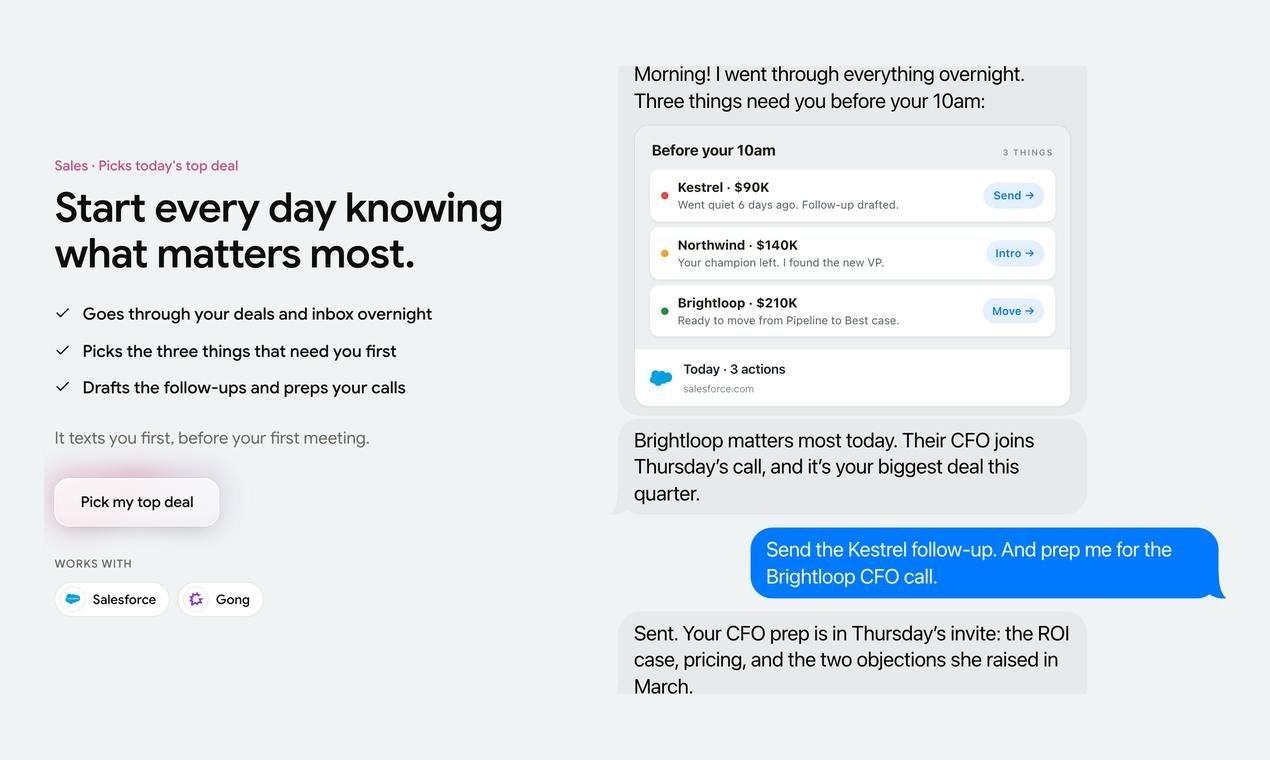
Airbot uses proactive push and prepared actions to act as an AI chief of staff for founders and small teams.
Airbot is the second-ranked proactive AI product on Product Hunt, positioned as an "AI chief of staff." Instead of waiting for questions, it scans email, Slack, calendar, and CRM, then pushes genuinely important items to WhatsApp or iMessage with prepared actions like drafted replies or CRM updates—just tap approve or ignore. It targets founders and lean teams drowning in notifications. The article also flags push accuracy and data privacy boundaries as key adoption considerations.
From "You Ask, It Answers" to "It Reaches Out to You"
Most AI assistants operate in a passive mode: you ask a question, it responds. But Airbot, ranked second on Product Hunt, wants to flip that model on its head—it messages you proactively.
Airbot positions itself as an "AI chief of staff." It proactively scans your conversations, meetings, and customer activity scattered across email, Slack, calendar, and CRM, then picks out the items that genuinely need your attention and messages them to you directly. Behind every message, the next action is already prepared: a drafted reply, a meeting brief, an appointment, or a CRM update. All you have to do is tap "approve" in WhatsApp or iMessage.
For founders and lean teams, this idea hits a real pain point: the problem isn't a lack of information—it's too much of it. Airbot isn't trying to give you yet another app to keep an eye on; it wants to pull you out of the notification quagmire.
How It Actually Works
Cross-Platform Information Aggregation
Airbot's value rests on one premise: your work information is scattered across multiple tools. Email holds customer communications, Slack holds team collaboration, the calendar holds meeting schedules, and the CRM holds sales progress. Airbot connects these sources and cross-references them, so you don't have to switch back and forth between four apps.
A CRM (Customer Relationship Management) system is the database sales teams use to record customer information, communication history, and deal progress; common products include Salesforce and HubSpot. Bringing the CRM into the aggregation scope means Airbot not only reads communication content but can also write new information from emails and meetings back as sales leads or customer activity updates. This kind of two-way sync demands high API permissions and is one of the most complex aspects of data integration for multi-source aggregation products.
Messaging as the Action Entry Point
Airbot's cleverest design lies in its interaction layer. It doesn't require you to open a new interface—instead, it pushes priority items through instant messaging tools you already use, like WhatsApp or iMessage. Every push comes with a prepared action draft, compressing your decision cost down to two options: "approve" or "ignore." This "work pre-completed, just waiting for your sign-off" model goes a step further than simple information reminders.
Positioning for Small Teams
Judging from the product description, Airbot clearly targets founders and lean teams. These users share a common trait: no dedicated assistant, but a high density of matters to handle; they don't lack tools—what they lack is a role that can filter and pre-process on their behalf. Airbot tries to fill exactly that spot.
A "chief of staff" in a corporate organization typically refers to a senior role reporting directly to the top executive, responsible for coordinating all affairs; its core functions are information filtering, prioritization, and cross-departmental coordination rather than executing specific business tasks. Airbot borrows this title to signal that it is not a simple task management tool but rather a decision-support function that "helps managers decide what deserves attention." Understanding this role positioning helps grasp the essential difference between the product and ordinary calendar assistants or to-do apps: the latter wait for users to enter items, while the former proactively judges the importance of items and pre-loads response plans.
The Product Logic and Hidden Concerns of Proactive AI
Airbot represents a rising "proactive AI" product approach: AI no longer waits for instructions but proactively pushes suggestions based on continuous contextual understanding. The product philosophy behind this is that what users are truly scarce on isn't compute power or information—it's the right to allocate attention.
That said, this model has aspects worth watching. Proactive push depends on the AI accurately judging "what's important"; if misjudgments become frequent, users will likely just turn notifications off again—which is precisely the problem the product aims to solve. Additionally, connecting multi-source data like email, Slack, and CRM into a single AI system places considerable demands on data permissions and privacy boundaries. Whether these were discussed among the 15 Product Hunt comments isn't covered in the source material, but they will be key considerations when users actually adopt the product.
"Proactive AI" stands in contrast to traditional "reactive AI." Reactive systems execute only after receiving explicit instructions, while proactive systems continuously perceive context and decide for themselves when to intervene. This distinction has been discussed in both academia and industry; its technical prerequisites include continuous data access, modeling of user intent, and control of false-positive costs. The difficulty of proactive AI isn't generating content—it's deciding "whether it's worth interrupting the user." The balance between push frequency and accuracy directly determines user retention, which explains why this model is generally approached cautiously at the productization stage.
Signals Worth Noting
Airbot garnered 117 votes and ranked second on Product Hunt, showing that the concept of a "proactive AI chief of staff" resonates to some degree with early users. Its differentiation isn't in model capability itself but in product form: using instant messaging as the interface, prepared actions to lower decision costs, and multi-source aggregation to replace manual switching. For entrepreneurs and small teams drowning in notifications, this is an approach worth trying out firsthand.
One-line Summary
With proactive push and prepared actions, Airbot serves as an AI chief of staff for founders and small teams.
Paragraph Summary
Airbot is the second-ranked proactive AI product on Product Hunt, positioned as an "AI chief of staff." Rather than waiting for users to ask questions, it proactively scans information across email, Slack, calendar, and CRM, cross-references it, and pushes items that truly need attention via WhatsApp or iMessage—each message accompanied by prepared actions such as drafted replies, meeting briefs, or CRM updates, requiring only a tap of "approve" or "ignore." The product targets founders and lean teams who lack a dedicated assistant but face high task density, using instant messaging to replace a new app and prepared actions to compress decision costs. The article also notes that the accuracy of proactive push and the permission and privacy boundaries of multi-source data integration are key considerations for actual adoption of such products.
Related articles
Building a VR Starship with an AI Agent Team: A Multi-Agent Collaboration Chronicle
A creator built Star Trek's Enterprise-D in VR from scratch using an AI agent team of Claude Code and Codex—breaking down roles, rules, and bottlenecks.

Schumer's Leadership Controversy: Tactics or Communication?
Based on a YouTube video, this explores Senator Schumer's leadership controversy: is it a matter of tactics or communication? It covers taxes, healthcare policy, and primary interventions.
MyClaw 3.0: Building an Always-On AI Team with Shared Memory
MyClaw 3.0 tops Product Hunt with multi-agent orchestration for OpenClaw, Claude Code and more, 50+ models, shared team memory, and always-on cloud agents via Slack and Telegram.