After Cursor's Acquisition by SpaceX, Why Does OpenAI Plan to Cut Off Model Supply?

After SpaceX acquired Cursor, OpenAI plans to cut off model supply, revealing that the real moat of AI coding tools lies in engineering delivery and multi-model adaptability.
The article uses SpaceX's ~$60B acquisition of Cursor and OpenAI's plan to stop supplying models as an entry point to analyze the chain reaction in the AI coding space. Cursor's core value is not any single model's capability but a cloud AI Agent that automates the 'error—locate—modify—verify' pipeline, charging by saving teams time, with annualized revenue exceeding $2B by February 2026. A model cutoff is sensitive because coding Agents depend heavily on underlying models, but the author argues that Cursor's accumulated task orchestration, multi-Agent parallelism, and result verification are not entirely tied to a single model. Long-term competitiveness lies in developers still being able to confidently deliver software when models change; the lesson for developers is to avoid deep lock-in to a single tool and model combination and to value verification of AI changes.
A Chain Reaction Sparked by One Acquisition
AI coding tool Cursor has been acquired by SpaceX at a valuation of roughly $60 billion, and word quickly followed that OpenAI plans to stop supplying models to it. Taken together, these two events form one of the most dramatic turning points in the AI coding space today. According to a breakdown in the Bilibili creator "AI50" series, Cursor's rise followed a fairly clear path: programmers used to have to find code, edit files, and run tests themselves; now they hand the task of fixing page errors to Cursor's cloud AI Agent, which automatically locates the relevant code, makes the changes, and tests them—even generating a video of the operations for people to review. Multiple Agents can also work in parallel.
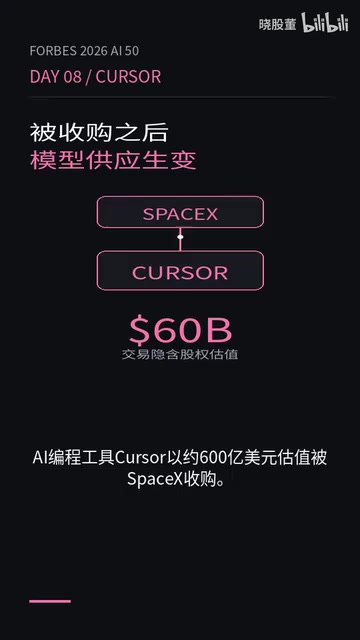
This value proposition speaks directly to the time costs of development teams. Cursor charges through individual subscriptions and enterprise services, and according to Bloomberg, its annualized revenue had exceeded $2 billion by February 2026. Joining SpaceX means more compute power and support for collaborative model development, but the change in model supply is simultaneously testing whether it can reliably serve its customers.
What Exactly Is Cursor Selling?
To understand this风波 ([Note: the original Chinese term here is "风波" — a controversy or storm — and should read: "To understand this controversy"]), you first have to see the product essence of Cursor. What it sells is not the capability of some model, but a delivery pipeline that strings together "error—locate—modify—verify." The reason developers pay is simple: it saves their teams time on tedious tasks.
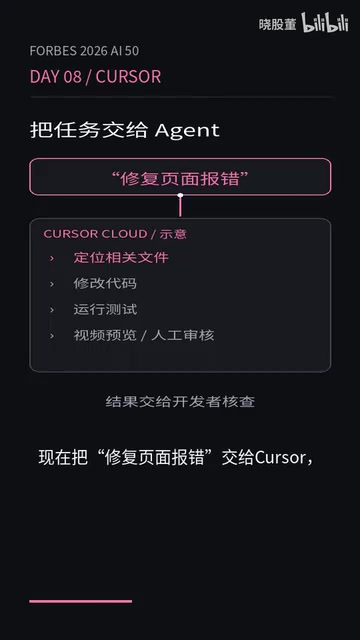
This also explains why the threat of a model cutoff is so sensitive. The value of a coding Agent depends heavily on the code comprehension and generation capabilities of the underlying model, and once supply is interrupted, the product experience takes an immediate hit. But conversely, the engineering capabilities Cursor has accumulated—task orchestration, multi-Agent parallelism, result verification—are not entirely tied to a single model.
AI Agent refers to an AI system that can autonomously perceive its environment, plan steps, and call tools to accomplish goals, unlike chat models that merely respond to single-turn prompts. In coding scenarios, an Agent breaks down tasks (such as "fix this error"), autonomously decides which files to read, which code to search, and which test commands to execute, and adjusts its strategy based on intermediate results. Multi-Agent parallelism means multiple agents handle different subtasks simultaneously—for example, one locates the error, another writes the fix, and a third runs the tests—thereby shortening overall delivery time. This architecture places high engineering demands on task orchestration, state synchronization, and result merging, and it is also the key to Cursor's product differentiation.
The Business Logic Behind the Cutoff
The original text does not elaborate on OpenAI's motives for planning to cut off model supply, but from the industry landscape it is not hard to infer: coding tools are a high-value scenario that model vendors compete for, and top customers are both a source of revenue and a potential foundation for competitors. When Cursor was taken into SpaceX's fold, the business considerations around model supply would naturally be recalculated.

The coincidence of the timeline is worth noting. According to Bloomberg, Cursor's annualized revenue had exceeded $2 billion by February 2026—a scale sufficient to make any model supplier reassess the relationship. The larger the revenue scale, the more delicate the balance of bargaining power and switching costs becomes.

Annualized Revenue Run Rate is a metric that scales current monthly or quarterly revenue to a full-year figure, commonly used for high-growth SaaS and subscription businesses so outsiders can quickly grasp their scale. It is not realized full-year revenue but an extrapolation based on recent revenue velocity, and therefore changes with growth or fluctuations. For a subscription-based tool like Cursor, annualized revenue above $2 billion means its paying user base and average revenue per user have reached considerable scale, which both strengthens its bargaining chip in model procurement and makes it an object that model vendors want to cooperate with while also seeking to balance against.
Long-Term Competitiveness Is Not About Which Model You're Tied To
The judgment offered by the video's author deserves elaboration: Cursor's long-term competitiveness is not about which model it is tied to, but about whether developers can still confidently deliver software when the underlying model changes.
This sentence captures the core proposition of companies in the AI application layer. Models will iterate, suppliers will change, and prices will fluctuate, but enterprises' need for "reliable delivery" is constant. Whoever can turn model capabilities into a predictable, verifiable engineering process holds the real moat. For Cursor, the compute power SpaceX brings is a buffer, but multi-model adaptability is the long-term answer.
Multi-model Abstraction refers to building an abstraction layer between the application layer and underlying large models, enabling a product to flexibly call models from different vendors based on task type, cost, latency, or availability, without deeply binding its workflow to a single supplier. For a coding Agent, this means that when a model is cut off or raises prices, the team can switch to an alternative model relatively quickly while maintaining consistency in task orchestration, verification processes, and user experience. Implementing multi-model abstraction requires handling differences in prompt formats, tool-calling protocols, and output quality across models; the engineering complexity is not low, but it can significantly reduce supply chain risk and is a common strategy for AI application-layer companies building long-term resilience.
Practical Lessons for Developers
This episode offers two reminders for teams using AI coding tools. First, do not lock your workflow deeply into a single tool or a single model combination; keep room to switch. Second, when evaluating AI coding tools, look beyond generation quality to whether they have robust verification mechanisms—whether they can produce auditable operation records and let humans review critical changes.
Agents working in parallel sounds wonderful, but delivery responsibility ultimately remains with people. The more automated the tool, the more valuable the verification step becomes.
One-line Summary
After SpaceX acquired Cursor, OpenAI plans to cut off model supply, revealing that the real moat of AI coding tools lies in engineering delivery and multi-model adaptability.
Related articles

Don't Rush AI to Write Code: 4 Skills That Turn Design into Executable Tasks
A 20-year veteran engineer explains why AI coding means humans should focus on design and planning, not code. Use architecture.md to anchor architecture with four skills—design, architecture review, HTML docs, and planning—to turn technical plans into executable tasks and improve software quality.

The Early History of the AI Revolution: Google, Musk, and the Race That Changed Everything
From Google's DeepMind acquisition to ChatGPT's surprise breakout, The Vergecast and Kevin Roose's new book reveal the early decisions that changed AI forever.

Gmod TTT in Horror Mode: Vampires and Werewolves New Roles Tested
Yogscast Halloween Gmod TTT special: Vampire conversion, Werewolf silver-bullet weakness, Frenchman wall-penetrating baguette kills, and role draft strategy shifts—plus balance feedback from the match.