AG-UI: An Interaction Protocol for Connecting AI Agents to the Frontend
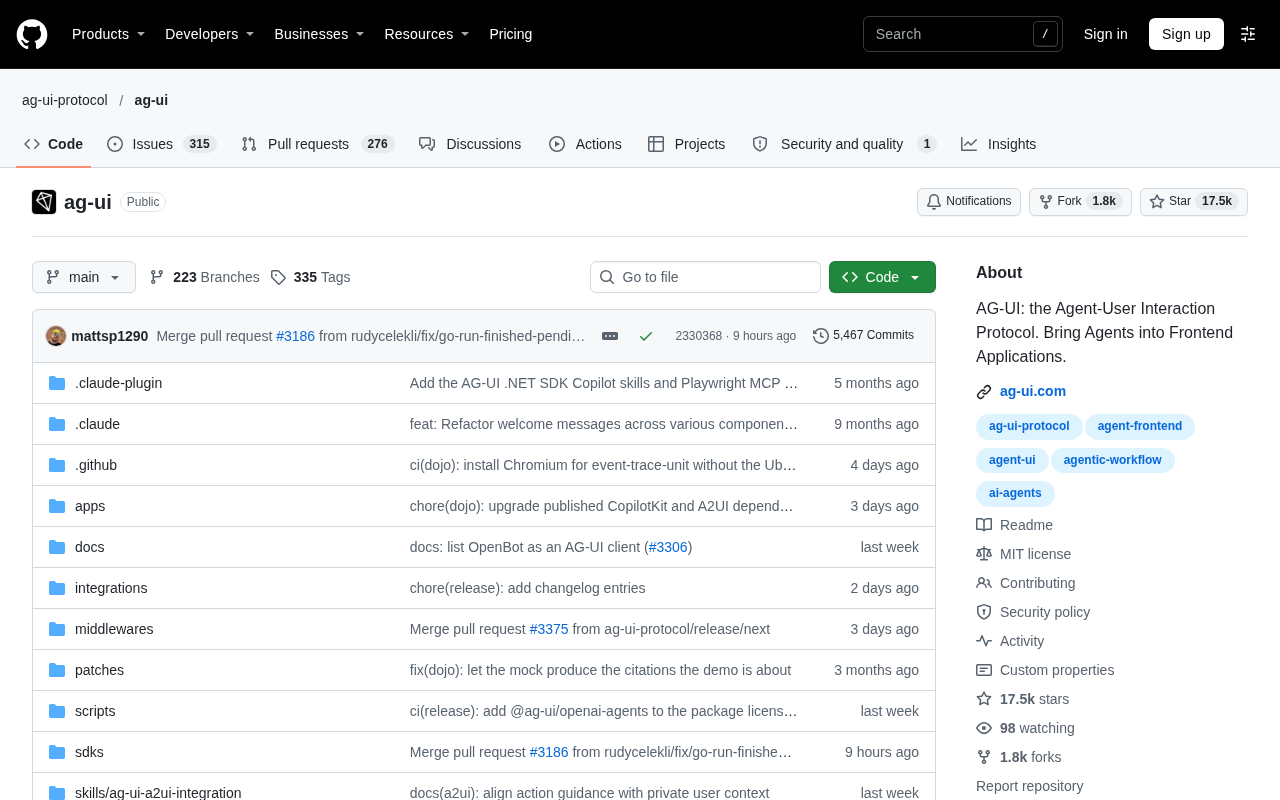
AG-UI defines an agent-frontend interaction protocol in TypeScript, standardizing intermediate-state rendering.
The article introduces the GitHub project ag-ui-protocol/ag-ui, which aims to provide a standard protocol for connecting agents to the frontend. It argues that connecting an agent to the frontend is a protocol problem, not a UI problem: the frontend must perceive thinking states, tool calls, streaming fragment assembly, mid-execution user input, and multi-turn state. AG-UI is implemented in TypeScript, frontend-oriented, emphasizes streaming, and decouples from frameworks. It advises evaluating it for complex interactions while warning that simple one-shot calls may not need it, and notes that long-term success depends on the breadth of framework adapters.
The Last Mile of Bringing Agents to the Frontend
When teams move LLM agents from demo scripts into real products, they often hit the same wall: the agent runs fine on the backend, but the frontend has no idea how to reliably render its intermediate states, tool calls, and streaming output. Every team ends up reinventing the same wheel—custom WebSocket message formats, ad-hoc state synchronization logic, and event types defined separately by each team.
The ag-ui-protocol/ag-ui project on GitHub attempts to standardize this layer. Its self-positioning is straightforward: AG-UI is an interaction protocol between agents and users, with the goal of bringing agents into frontend applications. Implemented in TypeScript, the project has accumulated 17,534 stars and 1,755 forks on GitHub, placing it among the more closely watched projects in the agent infrastructure space.
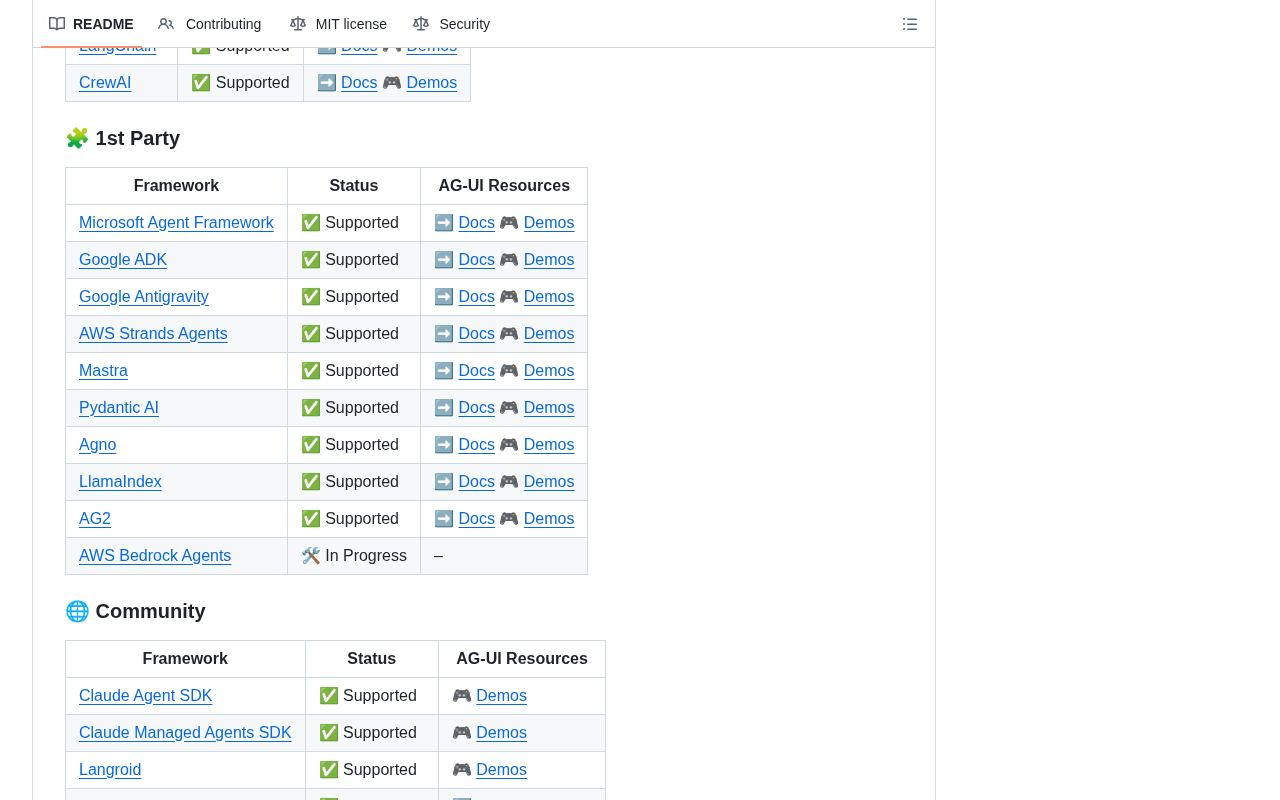
What Problem Does the Protocol Solve
Connecting an agent to the frontend is fundamentally not a UI problem but a protocol problem. The frontend needs to know: has the agent started thinking, which tool is it currently calling, how should streaming text fragments be assembled, can the user provide additional input after execution is interrupted, and where does the state of multi-turn conversations live.
If each product defines this information on its own, the result is that every time the backend switches frameworks or the frontend switches UI libraries, the glue layer has to be rewritten. AG-UI's approach is to define a set of event and state specifications decoupled from specific frameworks, so that the agent side and the frontend side each implement the protocol—turning "integration" into "interfacing."
For a project built with TypeScript, this positioning makes sense: the frontend ecosystem itself revolves around TypeScript, and if the protocol can be provided directly as type definitions, the developer onboarding cost will be significantly lower than reading a pure documentation specification.
Streaming refers to the model pushing results to the frontend token by token or fragment by fragment during generation, rather than waiting for a complete response and returning it all at once. For agents, streaming is not only a UX optimization but also the foundation of observability: users can see what the agent is "thinking," which tool it is calling, and where it is stuck. Implementation typically relies on long-lived connections such as SSE (Server-Sent Events) or WebSocket to push incremental events to the frontend in order. The difficulty lies in event ordering, out-of-order replay, resumption after connection interruption, and reassembling fragmented tokens into structured messages. One of the core values of protocols like AG-UI is elevating "how streaming incremental events are expressed" from proprietary conventions to unified semantics.
Tool Calling is a key mechanism of LLM agents: instead of giving an answer directly, the model outputs a structured request specifying the function name and arguments to call, which an external executor runs before feeding the result back to the model to continue reasoning. For the frontend, this means rendering intermediate states like "currently calling such-and-such tool," and potentially allowing the user to confirm, modify, or reject the call. Tool calling usually involves multiple round trips, with state frequently synchronized between the agent side and the frontend side. Without a unified way to express this, the frontend would have to adapt separately for each tool and each backend framework. Standardizing tool-calling events at the protocol layer lets the frontend render the execution process of any tool with the same set of components.
A Few Notable Design Orientations
From the project's positioning, we can infer its assumptions about use cases.
Frontend-oriented rather than server-oriented. Common agent protocols focus more on collaboration between agents or tool invocation; AG-UI places its perspective on the interaction interface between users and agents, which means it cares about observable process states, not just final results.
Emphasis on streaming and incrementality. User-agent interaction is naturally asynchronous, segmented, and interruptible. The protocol needs to express "in-progress" intermediate states—exactly where many teams' proprietary solutions are most prone to problems.
Keeping distance from frameworks. The protocol itself is not tied to specific agent frameworks or frontend frameworks. In theory, React, Vue, or other tech stacks can all implement the same interaction semantics.
It should be noted that the above judgments are derived from the project's positioning and description; the specifics of message types, event semantics, and state models should still be based on its official documentation and source code implementation.
Agent frameworks refer to development frameworks for building agents, responsible for orchestrating model calls, tool execution, memory management, and multi-step reasoning loops—common ones include LangGraph, CrewAI, AutoGen, etc. These frameworks mostly run on the server side and each have their own execution models and state representations. The significance of AG-UI keeping its distance from frameworks is that it does not require you to switch frameworks; instead, it requires the framework side to provide an adapter layer that translates the framework's internal events into the protocol-defined event stream. The richness of adapter implementations directly determines the integration cost—if the framework you use already has an official or community bridge, the frontend needs almost no changes; otherwise, you have to write this translation layer yourself, which is exactly the ecosystem breadth to examine in the third point during evaluation.
Applicable Scenarios and Selection Advice
If you are doing any of the following, this project is worth taking the time to evaluate: you need to show the agent's thinking and tool-calling process in your product; you need to support users intervening or supplementing information mid-execution; or your team maintains multiple agent backends and wants the frontend to have only one set of rendering logic.
Conversely, if the product simply calls a model API once and returns the entire result, introducing an interaction protocol may be over-engineering. The value of a protocol amplifies as interaction complexity rises; in minimalist scenarios, it brings more abstraction cost than benefit.
When evaluating, focus on three things: whether the protocol covers the interaction states you actually need; whether the TypeScript type definitions are complete and directly reusable; and whether there is already an adapter implementation in the ecosystem for the agent framework you use. The first two determine the integration difficulty, and the third determines whether you need to write the bridge layer yourself.
Editorial View
Competition in agent applications is shifting from "model capability" to "engineering deployment," and one of the bottlenecks in engineering deployment is the interaction contract between frontend and backend. The value of projects like AG-UI lies not in how complex they are, but in their attempt to turn something every team has to do into something that can be shared. For teams planning to make agents into formal products rather than internal tools, this is a reference item worth adding to the technology selection list.
The project's popularity also signals the existence of demand, but the long-term success of protocol-type projects depends on the breadth of the adapter ecosystem—how many agent frameworks are willing to implement it is often more critical than the protocol design itself.
One-line Summary
AG-UI defines an agent-frontend interaction protocol in TypeScript, standardizing intermediate-state rendering.
Paragraph Summary
The article introduces the GitHub project ag-ui-protocol/ag-ui, which attempts to provide a standard protocol for the repeatedly reinvented step of connecting agents to the frontend. The article points out that connecting an agent to the frontend is fundamentally a protocol problem rather than a UI problem: the frontend needs to perceive thinking states, tool calls, streaming fragment assembly, user supplemental input after interruption, and multi-turn conversation state. AG-UI is implemented in TypeScript and positioned as a frontend-oriented interaction protocol that emphasizes streaming incrementality and decouples from specific frameworks, currently with 17,534 stars. The article recommends evaluating it for scenarios with complex interactions, mid-execution user intervention, or unified rendering across multiple backends, while noting that introducing the protocol for simple one-shot calls may be over-engineering, and reminding readers that the long-term success of protocol-type projects depends on the breadth of the agent framework adapter ecosystem.
Related articles

No Coding Required: He Shipped an App Store App by 'Cutting Features' and Nitpicking with AI
A game designer with zero frontend/backend skills shipped a dual-platform App Store app with AI—not via one-click generation, but by cutting scope and nitpicking like a demanding client.
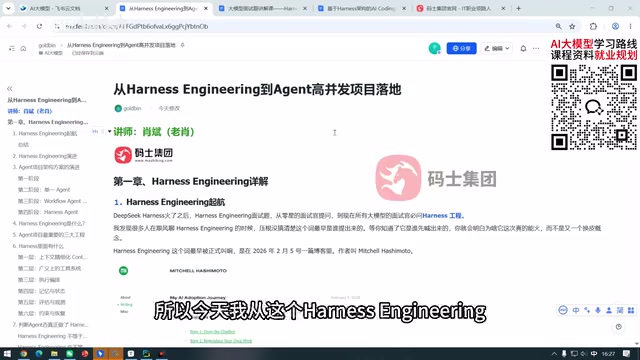
What Is Harness Engineering? From Concept Origins to Enterprise-Level Agent Implementation
What is Harness Engineering? This article traces the concept's origins and analyzes enterprise-level Agent requirements for tool call fault tolerance, data security, tenant isolation, and memory gaps.
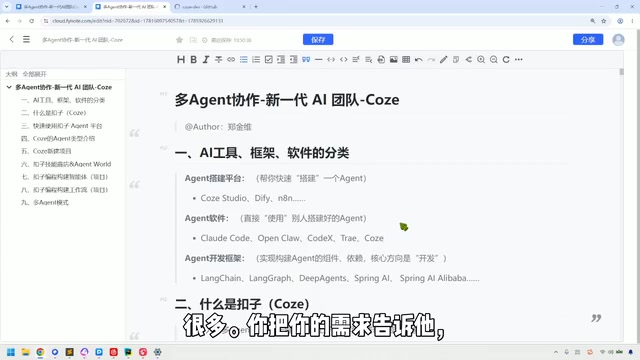
Coze in Practice: A Three-Tier Agent Classification and a Multi-Agent Collaboration Guide
A Bilibili tutorial breaks down the multi-agent collaboration toolchain into three categories: building platforms like Coze Studio and Dify, Agent software like Claude Code, and development frameworks like LangChain—plus a Coze demo of industry templates, three-platform interoperability, local Agent integration, and the trade-offs of credit consumption.