What Is Harness Engineering? From Concept Origins to Enterprise-Level Agent Implementation
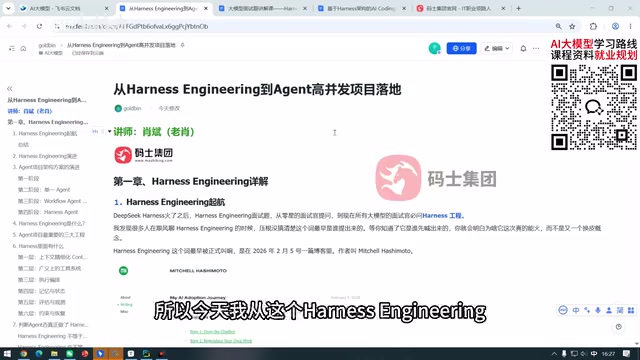
Harness Engineering is the engineering paradigm for production agent delivery, with interviews focusing on its engineering details.
The article traces Harness Engineering's origins: the term entered the agent context via Michelle Hashimoto's blog in February 2026, then OpenAI expanded it to the overall architecture, though related practices had been explored since late 2025, with naming lagging behind practice. It emphasizes this is an engineering paradigm for agent development, not a unified framework. The author notes interviewers evaluating agent, fine-tuning, and RAG projects really care about production delivery, focusing on fault tolerance, data security, high-concurrency context management, tenant isolation, and memory gaps. A learning path is provided, with a note that the single source should be cross-verified.
Concept Origins: Where Harness Engineering Came From
Harness Engineering has been mentioned frequently in agent circles lately, but many people only understand it at the level of a buzzword. According to a review by Bilibili creator "Teacher Xiao from Ma's Education," the landmark moment when the term formally entered the agent context was February 5, 2026—author Michelle Hashimoto used the phrase "Engineering the Harness" in the fifth chapter of a blog post. Six days later, OpenAI published a blog post with "Harness Engineering" directly in its title, expanding the concept to the entire agent architecture level.
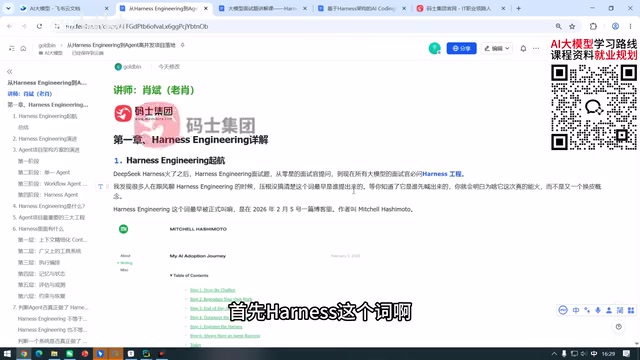
A common misunderstanding needs clarification: the ideas behind Harness Engineering did not appear out of nowhere in February 2026. According to the creator's observations, in the second half of 2025, teams at OpenAI, Anthropic, and domestic players such as DeepSeekAd, Tongyi, and Tencent were already continuously exploring similar architectures in agent projects and RAG projects—they simply had no unified name at the time. OpenCloud is regarded by the creator as an earlier product that embodied mature Harness engineering thinking, having been active by the end of 2025. In other words, industry practice preceded the naming—the two blog posts in February 2026 were more like "giving a name" to an engineering paradigm that had already taken shape.

The core judgment here is: Harness Engineering is an engineering paradigm for agent development, not a technical framework spawned by any single article. Different companies have different implementation paths, but they have gradually converged on similar architectures around issues such as tooling, long tasks, context management, and secure execution. This point is crucial for understanding the implementation requirements that follow.
On the metaphor of "Harness": In software and systems engineering, "harness" has long referred to the supporting layer wrapped around core components for driving, constraining, and observing them. In testing, a "test harness" refers to an automated test execution framework; in aviation, a "wiring harness" refers to a cable assembly. Borrowed into the agent context, "Harness" refers to the entire set of engineering infrastructure outside the model—tool registration and invocation, context and memory management, permissions and sandboxing, retries and fallbacks, observability, and so on. Its role is to stably "harness" uncontrollable model capabilities in real environments. Understanding this metaphor helps distinguish Harness Engineering from model-layer work such as prompt engineering and fine-tuning.
Why Interviewers Are Zeroing In on Harness Engineering Skills
According to interview feedback from students relayed by the creator, when interviewers look at agent projects, fine-tuning projects, and RAG projects on resumes, their biggest concern is no longer "have you done it" but "can it be delivered in production." And the criteria for judging production delivery often lie in the specific details of Harness engineering.
Interviewers typically probe project details with questions like: How do you handle tool invocation errors? How do you ensure data security? How do you handle high concurrency? How do you isolate users and tenants? How do you remedy memory gaps in agents? What these questions have in common is that none of them are things you need to consider at the demo stage—they are engineering challenges that only surface once a project enters a real production environment.
The creator's view is blunt: if you list an agent project on your resume and can't answer the above details, interviewers will assume it's demo-level. Conversely, if the project reflects these designs, it demonstrates the potential for production delivery. This also explains why Harness-related interview questions are almost mandatory in current hiring.
Engineering complexity differences between RAG and Agents: RAG (Retrieval-Augmented Generation) mainly solves the problem of "where knowledge comes from," with a relatively linear pipeline: chunking, embedding, retrieval, concatenation, generation. Failure points are concentrated in recall quality and context length. Agents, however, introduce autonomous decision-making and multi-step tool invocation. Execution paths are no longer fixed, errors amplify along the call chain, and thus requirements for state management, idempotent retries, timeout control, and permission boundaries increase significantly. This also explains why interviewers probe agent projects and RAG projects separately—the former tests engineering fallback capabilities under dynamic execution, not just retrieval performance metrics.
What Enterprise-Level Agent High-Concurrency Projects Must Solve
Moving from concept to project, the value of Harness engineering is reflected in a set of specific engineering problems. Based on the project practices mentioned by the creator, the focus areas can be summarized at several levels.
Fault tolerance for tool invocation. Failures when agents call external tools are the norm. Retry strategies, fallback plans, and error propagation mechanisms all need to be designed into the architecture in advance, rather than patched in after errors occur.
Data security and tenant isolation. In multi-user, multi-tenant scenarios, context, memory, and tool permissions must be isolated—otherwise data cross-contamination occurs. This is a hard requirement in enterprise delivery.
Context management under high concurrency. Long tasks and long contexts consume significant resources. How to manage the context window and avoid memory gaps directly determines whether agents remain stable in concurrent scenarios.
Handling memory gaps. Agents losing critical information during multi-turn interactions is a common failure. It needs to be mitigated through memory persistence, summary compression, state rollback, and other means.

These problems are nothing new individually, but combined within an agent project, they form the litmus test for Harness engineering skills. The creator's approach is to pair the code and demo process of two actual projects (from April and July–August respectively) with each key point of Harness engineering, explaining them one by one—the idea being to first build a conceptual framework, then return to project details to verify it.
Technical causes of context windows and memory gaps: Large models have hard context window limits, and early information in long tasks gets truncated or diluted. Meanwhile, most inference services charge by input length, making full historical concatenation prohibitively expensive. Common engineering approaches include sliding window truncation, rolling summary compression, extracting key information into structured state, attaching long-term memory via vector databases, and performing state rollback and replay during session recovery. In multi-tenant scenarios, these memory stores also need physical or logical isolation by tenant dimension to prevent vector retrieval from hitting across tenants—this is precisely the source of the data cross-contamination risk mentioned earlier.
Suggested Learning Path
For developers who want to build this capability, the creator's suggested path is: first clarify the conceptual origins and boundaries of Harness Engineering, then understand which code and capabilities it corresponds to in specific projects, and finally use real project details to cross-reference the points interviewers might probe. Simply memorizing concepts or writing only a simple case study is not enough to meet the requirements of current enterprise hiring.
It should be noted that this article's review of Harness Engineering is mainly based on a single source—the creator's account. The timelines and product judgments involved are their personal observations, and readers may cross-verify with other materials.
One-line Summary
Harness Engineering is the engineering paradigm for production agent delivery, with interviews focusing on its engineering details.
Paragraph Summary
The article traces the concept of Harness Engineering: the term first entered the agent context via Michelle Hashimoto's blog in February 2026, then was expanded to the overall architecture level by an OpenAI blog post—but related engineering practices had already been explored by OpenAI, Anthropic, and multiple domestic teams since the second half of 2025, with naming lagging behind practice. The author emphasizes that it is an engineering paradigm for agent development, not a unified framework spawned by any single article. The article further points out that when interviewers evaluate agent, fine-tuning, and RAG projects, they really care about production delivery, with probing questions focused on production-grade challenges such as tool invocation fault tolerance, data security, high-concurrency context management, tenant isolation, and memory gap handling. Finally, it offers a learning path of building a conceptual framework first, then cross-referencing with real project details, and notes that the single source should be cross-verified.
Related articles

No Coding Required: He Shipped an App Store App by 'Cutting Features' and Nitpicking with AI
A game designer with zero frontend/backend skills shipped a dual-platform App Store app with AI—not via one-click generation, but by cutting scope and nitpicking like a demanding client.
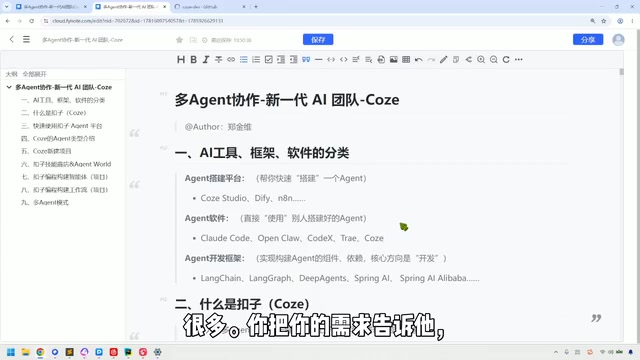
Coze in Practice: A Three-Tier Agent Classification and a Multi-Agent Collaboration Guide
A Bilibili tutorial breaks down the multi-agent collaboration toolchain into three categories: building platforms like Coze Studio and Dify, Agent software like Claude Code, and development frameworks like LangChain—plus a Coze demo of industry templates, three-platform interoperability, local Agent integration, and the trade-offs of credit consumption.

How the Mind Steers the Body: An Underrated Self-Regulation Revolution
An interpretation of the Substack essay Getting the mind to steer the body to steer you: how the mind regulates itself through bodily feedback, an embodied cognition framework for self-management, and the multi-angle discussion in the Hacker News community.