Against the International Oligarchy: How Tech Elites Influence Global Governance
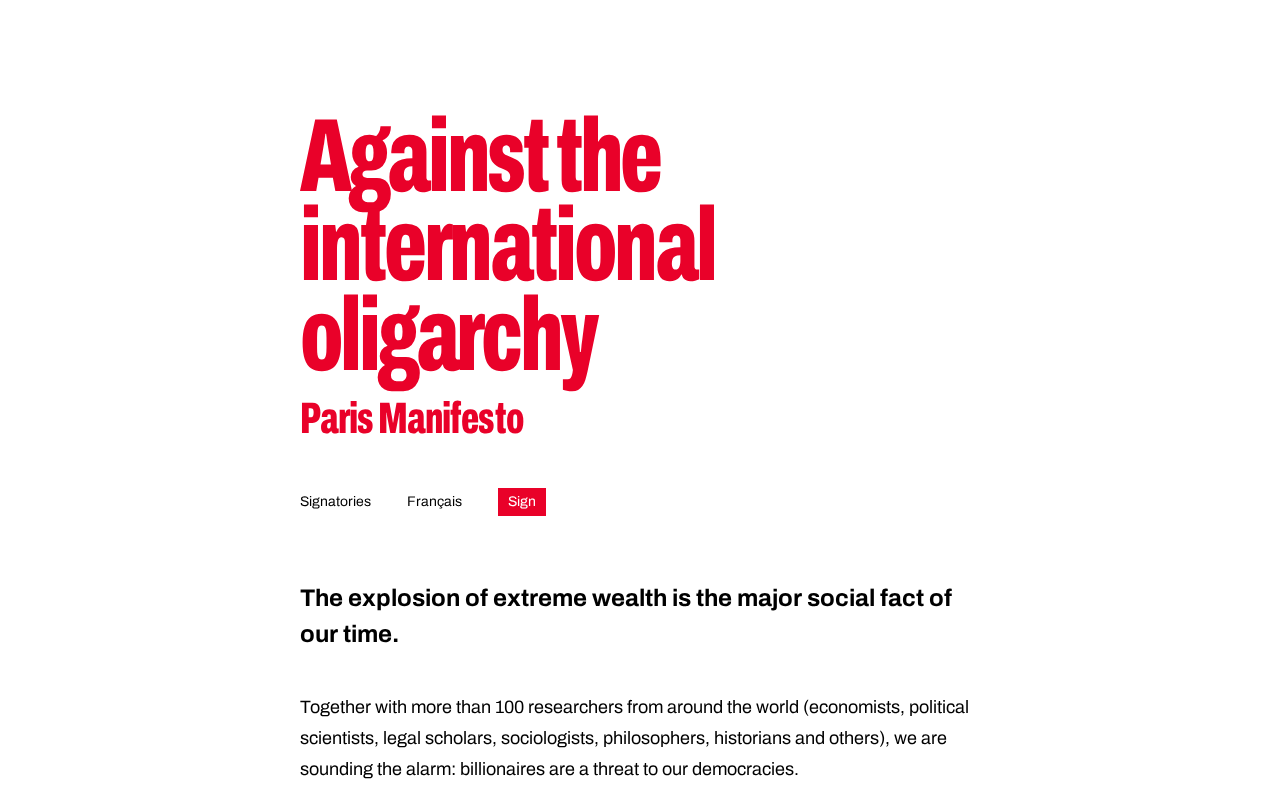
International oligarchy refers to multinational tech giants using capital and data to influence multiple countries' policies, creating a governance vacuum.
Starting from a brief Hacker News post, the article explores the meaning of 'international oligarchy' in the tech era. The author notes that a few global tech giants exert substantive influence on markets, public opinion, and policy in multiple countries through capital, data, and algorithms. Formation mechanisms include winner-takes-all dynamics from network effects and data monopoly, global regulatory arbitrage exploiting jurisdictional differences, and the siphon effect of capital and talent toward a few innovation hubs. These forces lead international oligarchies to assume quasi-public functions in content moderation and privacy protection without democratic accountability. The article concludes with approaches such as strengthening antitrust, promoting international regulatory coordination, enhancing transparency, and supporting decentralized technologies, emphasizing the tension between globalized digital forces and localized democratic governance as the core contradiction.
Introduction: Reflections on a Hacker News Post
Recently, a post titled "Against the International Oligarchy" appeared on Hacker News, garnering 14 points and 1 comment. Although the discussion was not particularly heated, the title itself points to an issue of growing concern: in the context of globalization and rapid technological development, is a new kind of "international oligarchy" taking shape? And how does it influence technology, the economy, and society?
What Is the "International Oligarchy"?
The term "oligarchy" traditionally refers to a small group of people who control a country through wealth or power. "International oligarchy" emphasizes influence that transcends national borders. In the tech sector, this usually refers to a handful of global tech giants, major investors, or platform owners who, through capital, data, and algorithms, exert substantive influence on markets, public opinion, and even policy in multiple countries.
The post's title suggests a critical perspective: does this concentration of power undermine democratic governance? Does it exacerbate inequality? Although the original content was brief, the HN community's focus tends to be on tech monopolies, regulatory arbitrage, and the governance vacuum created by globalization.
"Regulatory arbitrage" is a key concept for understanding the behavior of multinational tech companies. It refers to the practice of companies shifting operations, data, or profits to jurisdictions with looser regulations or lower tax burdens, thereby circumventing legal constraints in their home country or country of operation. In the digital age, this strategy is particularly effective: data can flow across borders at near-zero cost, companies can declare profits in low-tax countries like Ireland, store data in loosely regulated regions, while serving users worldwide. The result is that individual countries' regulatory efforts are diluted—even if a country enacts strict privacy laws, companies can still circumvent them through structural adjustments. This explains why international coordination (such as GDPR-style multilateral frameworks) has become necessary, and reveals how the "international oligarchy" has grown strong in the governance vacuum.
How Tech Oligarchies Form
Network Effects and Data Monopoly
The economic characteristics of digital platforms naturally tend toward concentration: the more users, the higher the platform's value, creating a winner-takes-all situation. Data, as a key factor of production, further reinforces the leaders' moat. A few companies thus acquire massive amounts of behavioral data, using it to optimize algorithms and expand their businesses, creating insurmountable competitive barriers.
"Winner-takes-all" is a typical market structure of the digital platform economy. Unlike traditional manufacturing, digital products or services have high fixed costs and near-zero marginal costs: developing a platform is enormously expensive, but the cost of serving one more user is almost zero. Combined with network effects—the more users, the higher the platform's value to each user—once a leader establishes a scale advantage, it can self-reinforce into market dominance. This structure naturally suppresses competition: new entrants struggle to persuade users to switch because the existing platform has higher network value. Economists call this the "lock-in effect," which poses new challenges for antitrust enforcement—traditional price and market share metrics may underestimate entry barriers in digital markets, while data accumulation and algorithm optimization constitute invisible moats.
Global Regulatory Arbitrage
Multinational tech companies can exploit differences in rules across jurisdictions to shift profits to low-tax regions or choose loosely regulated environments for data storage and processing. This arbitrage behavior weakens the regulatory effectiveness of individual countries and makes international coordination difficult.
"Regulatory harmonization" refers to different countries aligning their regulatory frameworks through multilateral agreements, mutual recognition of standards, or common rules, to reduce the space for companies to exploit regulatory differences for arbitrage. In the digital sphere, typical examples include the extraterritorial effects of the EU's General Data Protection Regulation (GDPR), the global minimum corporate tax agreement promoted by the OECD, and mutual recognition mechanisms for cross-border data flows. However, harmonization faces obstacles from sovereignty concessions and divergent interests: countries have different preferences regarding privacy, speech, and competition, and the discourse power between developing and developed countries is uneven. Therefore, the governance dilemma of the international oligarchy is essentially a microcosm of global governance fragmentation—there is no world government, yet there are world-class corporations, and the power to set rules itself becomes the focus of the game.
Siphon Effect of Capital and Talent
Venture capital and top tech talent are highly concentrated in a few global innovation hubs, creating a self-reinforcing cycle: capital chases successful companies, successful companies attract talent, and talent creates more success. This makes it difficult for innovation ecosystems in peripheral regions to grow, further consolidating the oligarchy's position.
Challenges to Governance and Society
The influence of the international oligarchy is not limited to business. They intervene in policy processes through lobbying, standard-setting, and public-private partnerships. In the absence of global democratic accountability mechanisms, this influence may deviate from the public interest.
At the same time, tech oligarchies' decisions on content moderation, privacy protection, and market competition effectively play quasi-public functions, yet are not subject to checks by traditional public institutions. This has sparked widespread discussion about legitimacy, transparency, and accountability.
"Quasi-public function" refers to private entities de facto assuming functions traditionally exercised by governments. Large platforms have acquired properties similar to public infrastructure in areas such as content moderation, identity verification, payment settlement, and even emergency information dissemination. For example, social media algorithmic recommendations determine the public's information exposure, and app store review rules affect whether developers can reach users. The problem is that these decisions are made by private companies based on commercial logic and internal policies, lacking public law constraints such as electoral accountability, administrative transparency, and judicial review. Academia has thus raised the issue of "platform governance": should these entities be treated as "common carriers," or should independent oversight bodies be established for them to ensure that the exercise of their quasi-public power serves the public interest.
Possible Approaches
In the face of the international oligarchy, several approaches are worth exploring:
- Strengthen antitrust and competition policy: Update antitrust tools at national and international levels to address the special challenges of digital markets.
- Promote international regulatory coordination: Reduce space for regulatory arbitrage through multilateral agreements or mutual recognition of standards.
- Enhance transparency and accountability: Require large platforms to disclose more information about algorithms, data usage, and governance decisions.
- Support decentralized technologies: Explore alternatives such as open source and federated architectures to reduce dependence on single platforms.
Conclusion
Although brief, this post on Hacker News touches on a core contradiction of the tech era: the tension between globalized digital forces and localized democratic governance. Understanding the formation and impact of the "international oligarchy" is the starting point for thinking about how to build a fairer and more sustainable tech ecosystem.
This article is based on the public post title and common discussion directions in the HN community; the specific views expressed do not necessarily represent those of the original author.
Related articles

Pure-Code Video Generation Tested: Which AI Model Actually Follows Instructions?
A Bilibili creator tested three AI models' pure-code video generation with unified prompts and three revisions each: Xiaonaomao has a high ceiling but lacks stability, GPT 6.2 Extra models well but only follows half the instructions, and OPAS 5.5 remains the benchmark.

GPT-6 Six-Tier Hands-On Test: Astra Ultra Dominates but Bills Double
GPT-6 six-tier test: Astra Ultra sweeps 3:0 in 3D tasks thanks to sub-agents and runs 14% faster, but hidden backend bills make its real cost 2.6x single-threaded.

GPT-6.2 Astra vs Fable 5.2: Huge Cost-Efficiency Gap Across 12 Real-World Tests
Bilibili creator tests GPT-6.2 Astra vs Fable 5.2 across 12 real tasks: Fable wins 7-5 but costs 7.2x more and takes nearly 5x longer. Token efficiency emerges as the key selection metric.