Agent Etna: A Pre-Deployment Staging Environment Built for AI Agents
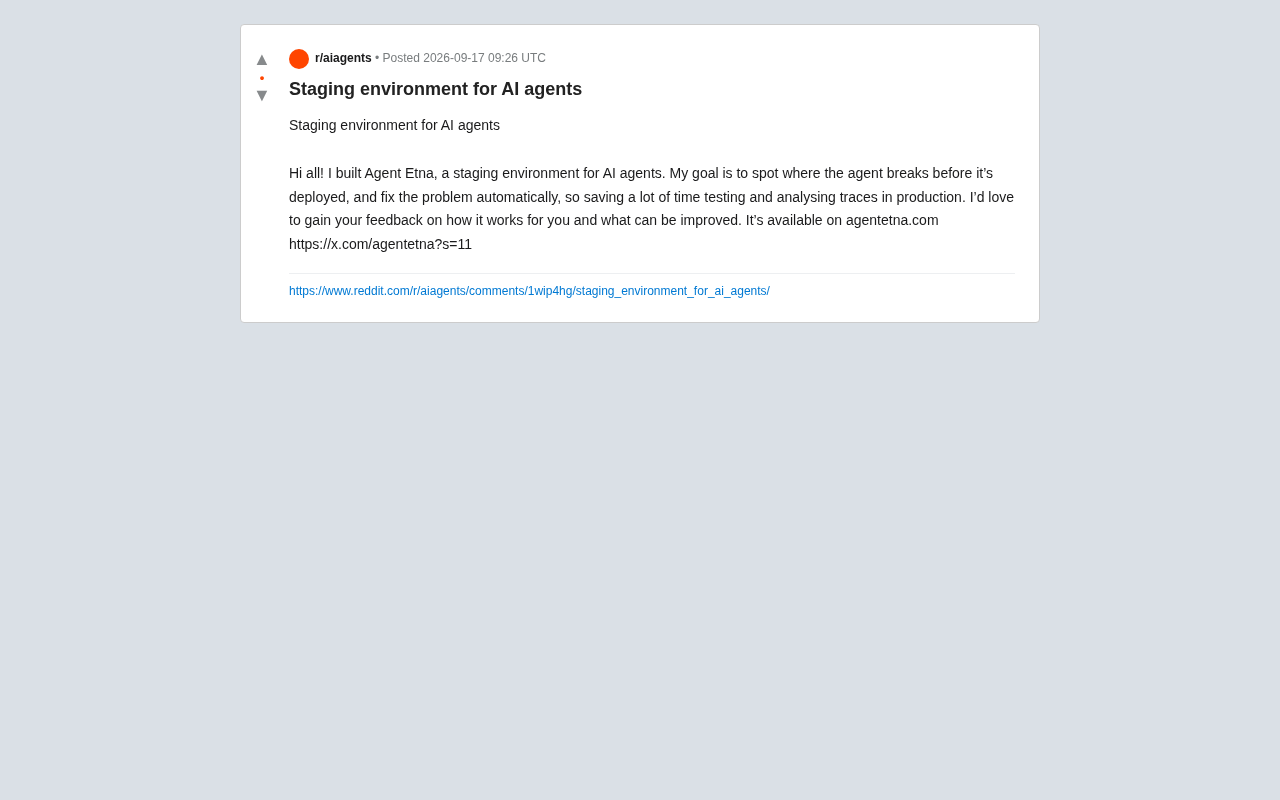
Agent Etna is a pre-deployment staging environment that auto-detects and fixes AI agent failures before launch.
As AI agents move into production, finding failures before deployment rather than after has become a critical engineering challenge. Agent Etna is an early-stage project targeting this need — a dedicated staging environment for AI agents that claims to automatically locate crash points and fix them pre-deployment. Its most compelling yet unverified feature is "auto-fix," whose underlying mechanism remains publicly undisclosed. The project is in active early development, with the author seeking community feedback on Reddit. It targets the fast-growing niche of agent evaluation and observability, and its "pre-deployment staging + auto-fix" combination could offer meaningful differentiation if proven to work reliably.
A Neglected Problem: How Can AI Agents Surface Failures Before Going Live?
As AI agents make the leap from research labs to production environments, a thorny problem is coming into focus: how do you identify an agent's failure points before deployment, rather than scrambling to comb through logs and execution traces after something breaks in production? Recently, a developer shared a project on Reddit called Agent Etna, aimed at addressing exactly this pain point.
According to the author, Agent Etna is a staging environment purpose-built for AI agents. Its core goal is to "identify where an agent will crash before it's deployed, and automatically fix the problem" — saving developers significant time that would otherwise be spent testing and tracing issues in production. The project is already live and accessible at agentetna.com.
Why AI Agents Need Their Own Staging Environment
In traditional software development, staging environments have long been standard practice — code runs through an environment that mirrors production as closely as possible before going live, surfacing potential defects early. But AI agents introduce a new layer of complexity.
Agent behavior is non-deterministic. It depends on LLM reasoning, external tool calls, and multi-step decision chains — any deviation at any step can cause the final output to go wrong, and these errors are often difficult to reproduce. Developers typically have no choice but to dig through lengthy execution traces after something breaks in production, painstakingly tracing back to figure out exactly where a prompt, a tool response, or a logic branch went sideways. It's a slow, reactive process.
Agent Etna aims to break this "firefighting after the fact" cycle. By shifting problem discovery from production to pre-deployment, it could theoretically reduce the rate of live incidents and cut debugging costs significantly.
The non-determinism at the heart of AI agents stems from the probabilistic sampling used by the underlying large language models (LLMs) — the same input can produce meaningfully different outputs at different times. On top of that, agents typically interact with external systems through "tool calling" (also known as Function Calling) — querying databases, calling APIs, executing code — and each external call introduces new variables. In multi-step reasoning chains, there's also an error accumulation effect: small deviations early in the chain get amplified as execution continues, causing the final result to drift far from the intended outcome. This stands in stark contrast to the deterministic logic of traditional software, and it's why conventional QA approaches like unit tests and integration tests don't transfer cleanly to agent development — passing a test case doesn't mean the agent won't hallucinate or go off the rails in a real-world scenario.
"Auto-Fix" Is Both the Standout Feature and the Open Question
The most attention-grabbing claim in the project description is the promise to "fix the problem automatically." If a tool can not only detect where an agent fails but also automatically produce a fix, that's a compelling proposition for developers.
However, based on the information publicly available, the author hasn't explained the specific mechanism behind "auto-fix" — does it rewrite prompts, adjust tool-calling logic, or generate suggested changes for human review? Given how heavily agent behavior depends on context, the reliability and boundaries of fully automated fixing warrant closer scrutiny. This is a key question the project will need to answer clearly for users as it matures.
An Early-Stage Project Still Seeking Feedback
To the author's credit, they've launched the project with an open posture, actively soliciting real user feedback from the community: "I'd love to know how it works in your use case and what could be improved." This kind of early validation approach fits well with the fast-iteration mindset typical of AI tooling products today.
From a market positioning standpoint, Agent Etna is entering a segment that's heating up fast. As AI Agent applications scale into production, demand for tooling around agent evaluation, observability, and testing is growing rapidly. Quite a few teams are already building agent tracing and evaluation platforms, but Agent Etna's emphasis on the "pre-deployment staging + auto-fix" combination — if it can be made to work reliably — carves out a genuinely differentiated angle.
Agent Evaluation and Observability are among the fastest-growing sub-areas in AI engineering today. Observability tooling typically operates across three layers: Tracing (recording inputs, outputs, and latency for each LLM call), Metrics (aggregating success rates, token consumption, etc.), and Logging (preserving raw execution details). Platforms like LangSmith, Langfuse, Arize AI, and Weights & Biases are already active in this space, primarily focused on post-hoc analysis in production. The "pre-deployment testing" angle — proactively stress-testing agents in simulated scenarios before they go live — has relatively few mature products so far, which is precisely the niche Agent Etna is trying to occupy. The core challenges for this category are building test scenarios realistic enough to matter, and defining what "failure" actually looks like, given that agent outputs rarely have a single correct answer.
Summary
Agent Etna is still an early-stage project with limited public information, and the substance of its "auto-fix" capability will need more technical detail and real-world case studies before a proper verdict can be reached. But the problem it's targeting — how to detect and resolve AI agent failures before they reach production — is a genuine, high-value pain point in the current agent engineering landscape. For developers building AI Agent applications, pre-deployment testing tools like this are worth keeping an eye on.
Note: This article is based on the developer's self-described post on Reddit and publicly available project information. For a true assessment of the product's effectiveness, we recommend trying it yourself.
Related articles
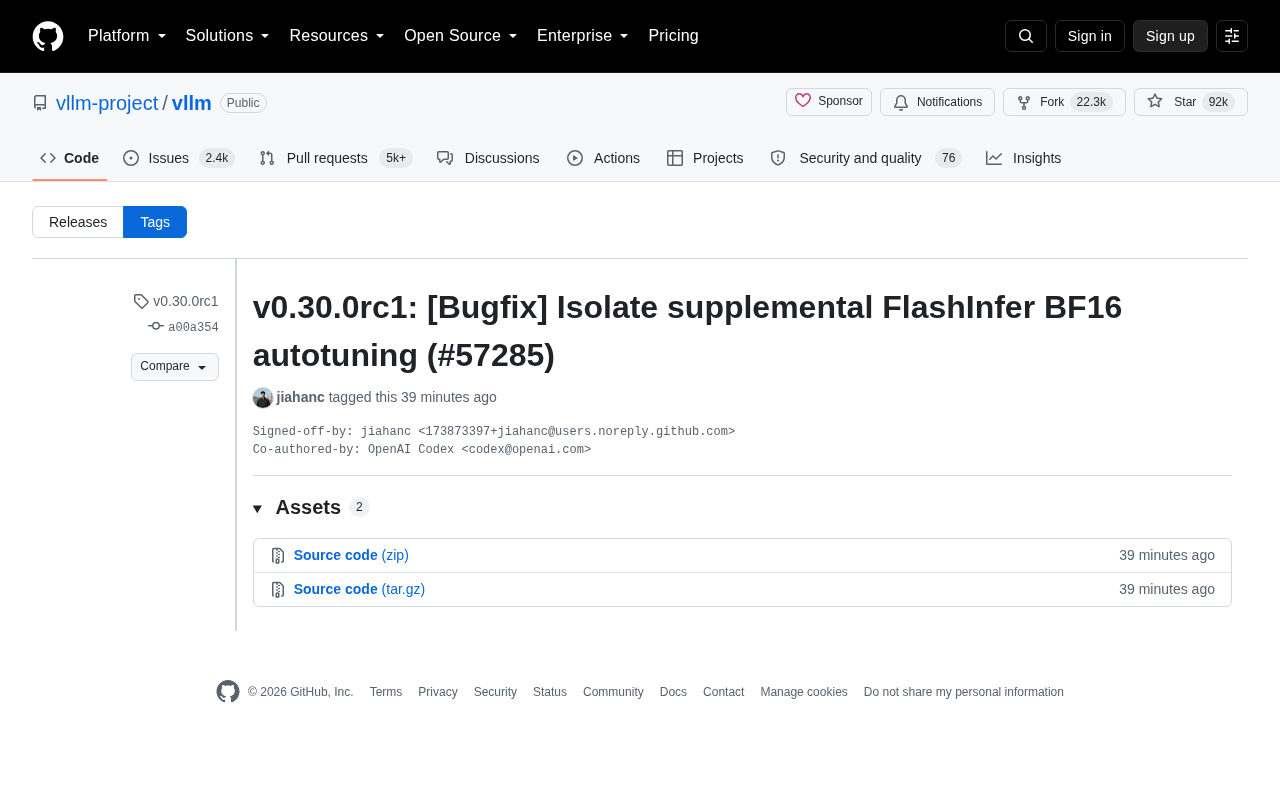
vLLM v0.30.0rc1 Released: Isolates FlashInfer BF16 Autotuning Logic
vLLM v0.30.0rc1 release candidate fixes FlashInfer BF16 autotuning isolation (PR #57285). Learn the technical background and its impact on inference deployment.

Comp AI Raises $34M Series A, Bets on Agentic Security Compliance
Comp AI raises $34M Series A led by Roo Capital and Grand Ventures, betting on "continuously agentic" AI to transform compliance from periodic audits into real-time monitoring.

MIT Technology Review's 35 Innovators Under 35: A Climate Tech Edition Explained
MIT Technology Review's latest 35 Innovators Under 35 list focuses on climate tech, spotlighting nine young global innovators. Here's what the list means and why it matters.