Gemini 4 Carbon Arrives: The LLM Race Enters the Era of Million-Token Context and Trillion-Parameter Open Source
Google, Anthropic, OpenAI, and open-source players upgrade in sync as LLM competition turns into systematic combined contests.
This article reviews the latest LLM release wave: Google's Gemini 4 Carbon with the multi-agent tool Swarm, Anthropic's million-context Fable 5.2 and Mythos 5.2, and OpenAI's highest-preparedness GPT-6 Cyber. On the open-source side, Mistral open-sourced the trillion-parameter Mistral Large-4, Moonshot AI released full weights for the 2.8-trillion-parameter Kimi K3.1 Pro, and Meta introduced the lightweight Muse Amber 1.0. The competitive bar has shifted from parameter scale to combined contests of context length, open strategy, pricing, and vertical capability.
Google's Gemini 4 Carbon, Anthropic's dual million-context models, OpenAI's security-focused GPT-6 Cyber, and Kimi K3.1 Pro's trillion-parameter open weights — this latest round of updates has pushed nearly every dimension of the LLM competition higher at once. According to a roundup from Bilibili's AI Morning Report, the release cadence of frontier models is shifting from "single-point breakthroughs" to "systematic dominance."
Three Approaches Among Frontier Closed-Source Models
Google: Ultra Exclusivity and Multi-Agent Collaboration
Google positions Gemini 4 Carbon as its strongest frontier model, debuting first for Ultra subscribers, with a paid API offer of $2 per million input tokens. More notable is the simultaneous launch of Swarm, a multi-agent collaboration tool that supports assembling development teams for parallel verification. The combination means Google is binding model capability to engineering collaboration — the model itself isn't the novelty; how to get multiple agents working in parallel and verifying one another is the infrastructure developers actually need.
Multi-Agent Collaboration refers to multiple AI agents with independent reasoning capabilities dividing labor and completing tasks in parallel. Unlike serial inference by a single model, multi-agent systems typically include distinct roles such as planners, executors, and verifiers, achieving task decomposition and cross-validation through message passing and result aggregation. The core value of tools like Google's Swarm lies in the orchestration layer: it schedules the parallel execution of each agent, handles conflicts and dependencies, and feeds verification results back to the controlling agent. This architecture can significantly reduce single-point error rates in complex software development, vulnerability auditing, and scientific hypothesis validation, but it also introduces new engineering challenges around communication overhead and consistency maintenance.
Anthropic: A Dual-Model Strategy and Ultra-Long Context
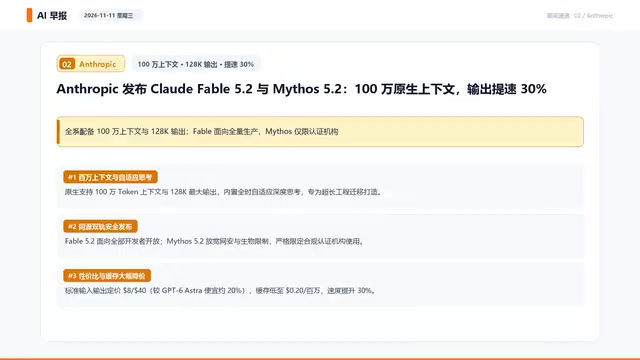
Anthropic has launched two models, Fable 5.2 and Mythos 5.2, sharing the same origin and architecture, with the entire lineup natively equipped with a 1 million Token context window and a maximum output of 128,000 Tokens. The access strategy draws a clear split: Fable 5.2 is fully available to enterprises and developers, while Mythos 5.2 — with relaxed restrictions on research and cybersecurity — is limited to invited, compliance-certified organizations. On pricing, Fable 5.2's input and output pricing is roughly 20% lower than GPT-6 Astra, with caching as low as $0.20, and generation speed improved by 30%. This is a clear signal — trading pricing and speed for market share without sacrificing context length.
Token context window is the maximum amount of text a model can process in a single pass (input plus output). One million Tokens is roughly equivalent to 700,000 to 800,000 English words, or the scale of several long-form books or several mid-sized code repositories. The longer the context, the more a model can complete tasks such as cross-document comparison and long-codebase understanding in one pass without relying on retrieval-augmented (RAG) chunking. But long context places higher demands on memory, attention computation complexity, and inference cost, and the industry often mitigates this with techniques like sparse attention and block caching. Anthropic's native million-token window across its lineup means its architecture and inference stack were optimized for long sequences at the design stage, rather than being bolted on afterward.
OpenAI: Deepening Into Security Verticals
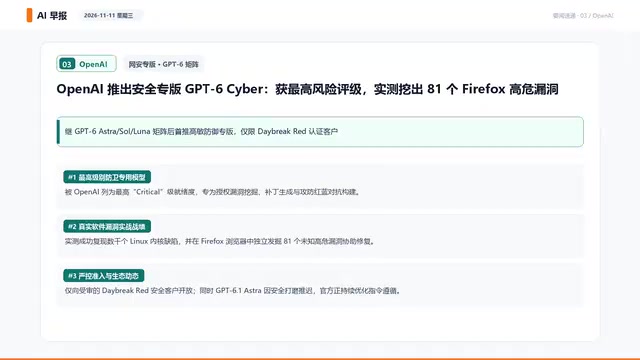
Following the GPT-6 Astra, Soul, and Luna family, OpenAI has launched GPT-6 Cyber and rated it at the highest preparedness level. This edition is purpose-built for authorized vulnerability discovery and red-team/blue-team exercises, having empirically reproduced thousands of Linux kernel flaws and independently uncovered 81 unknown high-severity vulnerabilities in Firefox to assist with fixes. It is currently limited to Daybreak Red certified security customers, and the company is also accelerating work on GPT-6.1. Handing the most capable — and highest-risk — model to certified security teams is a compromise OpenAI has found between capability release and risk control.
Preparedness is an internal tiering framework OpenAI uses to assess a model's potential for misuse in high-risk domains such as biology, cybersecurity, and chemistry. The higher the level, the stronger the model's actual capability in the relevant domain and the more severe the potential consequences of misuse. Being rated at the highest preparedness level typically means the model has near-expert-level practical capability in cyber offense and defense and vulnerability discovery, and therefore must be paired with stricter access controls, usage monitoring, and customer qualification review. GPT-6 Cyber being open only to certified security customers is a direct manifestation of this tiering system in release strategy.
The Open-Source Camp Advances on Two Fronts
Mistral and Meta Make Different Trade-offs
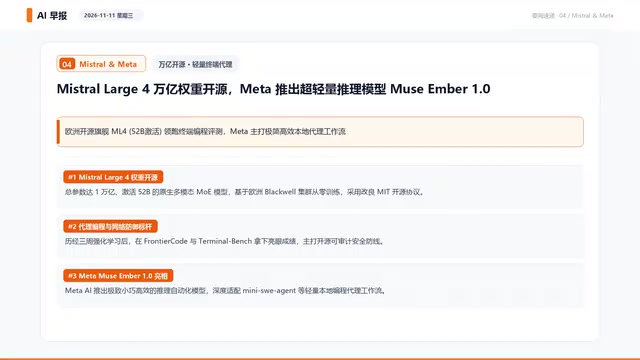
Mistral AI has officially open-sourced Mistral Large-4, a trillion-parameter native multimodal model with 52 billion active parameters for inference, trained on Blackwell clusters in Europe, and released under a modified MIT license. After reinforcement-learning fine-tuning, it performs impressively on terminal coding benchmarks. Meta, meanwhile, has introduced Muse Amber 1.0, an ultra-lightweight, efficient inference model — small in size but purpose-built for development automation, capable of smoothly driving lightweight local coding agents. One pursues the upper limit of scale, the other lowers the deployment barrier — the division of labor in the open-source ecosystem is becoming clearer.
Moonshot AI: Kimi K3.1 Pro Fully Open-Weights
Moonshot AI has open-sourced the full weights of its flagship model Kimi K3.1 Pro on Hugging Face, with 2.8 trillion total parameters, 104 billion active, equipped with sparse attention and a million-token window, gaining VLM support on day one and integrating with Microsoft's platform. Full weight availability plus a million-scale window makes this one of the few directly deployable options currently available for teams wanting to build large-context applications. On Alibaba's side, the official account posted a four-word teaser, "The Becoming Begins," and combined with arena blind-test signals, QN4's unveiling is not far off.

Total parameters vs. active parameters are a pair of key metrics in Mixture-of-Experts (MoE) architectures. Total parameters refers to the sum of all expert weights in the model, while active parameters refers to the number of parameters actually involved in computation during a single forward inference pass. Kimi K3.1 Pro has 2.8 trillion total parameters but only 104 billion active, meaning each inference invokes only about 3.7% of the parameters, greatly reducing per-pass computation while retaining the model's knowledge capacity. Sparse attention further lets the model focus only on some relevant positions under a million-scale window, controlling the computational overhead of long context. Full open weights allow researchers and enterprises to deploy, fine-tune, and audit the model themselves, in sharp contrast to API-only access.
Compute Ecosystem and Embodied Intelligence
Domestically, DeepSeekAd V4.1 Flash continues to spawn ultra-fast inference optimization variants, and Zhipu has officially disclosed a dual-track roadmap for its trillion-parameter GLM 5.4 and 5.5, strengthening AutoGLM agent capabilities. Overseas, Adobe and Google announced deepened collaboration at Adobe Max, bringing frontier visual generation fully into Photoshop and related product lines; Nvidia unveiled its robotic world-action model GRM at the Core conference, accelerating the rollout of embodied intelligence.
From Gemini 4 Carbon's Ultra-only availability, to the Claude twins with million-token context, to trillion-parameter open weights and breakthroughs in embodied intelligence, a common trend is visible: the bar for competition is no longer just parameter scale, but a combined contest of context length, open strategy, pricing structure, and vertical-scenario capability. For developers and enterprises, the complexity of model selection is rising, but the range of available tools is expanding in tandem.
One-line Summary
Google, Anthropic, OpenAI, and the open-source camp upgrade in sync, as LLM competition shifts to systematic combined contests.
Paragraph Summary
This article reviews the latest wave of LLM releases: Google launched Gemini 4 Carbon alongside the multi-agent collaboration tool Swarm, Anthropic entered with a dual-model strategy of Fable 5.2 and Mythos 5.2 featuring million-token context, and OpenAI introduced GPT-6 Cyber, its highest-preparedness security edition. On the open-source side, Mistral open-sourced the trillion-parameter Mistral Large-4, Moonshot AI open-sourced the full weights of the 2.8-trillion-parameter Kimi K3.1 Pro, and Meta introduced the lightweight Muse Amber 1.0. The article notes that the competitive bar has shifted from parameter scale to a combined contest of context length, open strategy, pricing structure, and vertical-scenario capability — selection complexity is rising, but the range of tools is expanding in tandem.
Related articles

How Do Cursor, Devin, TRAE, and Copilot Compare on Price? Calculate Your Credits Before You Compare Monthly Fees
Side-by-side comparison of individual and team pricing for Cursor, Devin Desktop, TRAE, and Copilot, breaking down credit rules, third-party model inclusion, overage billing, and practical methods for measuring usage before paying, setting spending caps, and choosing the right tool.
Copilot Retires Three Models: Pro Users Left With Only One Alternative
GitHub Copilot retires Claude Opus 4.8, Claude Opus 5, and GPT-5.6 Tera on Nov 16 across Chat, code completion, and Agent mode. Pro users have only GPT-6 Luna left; Legacy annual plans miss Opus 5.5; admins must enable replacements manually.
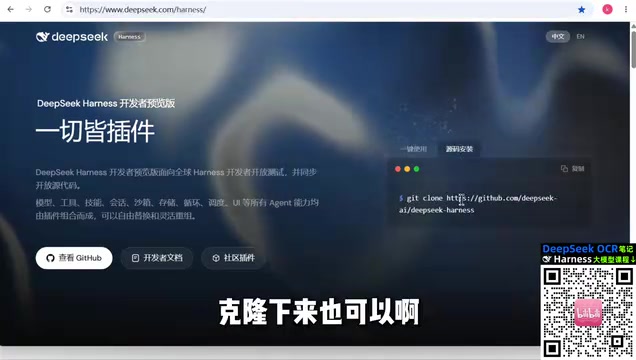
What Is DeepSeek Harness? The Entire Engineering Layer Beyond the Model
What is DeepSeek Harness? Starting from the horse-tack metaphor, this article explains that Harness is the engineering system beyond the model—covering prompts, tool calls, memory, sandbox, and orchestration—and analyzes its open-source "everything is a plugin" architecture along with the significance of its four operating modes.