Agent Hands-On Project Learning Path: A Guide from Beginner to Advanced Interview Prep

Source-code-based Agent concept cards using gradient learning from LLM APIs to enterprise scenarios.
This Agent learning material, based on Hermes analysis of 177 articles, distills 180+ knowledge points into a gradient path from foundational LLM APIs to enterprise multi-tenant scenarios. Its core feature is the "concept-evidence-application" chain: each card cites original sources and cross-framework naming differences to avoid LLM hallucinations. It proposes a multi-tier gradient method and supports both interview sprinting and daily reference, with suggestions to import into Codex or Claude for personalized plans.
Why Agent Learning Needs a Systematic Roadmap
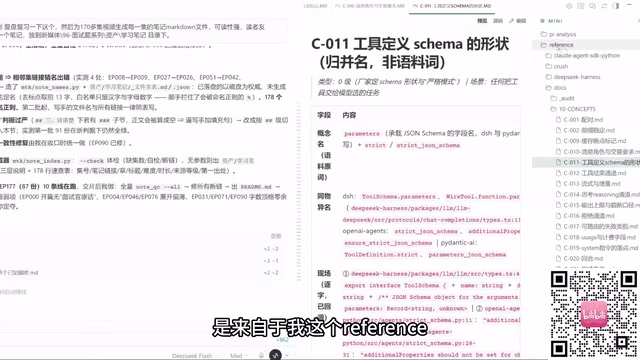
Agent tutorials are everywhere, but content that genuinely helps you build a knowledge system from scratch and hits interview key points directly is rare. According to a Bilibili creator, a set of Agent concept cards generated based on Hermes analysis covers 177 articles and 180+ knowledge points, extending from large model foundational interfaces all the way to enterprise-level multi-tenant scenarios, forming a clear gradient learning path.
The core logic of this material is not to make you memorize by rote, but to start from the source code of real open-source Agent frameworks and build a complete chain of "concept—evidence—application."
Gradient Learning Method: From LLM APIs to Enterprise-Level Agents
Tier 1: Foundational Capabilities of Large Models
All Agents are built around large models — no model, no Agent. The core of this tier is understanding what interfaces and capabilities large models provide — API constraints, context window limitations, and how to configure max output tokens. These seemingly basic topics are exactly the underlying knowledge that many interviewees tend to overlook.
Starting from the most fundamental physical world and understanding API call logic is what lays a solid foundation for subsequent Agent development.
Context Window refers to the maximum number of tokens a large model can process in a single inference, covering the sum of input (prompt) and output (completion). Content exceeding the window gets truncated or causes the call to fail, making it a hard constraint in Agent design. Window sizes vary significantly across models, from early 4K and 8K to today's 128K or even 1M. In practical development, the context window directly determines how much conversation history an Agent can "remember" and how many tool return results it can stuff in. When multi-turn conversations or long tasks accumulate tokens approaching the limit, strategies like summary compression, sliding windows, and vector retrieval need to be introduced — this is also the prerequisite knowledge for the later concept of "context degradation."
Max Output Tokens (max_tokens) is a parameter used during API calls to limit the length of a single response, and it's an independent dimension from the context window. Many beginners mistakenly believe that a large window means long output — in reality, output length often has a separate cap, and setting it too small leads to chain reactions like hard truncation of answers, JSON parsing failures, and incomplete tool call parameters. Understanding the boundaries of these two parameters is the first lesson in building a stable Agent.
Tier 2: From Chat to Tool Calling
After mastering basic APIs, the next step is building a simple chat application, then gradually transitioning to an Agent that can call tools. The key at this stage is understanding how Agents extend their capability boundaries through tools.
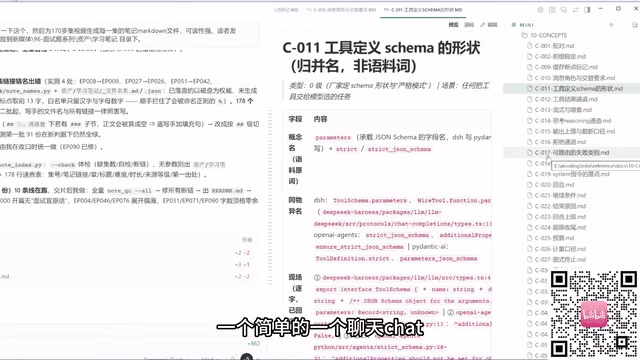
Tool Calling / Function Calling is the key mechanism for large models to move from "only able to chat" to "able to do things." The principle: developers describe available tools' names, parameters, and purposes to the model using structured schemas (usually JSON Schema). During inference, if the model determines external capabilities are needed, it outputs a call request conforming to the schema, which an external program executes and returns the result to the model for continued reasoning. This process connects the model's semantic understanding with the external world (databases, APIs, file systems).
The difficulty of tool calling isn't in the call itself, but in orchestration: when to call, how to retry on failure, how to chain or parallelize multiple tools, and how to trim overly long return results. These engineering details determine an Agent's reliability. Mainstream Agent frameworks (like LangChain, Hermes, Gemini CLI) have different abstractions for tool calling, and the same concept has inconsistent naming and parameter formats across frameworks — this is exactly why the concept cards emphasize "cross-framework naming comparison."
Tier 3: Long Tasks and Enterprise-Level Scenarios
When Agents need to handle long-cycle tasks, support multi-tenancy, and multi-agent collaboration, complexity rises sharply. This is when you need to understand enterprise-level concepts like quota management, metering standards, and context degradation. The creator particularly emphasizes that in multi-agent or programmatic tool calling scenarios, you must "define the standards before discussing launch."
Metering and Quota Management are two concepts that enterprise-level Agents can't avoid. Metering refers to "what unit and what rules are used to measure resource consumption" — is it by token count, by number of calls, or by tool execution time? Inconsistent metering standards will cause billing, rate limiting, and SLA to fail to reconcile with each other. Quota management, building on metering, sets consumable limits for each tenant and each user to prevent single-point abuse from dragging down the entire service.
Multi-tenancy requires the same Agent service to logically isolate different customers' data, configurations, and resources while sharing underlying infrastructure. This brings complex issues like permission isolation, context isolation, and cost allocation. Context degradation refers to how, in long tasks, as conversation history accumulates, the model's attention gets diluted and early key information gets buried, leading to declining response quality. Common countermeasures include summary compression and externalizing key information to tools or vector stores. The creator emphasizes "define standards before discussing launch" precisely because once these concepts are launched and then changed, migration costs are extremely high.
Concept Cards: A Dual Tool for Interview Sprinting and Daily Reference
Every Concept Is Verifiable
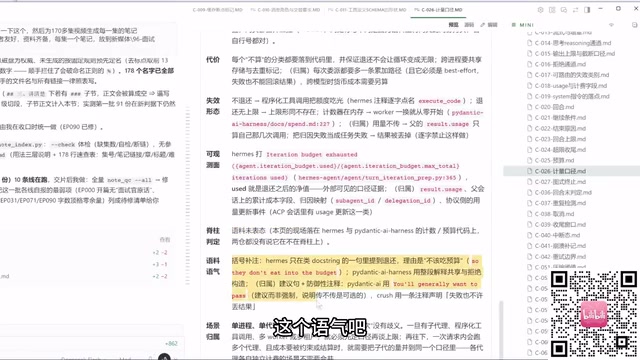
The most prominent feature of this material is "no evidence, no citation, no validity." Each concept card labels: the concept name, the original corpus source (which Agent framework it comes from), and naming differences across frameworks. For example, the same concept may have different names in frameworks like Hermes and Gemini CLI — this comparison helps you demonstrate deeper understanding in interviews.
Why You Can't Rely Entirely on LLMs to Generate Interview Prep Material
Using large models directly to prepare interview talking points carries obvious risks — models can produce hallucinations, generating outdated or incorrect content. An interviewer can tell immediately that you've memorized "fake knowledge." These concept cards, however, are based on real source code analysis. Every knowledge point has a clear contextual connection — for example, why the concept of "metering" was forced into existence and what new capabilities it spawned — all have complete logical chains.
Hallucination refers to a model generating seemingly reasonable but actually incorrect content when lacking factual basis, including fabricating API names, inventing parameters, and confusing version differences. In technical interview scenarios, the harm of hallucination is particularly evident: the model may generate long-deprecated interface usage or misattribute concepts from different frameworks. Interviewers can easily identify rote-memorized answers by asking "which framework did this concept appear in, and why was it needed?"
Source code evidence chains are an effective means of resisting hallucination. Concept cards require every knowledge point to label the original corpus source, framework name, and naming differences across frameworks, forming a closed loop of "concept—evidence—application." The value of this methodology lies in: when you can clearly explain what problem forced a concept into existence and what new capabilities it spawned, you're demonstrating causal understanding rather than memorization — this is exactly the key criterion interviewers use to distinguish real from fake knowledge.
How to Efficiently Use Concept Cards
The creator suggests importing the concept card directory into tools like Codex and Claude, letting the AI first learn the entire directory, then generating a personalized study plan. You can even generate audio format and use TTS to listen on your phone anytime — this approach is extremely low-cost yet fully utilizes fragmented time.
For beginners, if you can't even understand the terminology in the concept cards, it means you haven't yet built a systematic knowledge framework and need to start from the basics.
Efficient Sprint Strategies During Interview Peak Season
September and October are peak interview seasons, and this resource covering 177 articles is perfect as sprint material. It was designed to satisfy two needs simultaneously: rapid memorization for interviews in the short term, and long-term use as a concept reference manual.
Usage is also flexible — you can do specialized analysis for a particular type of Agent, or systematically read through the entire gradient path. The key is understanding the causal relationships between concepts, not memorizing each term in isolation.
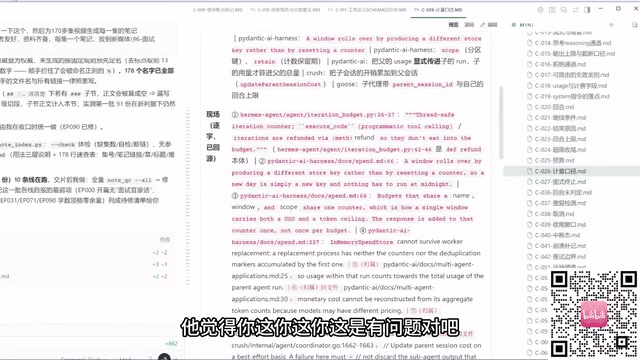
From practical results, a source-code-researched Agent knowledge system is more reliable and deeper than content simply generated by large models. For developers wanting to go deep in the Agent direction, building this "from source code to concept to application" learning path may be more effective than grinding through hundreds of interview questions.
One-line Summary
Source-code-based Agent concept cards, using gradient learning to go from LLM APIs straight to enterprise-level scenarios.
Paragraph Summary
This Agent learning material is based on Hermes analysis of 177 articles, distilling 180+ knowledge points into a gradient learning path from foundational LLM APIs to enterprise-level multi-tenant scenarios. Its core feature is the "concept—evidence—application" chain: each concept card labels original corpus sources and cross-framework naming differences, avoiding erroneous knowledge from LLM hallucinations. The article proposes a four-tier gradient learning method and emphasizes that concept cards serve dual purposes of interview sprinting and daily reference, suggesting importing them into tools like Codex and Claude to generate personalized plans, or even converting them to audio for fragmented learning.
Related articles

Penguin Moves Up Publication of 'Smarter Than Us': An AI Risk Guide for General Readers
Penguin moves up publication of 'Smarter Than Us,' an AI guide co-written with Patchen Barss that explains how AI works and lays out its many risks for non-technical readers.

From Photons to Production: An Open-Source Computer Vision Engineering Reading Path
Reddit user open-sources a computer vision engineering reading path with 16 chapters from image formation to production deployment, emphasizing primary sources, dependency order, and reproducible benchmarks to help engineers understand why models fail and build reliable vision systems.

Prompt Failures? The Truth About Why AI Agents Struggle in Production—and How to Fix It
A Reddit developer built Agents with Copilot and Gemini but faced unstable behavior. This article analyzes three gaps in prompt engineering for Agent scenarios and offers three practical paths to reliable Agent deployment, including structured prompts, workflow-first approaches, and building an evaluation loop.