Agent Inbox: Assigning Email and Instant Messaging Accounts to AI Agents

Agent Inbox assigns email and IM accounts to agents, consolidating multi-channel messaging behind one API.
Agent Inbox is a product that gives AI agents communication identities—dedicated email, Slack, and Telegram accounts—unified behind a single API. It replies on the same channel and thread, isn't tied to any model, and supports Claude, OpenAI, Grok, and Hermes. Positioned at the communication layer, it handles message normalization, attachments, and thread tracking to reduce glue code.
Agent Inbox: Assigning Email and Instant Messaging Accounts to AI Agents
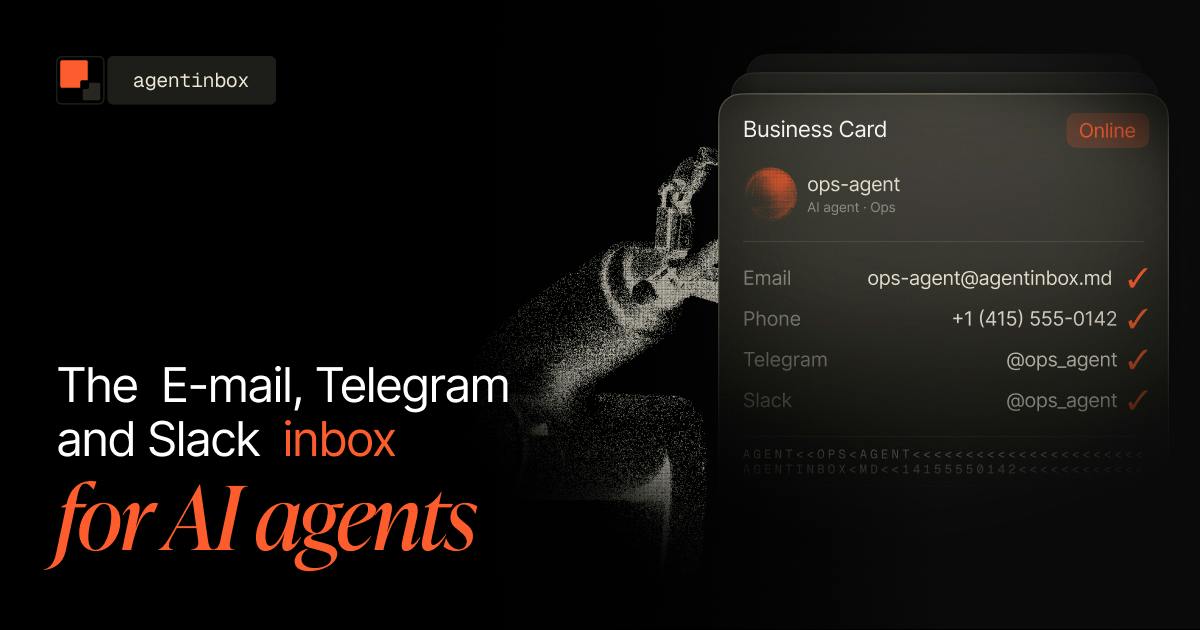
AI agents are moving from chat windows into real workflows, but an awkward question persists: how do you reach them? Most agents can only be accessed through a specific web interface or API call, and can't receive tasks via email or Slack messages like a colleague would. Agent Inbox, ranked #8 on Product Hunt, tries to solve this problem—it assigns each agent a dedicated email address, Slack account, and Telegram account, all unified behind a single API.
From "Calling an API" to "Messaging an Agent"
Agent Inbox's core proposition is straightforward: let agents have a communication identity like a person. Developers don't need to write separate integration code for each channel; instead, through a single unified API, agents gain full inbox capabilities.
Specifically, each agent can get:
- A dedicated email address for receiving and replying to emails
- A Slack handle to participate in conversations within team workspaces
- A Telegram handle for instant responses on mobile
Whichever channel a message comes from, the reply goes back to the same thread on that same channel. This "same-thread reply" design means conversation context doesn't need to be manually carried over—the agent naturally understands whether the user sent the message from email or Slack.
For teams already accustomed to email and instant messaging, this is far more natural than making users go to some dashboard to converse with an agent.
Multi-Framework Compatibility Behind a Single API
Agent Inbox explicitly lists support for Claude, Grok, OpenAI, Hermes, and "any other agent framework." This reveals a key design philosophy: Agent Inbox itself isn't tied to a specific model or inference backend—it handles the "communication layer."
In other words, whether your agent is powered by OpenAI models or built on Claude, Agent Inbox handles message sending and receiving, channel adaptation, and thread management. This positioning lets it serve as a complementary layer to existing agent stacks without requiring developers to refactor inference logic that already works.
What developers save is "glue code"—writing a set of webhook handlers for Slack, a set of bot logic for Telegram, and a set of SMTP parsing for email. This code has no intellectual value in itself yet consumes a lot of debugging time. Agent Inbox consolidates these channel differences behind a single interface, letting developers focus on designing the agent's own behavior.
So-called "glue code" refers to adapter code that doesn't carry core business logic and is only used to connect different systems or components. In multi-channel agent scenarios, typical glue code includes parsing the request body of the Slack Events API, verifying webhook signatures for Telegram bots, and decomposing email MIME format into plain text and attachments. This kind of code isn't technically difficult, but each channel has different edge cases, making debugging costly and prone to becoming a failure point. Once glue code is consolidated into a unified interface, developers only need to maintain a single message contract, and when channels change, there's no need to modify the agent's core logic—reducing long-term maintenance burden.
The Engineering Value of Multi-Channel Routing
From a product perspective, Agent Inbox addresses the narrow but real problem of multi-channel routing. Technical teams are no strangers to this: when an agent needs to connect to email, Slack, and Telegram simultaneously, each channel has different identity authentication, message formats, and session window rules.
Email is asynchronous long-form text, Slack has workspace permissions and a channel model, and the Telegram Bot API has its own set of message types. Unifying these into "one inbox" means doing message normalization, attachment handling, and thread tracking behind the scenes. Agent Inbox encapsulates this complexity, which has practical significance for teams that need to quickly validate agent collaboration scenarios.
However, the product doesn't disclose details about message storage, data retention policies, or fine-grained control of channel permissions. For enterprise users, these details directly affect whether it can be used under compliance requirements.
Message normalization refers to the process of converting raw message formats that differ across channels into a unified internal representation. Email carries body text and attachments in MIME structure, Slack uses JSON-based Block Kit rich-text blocks, and Telegram distinguishes between text, images, files, and other message types. The normalization layer needs to extract sender identity, timestamps, session identifiers, and content body, and handle differences in encoding, length limits, and attachment storage locations. After normalization is complete, downstream agents only need to deal with one message model, and thread tracking and reply routing can also achieve cross-channel context continuity based on unified identifiers.
The Agent Communication Layer Is Becoming an Independent Track
The emergence of Agent Inbox reflects a trend: as agents move from demos to everyday collaboration, the infrastructure around agents is stratifying. The inference layer has model vendors competing, the orchestration layer has frameworks and platforms, and the "communication layer"—how agents are reached and how they proactively initiate conversations—has previously lacked a standardized solution.
Giving an agent an email address sounds like a small feature, but it changes how agents are used. Users don't need to open a specific application; they can message the agent using the tool they're most comfortable with. Agents also transform from "services that are called" into "colleagues you can contact."
Whether this model can succeed depends on two factors: first, the stability of channel coverage and message latency; second, whether the agent can reliably complete tasks and reply after receiving a message. What Agent Inbox currently demonstrates is the capability of the communication layer, while the execution quality of the agent itself still depends on the integrated model and prompt design.
For teams building agent products, the approach offered by Agent Inbox is worth noting: rather than making users adapt to your interface, put the agent in the channels users are already using.
The stratification of agent infrastructure can be understood as follows: the inference layer handles model invocation and generation quality, the orchestration layer handles task decomposition, tool invocation, and multi-agent collaboration, and the communication layer handles message sending and receiving and identity presentation between agents and the outside world. The three layers are decoupled through standard interfaces, allowing teams to independently replace one layer without affecting the others. The reason the communication layer can become an independent layer is that channel adaptation, identity management, and thread maintenance are universal and unrelated to specific models; they have high reuse value and thus the conditions to be productized separately.
One-line Summary
Agent Inbox assigns email and instant messaging accounts to agents, consolidating multi-channel communication behind a unified API.
Paragraph Summary
Agent Inbox is a product that provides communication identities for AI agents, assigning each agent a dedicated email address, Slack account, and Telegram account while encapsulating channel differences through a unified API. Its core design is that messages return to the same thread on whichever channel they came from, so conversation context doesn't need to be manually carried over. The product isn't tied to a specific model and is compatible with frameworks such as Claude, Grok, OpenAI, and Hermes, positioning itself at the communication layer rather than the inference layer, and can serve as a complement to existing agent stacks. It solves engineering problems in multi-channel routing such as message normalization, attachment handling, and thread tracking, reducing developers' glue code. However, details on message storage, data retention policies, and permission control have not yet been disclosed, and enterprise-compliant use remains to be seen. The article argues that the agent communication layer is becoming an independent infrastructure track.
Related articles

Prompt Engineering for Beginners: From Writing Instructions to Systematic Design
A beginner's guide to prompt engineering: the difference between prompts and prompt engineering, the four roles of prompts, the six-step process and four goals, plus key limitations around capability ceilings, stability, hallucinations, context length, and cost.

GPT-6.2 Astra Leaked: Low-End Config Beats Previous Top-Tier, SVG Generation Stuns
Leaked GPT-6.2 Astra benchmarks and SVG demos surface: lowest inference tier beats previous top-tier; same batch includes Tencent HY4, Anthropic FlashProve model verification, DeepSeek V5 Ascend roadmap, and Binance security incident.

PolicyIK: Reinforcement Learning for High-Precision Robotic Arm Inverse Kinematics
PolicyIK uses goal-conditioned reinforcement learning to achieve high-precision robotic arm inverse kinematics, with 93.5% of simulated tasks within 1mm and 0.2° error, a deployment protocol raising success to 98.9%, and the ability to execute VLA policy commands.