Agent Loop Explained: Core Principles and Implementation of the Agentic Cycle

The Agent Loop is the self-driven think-act cycle that separates true AI Agents from ordinary LLMs.
The Agent Loop is the core mechanism that defines AI Agents: unlike standard LLMs that passively express tool-call intent, agents autonomously cycle through reasoning, tool execution, and re-evaluation until a task is complete. Rooted in the ReAct paradigm, this while-loop-based architecture underpins all modern agent frameworks, from LangChain to LangGraph.
What Is an Agent Loop
In the world of AI Agents, the Agent Loop is a foundational concept you simply can't avoid. To understand it, it helps to start with the essential difference between a large language model and an agent.
Whether you're a developer who has worked with frameworks like LangChain or someone just getting started with AI applications, you've almost certainly heard the term "agent." But few people can clearly articulate what sets it apart from a regular LLM. The most important distinction lies in how agents handle tool calls — a fundamentally different approach from what ordinary LLMs do.
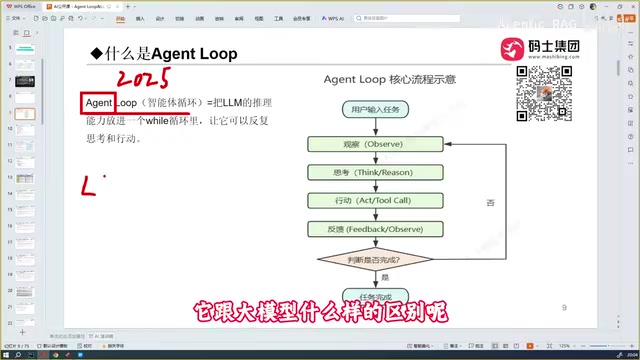
A standard LLM can call tools to access external knowledge, but this process requires human intervention. The model can only "reason" about which tool to call — the actual execution typically needs to be triggered manually by a developer. In other words, tool calling in a regular LLM is passive, requiring a human to wire everything together.
Background: The Origins of Tool Calling The tool-calling capability of LLMs traces back to the Function Calling mechanism introduced by OpenAI in 2023, which was subsequently adopted by Anthropic, Google, and other major model providers. The core design is this: the model can "declare" during inference that it wants to call a specific function with specific parameters — but the actual execution must be carried out by an external system. This is fundamentally an "expression of intent" rather than "autonomous execution" — the model tells the external program "I want to call the search tool with the argument 'today's weather,'" but the actual network request is made by external code. It is precisely this passive design that defines the core boundary between ordinary LLMs and AI Agents.
The Autonomous Cycle of an Agent
The defining characteristic of an AI Agent is its autonomy. An agent doesn't just call tools — it can also reason again after receiving a tool's result, deciding whether it needs to call additional tools to gather more information, or whether it already has enough to give the user a final answer.

Embedded in this behavior is a loop mechanism. The agent continuously iterates through Think → Act → Think Again → Act Again, cycling until it judges that the information collected is sufficient to answer the user's question. This self-driven, iterative process is the very essence of the Agent Loop.
Theoretical Roots: The ReAct Paradigm The "think-act" cycle of the Agent Loop has a well-defined academic origin — the ReAct (Reasoning + Acting) paradigm proposed jointly by Google and Princeton University in 2022. The core insight of ReAct is to interleave the model's language reasoning traces with external tool execution in a single sequence, enabling the model to "think while doing." The paper demonstrated that this approach significantly outperforms pure reasoning (Chain-of-Thought) or pure execution on complex question answering, fact verification, and interactive decision-making tasks. Most modern Agent frameworks' loop mechanisms can be seen as engineering implementations of the ReAct paradigm, and its three-part Thought / Action / Observation structure remains the dominant design template for Agent prompts today.
Simply put, an agent is no longer a static "question-in, answer-out" model. It is an actor that dynamically adjusts its strategy based on intermediate results — actively evaluating its current state and deciding what to do next. This capability makes it far more powerful than a standalone LLM when handling complex tasks.
How the Agent Loop Works
From an engineering perspective, the early Agent Loop was surprisingly straightforward. At its core is a while loop: the program repeatedly calls the LLM, feeds in the user's request, observes the model's output, and decides on the next action.
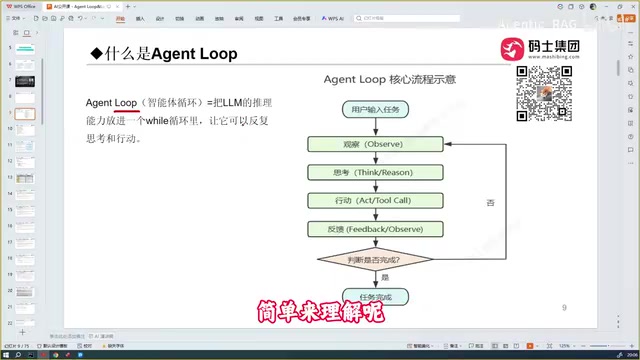
The entire flow can be broken down into the following key steps:
1. Observe and Reason
After the user provides input, the LLM first observes and reasons about it, deciding what action to take — whether to answer the user directly or call a tool to gather additional information.
2. Act (Tool Call)
If the model determines a tool call is necessary, it executes the appropriate tool and feeds the returned result back into the loop.

3. Evaluate and Terminate
After receiving the tool's result, the model re-enters the reasoning phase to determine whether it now has enough to deliver a final answer to the user. This is the critical termination check: if the model considers the current information sufficient, it outputs a final answer and completes the conversational loop.
If the information is still insufficient, the loop continues — the agent calls another tool, reasons again, and repeats until the termination condition is met.
Engineering Detail: Termination Conditions and Safety Mechanisms The termination logic of an Agent Loop is one of the most easily overlooked challenges in implementation. Common termination strategies operate on three levels: ① Semantic termination — the model outputs a specific "final answer" marker (such as the
Final Answer:prefix in LangChain), which the program detects to exit the loop; ② Iteration cap — amax_iterationslimit is enforced (typically defaulting to 10–15), after which execution is forcibly terminated and the best available result is returned; ③ Timeout protection — atimeoutparameter prevents a single tool call from blocking the entire loop. Infinite loops are a high-risk failure mode in production agent systems. Common causes include tools returning empty results due to errors, hallucination-driven faulty reasoning chains, and circular dependencies between tools. Mature frameworks typically layer all three mechanisms together for multi-level protection.
Why Mastering the Agent Loop Matters
Understanding the Agent Loop means understanding the underlying runtime logic of modern AI Agent applications. This "think-act-think" cycle is the foundational paradigm for building agentic systems — no matter what framework or use case you're dealing with, you can't avoid it.
For developers, mastering the Agent Loop means:
- Being able to design an agent's decision-making workflow from scratch, rather than just calling an LLM API
- Deeply understanding how tool calls and reasoning connect, enabling you to build more complex, multi-step tasks
- Grasping the logic behind loop termination, effectively preventing agents from running forever or stopping prematurely
From the humble while loop as a starting point, to today's sophisticated Agent frameworks, the core remains a continuation and evolution of this looping concept.
Framework Evolution: From While Loops to Directed Graphs The engineering implementation of the Agent Loop has gone through three distinct phases. Phase 1 was the bare while loop — developers manually managed state, parsed model output, and routed tool calls. Flexible, but error-prone. Phase 2 was exemplified by LangChain's
AgentExecutor, which encapsulated the loop into a standardized workflow with built-in Agent types (Zero-shot ReAct, Conversational, OpenAI Functions Agent, etc.), dramatically lowering the barrier to entry. Phase 3 is represented by LangGraph and Microsoft AutoGen — LangGraph abstracts the loop into a stateful directed graph where nodes represent computation steps and edges represent conditional routing, natively supporting branching, parallelism, and human-in-the-loop collaboration; AutoGen introduces a multi-agent conversation framework that lets multiple agents cooperate within the loop to accomplish complex tasks. Understanding the most fundamental while loop logic is a prerequisite for reading these frameworks' design philosophies and building on top of them.
Conclusion
The Agent Loop is the critical step from "large language model" to "AI Agent" — it endows AI systems with the ability to think autonomously, take proactive actions, and make dynamic decisions. Once you understand this loop mechanism, you've laid the first cornerstone of agent development.
For learners who want to go deep into AI Agent development, the recommended path is to start with the most basic while loop implementation: manually write a simple agent that can call tools autonomously and reason in a loop, then gradually transition to using mature frameworks. From the theoretical principles of the ReAct paradigm, to LangChain's encapsulated implementation, to LangGraph's graph-based orchestration — following this path from first principles to practical application will help you truly internalize how agents work, rather than staying at the surface level of framework API calls.
Key Takeaways
Related articles
Claude Completes First Formal Proof of Fermat's Last Theorem: A Record-Breaking 13 Million Lines of Lean Code
Anthropic's Claude completes the first formal proof of Fermat's Last Theorem in over 13 million lines of Lean code — the largest ever — plus 29,000+ subsidiary theorems, opening new paths for AI-assisted math verification.

Microsoft Copilot Enters the NFL: How AI Is Supporting On-Field Decision-Making
Microsoft Copilot and Excel are entering NFL sidelines and booths, helping Seahawks analysts and coaches with real-time game decisions. Here's what it means for AI in pro sports.
Microsoft Copilot Goes Autopilot: From Assistant to Autonomous Long-Running Task Execution
Microsoft is evolving Copilot into autonomous Autopilots powered by Opal and Windows 365 cloud PCs, enabling end-to-end completion of long-running tasks without human intervention.