agent-manager: Unified Management of 6 Major AI Coding Assistants with tmux

Open-source tmux-based tool for managing multiple AI coding agents in a unified terminal workflow.
agent-manager is an open-source Go tool that unifies management of six AI coding assistants (Claude Code, Codex, Gemini CLI, OpenCode, Grok, Pi) through tmux. It provides live session status, keyboard shortcuts for responding to blocked agents, conversation forking, code review with line-level comments, and git worktree isolation for parallel development — solving the growing complexity of multi-Agent programming workflows.
When AI Coding Assistants Multiply, Management Becomes the New Problem
With the explosive growth of AI-assisted programming tools, developers often find themselves running multiple AI Agents simultaneously: Claude Code, Codex, Gemini CLI… Each tool occupies its own terminal window, and switching between, monitoring, and responding to them has become a real headache.
The open-source tool agent-manager, recently launched on Product Hunt, was created specifically to solve this pain point. Its positioning is crystal clear — "The fastest workflow for developing with AI." After launch, it quickly garnered 86 votes and reached #13 on the daily leaderboard, categorized under Open Source, Developer Tools, and Artificial Intelligence.
One tmux List to Rule Six AI Agents
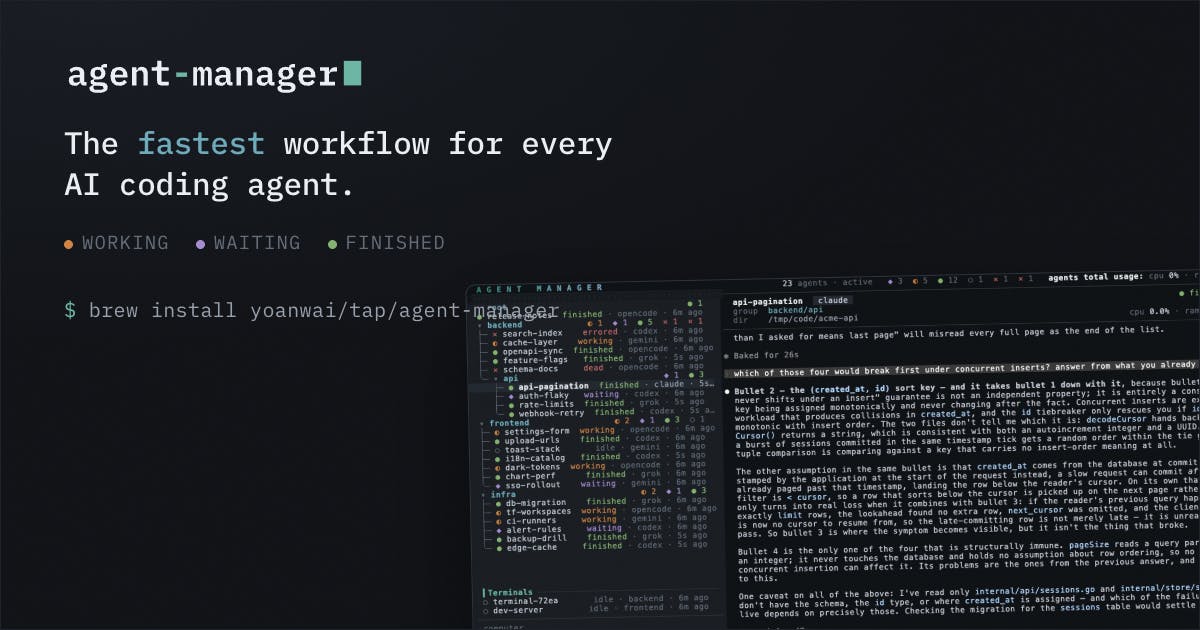
The core capability of agent-manager is integrating all mainstream AI coding assistants into a single tmux list for unified management.
A brief background on tmux is helpful here: tmux (Terminal Multiplexer) is a terminal multiplexer that allows users to create and manage multiple virtual terminal sessions within a single terminal window. Its key features include session persistence (processes continue running in the background after disconnection), window splitting, and session attach/detach mechanisms. tmux has extremely high adoption rates in server operations and developer communities, and is considered foundational infrastructure for command-line workflows. agent-manager's choice to build on tmux leverages both its session management capabilities and developers' existing habits.
Currently supported Agents include:
- Claude Code (Anthropic)
- Codex (OpenAI)
- OpenCode (open-source solution)
- Gemini CLI (Google)
- Grok (xAI)
- Pi
More importantly, each session comes with live status display (live status per session). Developers can see at a glance which Agent is working, which is blocked, and which is waiting for input — without attaching to each terminal individually. This "dashboard-style" view fundamentally transforms the multi-Agent parallel development experience.
Carefully Crafted Keyboard Shortcuts
What truly makes agent-manager feel professional is its polished keyboard interaction design. All operations can be completed via keyboard shortcuts — no mouse needed, no constant jumping between sessions:
Quickly Respond to Blocked Agents
When an AI Agent is stuck waiting for your confirmation, you don't need to switch over to it. Simply press Space to answer the blocked Agent, keeping your workflow uninterrupted.
Fork Conversations
Press f to fork the current conversation into a named sibling session.
The concept of conversation forking draws from the branching philosophy in version control systems, and applying it to AI conversation management is an innovative design. In real development, developers frequently face decision points like "should I try a different approach?" The traditional approach is either starting a new conversation (losing context) or continuing in the current one (polluting the original line of thinking). The fork mechanism allows creating parallel exploration paths while preserving complete context — similar to Git's branch operation. The original conversation remains as the mainline, while the forked "sibling session" inherits the full history but can evolve independently. This is extremely useful when exploring different implementation approaches — you can preserve the original context while opening a new conversation branch to try an alternative strategy.
Pin a Plain Shell
Press T to pin a plain shell terminal alongside your Agents. This lets you execute regular command-line operations while collaborating with AI, keeping your workflow unified.
Full-File Diff and Code Review
Press ctrl+r to open a full-file diff view. You can add line-level comments here, and these comments are aggregated into a unified review prompt sent back to the Agent. This design is quite clever — it seamlessly transforms human code review habits into instruction input for AI.
Deep Integration with Git and tmux
agent-manager is also thoughtfully designed at the engineering level.
Each session can spawn into an independent git worktree. Git worktree is a feature introduced in Git 2.5 that allows simultaneously checking out multiple working directories in the same repository, with each worktree corresponding to a different branch. Unlike traditional git stash or branch switching, worktrees let developers operate on different branches' code in parallel across different directories without uncommitted change conflicts. In multi-Agent scenarios, each Agent working in an independent worktree means they can freely modify files without overwriting each other's work, ultimately merging their results through merge operations. This design is particularly suited for having multiple Agents handle different tasks simultaneously, avoiding the chaos of branch switching.
Additionally, it maintains excellent compatibility with the tmux ecosystem: regular tmux sessions survive after exiting the manager. In other words, agent-manager only provides a management layer on top of tmux without disrupting your existing terminal environment. This "non-invasive" design philosophy is very friendly to existing tmux users.
Lightweight, Open Source, Cross-Platform
From a technical standpoint, agent-manager takes a minimalist approach:
- Single Go binary: No complex dependencies, download and run immediately, fast startup.
- Apache-2.0 open-source license: Business-friendly, free to use and modify.
- Cross-platform support: Native support for macOS and Linux; Windows users can run it via WSL2.
Author Yoan Wainmann packed all functionality into a single Go binary — a technical choice that ensures both performance and low barrier to entry. Go compiles to statically-linked single binary files with no external runtime or dynamic library dependencies. This distribution method, compared to Python (requiring virtual environments) or Node.js (requiring npm dependency installation), offers extremely low deployment friction. Users simply download the platform-appropriate binary and run it — no need to install interpreters or manage dependency version conflicts. Well-known developer tools like Docker, Kubernetes, and Terraform all use the same Go single-binary distribution strategy, which has become the gold standard in the developer tools space.
Why agent-manager Deserves Attention
AI programming is currently transitioning from "single assistant conversations" to a "multi-Agent collaboration" phase. Between 2024-2025, AI programming tools rapidly evolved from single-conversation mode to multi-Agent architectures. Anthropic's Claude Code, OpenAI's Codex CLI, Google's Gemini CLI and other products successively launched command-line versions, enabling developers to collaborate with AI directly in the terminal. The logic behind this trend is that different models excel at different tasks — Claude excels at complex reasoning and long-context understanding, Codex stands out in code generation, and Gemini has unique advantages in multimodal and large-scale codebase analysis. Consequently, professional developers have begun choosing the most suitable model based on task characteristics, creating demand for Agent orchestration tools.
However, the management complexity brought by multi-Agent setups has long lacked good solutions.
The value of agent-manager lies precisely in addressing this emerging real pain point:
- It doesn't try to reinvent an IDE — instead, it builds on tmux, infrastructure developers already know well;
- It distills high-frequency actions like "status monitoring," "quick response," "conversation forking," and "code review" into keyboard operations;
- It leverages git worktree to solve the isolation problem of multiple Agents modifying code in parallel.
For developers already deeply embedded in command-line AI tools and accustomed to tmux workflows, agent-manager offers a more efficient and organized multi-Agent development paradigm. As the number of AI coding Agents continues to grow, this category of "Agent orchestration/management" tools will likely become the next essential tooling category.
Key Takeaways
Related articles

Risklytics: An Insurance Brokerage Platform Built for Frontier Tech Companies in AI, Nuclear Fusion, and Beyond
YC S26 startup Risklytics provides specialized insurance brokerage for AI, nuclear fusion, and autonomous driving companies, solving the gap where traditional insurance fails to cover emerging tech risks.

Coze 3.0 Workflow in Practice: Build an Automated AI Agent in Three Steps
Learn to build AI Agents on Coze 3.0 in three steps: prompt engineering & API calls, RAG knowledge base construction, and multi-agent autonomous decision-making for low-code AI app development.
Gemini 3.5 Transcribe Explained: From Dictation to Intelligent Speech-to-Text
An in-depth look at Google Gemini 3.5 Transcribe's intelligent speech-to-text capabilities, covering contextual correction, terminology recognition, and real-world applications.