Gemini 3.5 Transcribe Explained: From Dictation to Intelligent Speech-to-Text
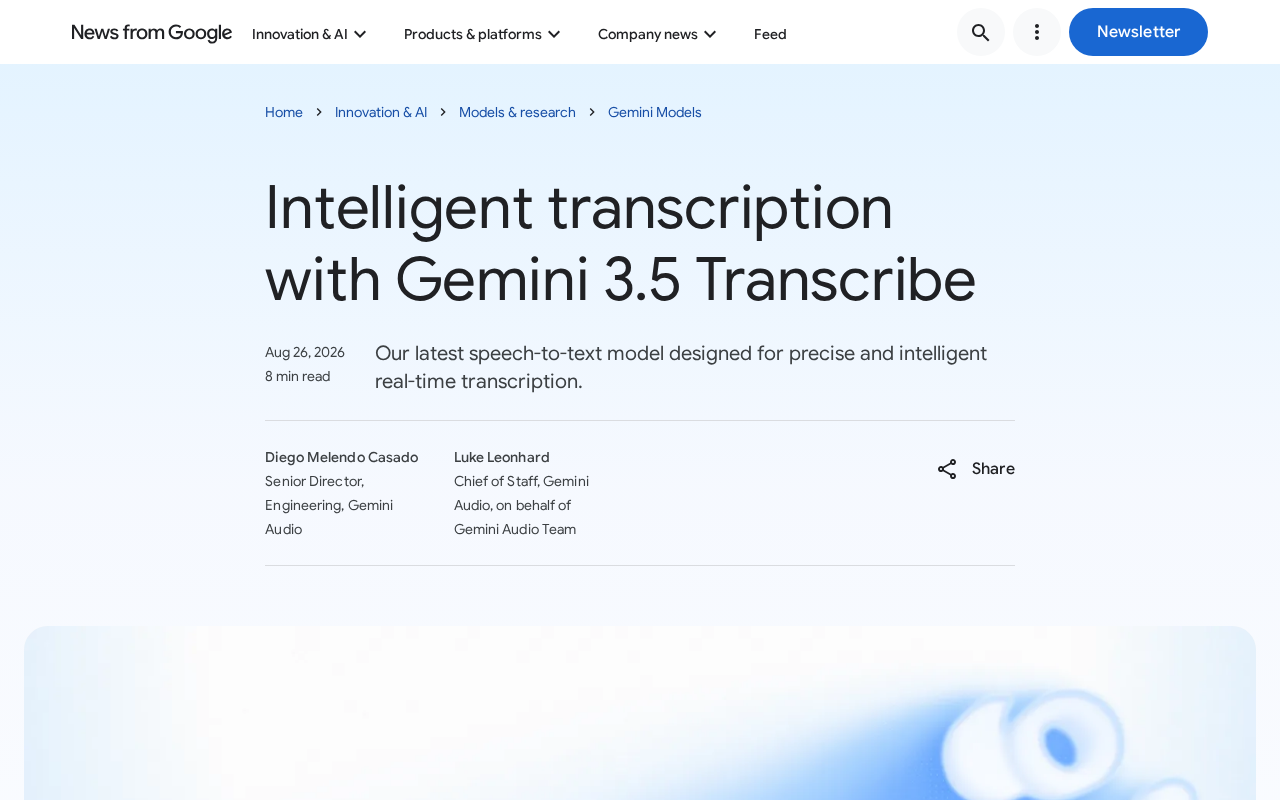
Gemini 3.5 Transcribe brings LLM-powered semantic understanding to speech-to-text transcription.
Google's Gemini 3.5 Transcribe moves beyond traditional dictation-style speech-to-text by integrating large language model capabilities for contextual error correction, specialized terminology recognition, and spoken language cleanup. This article examines its core features, application scenarios including meeting minutes, content creation, and compliance auditing, as well as open questions around multilingual support, latency, and cost.
Introduction: Speech Transcription Enters the Intelligence Era
Speech-to-Text (STT) technology has been around for years, but it has long faced the same bottleneck: machines can "dictate," but they struggle to truly "understand." Traditional transcription tools tend to reproduce spoken content word-for-word, falling short when encountering misspoken words, repetitions, specialized terminology, or multi-speaker conversations. Google's newly launched Gemini 3.5 Transcribe targets precisely this pain point—it no longer just converts sound into text, but brings genuine semantic understanding to the transcription process.
What Is Gemini 3.5 Transcribe
According to official release information, Gemini 3.5 Transcribe delivers "more intelligent speech-to-text transcription." The keyword here is intelligent—it means transcription is no longer a simple mapping from acoustic signals to characters, but incorporates the deep comprehension capabilities of large language models.
The Technical Leap from "Dictation" to "Understanding"
Traditional STT systems are essentially combinations of acoustic models and language models, primarily aimed at accurately recognizing every syllable. Gemini 3.5 Transcribe, built on the underlying capabilities of the Gemini series multimodal large models, can perform semantic reasoning based on context while transcribing. This leads to several direct improvements:
- Contextual error correction: When pronunciation is unclear or environmental noise interferes, the model can infer the most reasonable word based on surrounding context, rather than mechanically outputting an incorrect approximation.
- Specialized terminology recognition: In fields like healthcare, law, and finance, proprietary terms are a persistent challenge for traditional transcription. A model with semantic understanding can better handle these high-difficulty scenarios.
- Spoken language cleanup: Real speech is filled with filler words like "um," "uh," and "you know," along with repetitions and self-corrections. Intelligent transcription can produce cleaner text while preserving the original meaning.
Why Intelligent Transcription Matters
Large Models Reshaping Traditional Speech Recognition
The emergence of Gemini 3.5 Transcribe is yet another typical case of large language model capabilities permeating traditional AI tasks. In the past, speech recognition, machine translation, and text summarization were each handled by separate specialized models. Now, these capabilities are being unified under powerful general-purpose foundation models. This trend of reconstructing traditional tasks with large models means the performance ceiling for individual tasks has been significantly raised.
For developers and enterprises, the practical value of this shift is clear: there's no longer a need to stitch together multiple tool chains—first transcribe, then correct errors, then summarize—when a single model can complete the entire pipeline from audio to high-quality structured text.
Core Application Scenarios for Intelligent Transcription
Intelligent transcription has a wide range of real-world applications:
- Meeting notes and minutes generation: Automatically generating accurate, readable meeting minutes, identifying different speakers, and organizing key points.
- Media and content creation: Subtitle generation and transcript preparation for podcasts and videos, dramatically reducing post-production editing costs.
- Customer service and compliance auditing: Accurate transcription of call recordings is critical for quality inspection and compliance audits.
- Accessibility services: Providing real-time, accurate speech-to-text conversion for people who are deaf or hard of hearing.
Key Questions to Consider Before Adoption
You may not have noticed, but the publicly available information is fairly brief. The official announcement emphasizes the core selling point of being "more intelligent" without disclosing detailed technical metrics such as Word Error Rate (WER), number of supported languages, real-time performance, or pricing strategy.
Therefore, until formal benchmarks and third-party evaluations are released, expectations about actual performance should remain measured. Several questions worth ongoing attention include:
- Multilingual and dialect support: Does it cover a sufficiently broad range of languages, and how does it perform with complex languages like Chinese?
- Real-time transcription latency: Does intelligent inference introduce noticeable delays that could affect the user experience in real-time scenarios?
- Cost and scalable deployment: Large model-based transcription typically costs more in compute than traditional approaches—can it be price-competitive?
Conclusion
Gemini 3.5 Transcribe represents an important step in the evolution of speech transcription technology from "accurate recording" to "intelligent understanding." When the semantic capabilities of large language models are injected into traditional STT tasks, transcription quality, usability, and scenario adaptability are all poised for comprehensive improvement.
For industries and developers that rely on speech-to-text, the maturation of such tools will continue to lower the barriers to information processing. However, ultimate real-world value still needs to be validated through testing in actual scenarios. As more technical details and user feedback become available, we'll be able to more comprehensively assess the true capabilities of Gemini 3.5 Transcribe.
Related articles

Free Unlimited Claude Code Solution: Agnes AI + CC Switch Setup Guide
No paid subscription needed — pair the free AI platform Agnes AI with the open-source tool CC Switch to provide a backend for Claude Code, enabling unlimited free calls to text, image, and video models. This guide covers the full setup, test results, and usage boundaries.

A Complete Zero-Cost Guide to Getting Started with Claude Code for Beginners in China
A beginner's guide to Claude Code for users in China: two installation methods (command line and IDE plugin), full configuration steps for replacing the official API with the free domestic LongCat model, and a hands-on demo of building a small tool with natural language, plus tips.

When the NSA Gets Involved: The AI Supply Chain Crisis Behind Open-Source CVEs and API Key Hijacking
Multiple open-source projects disclosed severe CVEs in one day, PHP flaws alarmed the FBI, and Railway and OpenCode were breached with API keys stolen. This article breaks down the vulnerability window, AI-accelerated exploitation, and the AI supply chain crisis behind the API key black market, with a developer defense checklist.