Agent-Reach Open Source Deep Dive: Give Your AI Browsing Eyes — Zero API Fees

Agent-Reach gives AI agents zero-cost web access across six major platforms with a single install command.
AI Agents are great at writing code but helpless at browsing the web — blocked by paid APIs, IP bans, mandatory logins, and messy HTML across six major platforms. Agent-Reach bundles all of this into a single "capability layer": install it with one natural-language instruction, run `agent-reach doctor` to verify channel status, and get six zero-config channels (webpages, YouTube, RSS, search, GitHub, Bilibili) working immediately. Twitter, Xiaohongshu, and Reddit connect via cookie-based login. Multi-backend routing with automatic failover keeps everything running at near-zero API cost.
The AI Agent Problem: Great at Writing Code, Hopeless at Browsing the Web
A lot of people have run into this: ask an AI Agent to write code and it handles it flawlessly, but the moment you ask it to look something up online, it falls completely flat. According to hands-on analysis by Bilibili creator "Dashu Da," this helplessness consistently shows up across six specific platforms — and each one has its own unique blocker.
Here's the breakdown: Twitter is off-limits — the official API requires payment, so without paying, you can't retrieve tweets. Reddit rejects anonymous requests, with its public endpoints now blocked and server IPs returning 403 errors. Xiaohongshu requires a login just to view content, making it impossible to research product reputation. Bilibili has anti-scraping controls that defeat generic download tools trying to access search results and video details. YouTube doesn't expose subtitles easily, so figuring out what a tutorial covers means coming up empty. And regular web pages return a wall of HTML tags that an Agent can't directly consume.
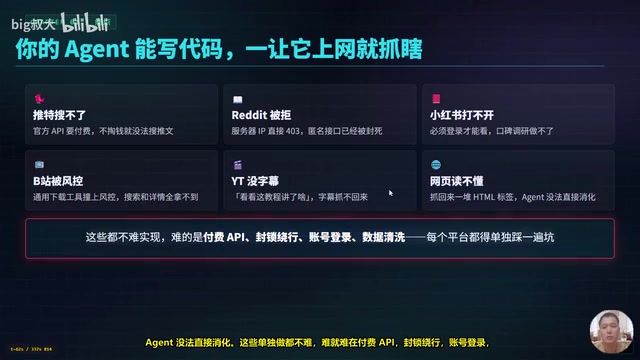
None of these problems is particularly hard to solve in isolation. The real difficulty is that paid APIs, IP blocking, mandatory logins, and data cleaning are obstacles you have to tackle separately for every single platform. Agent-Reach exists to bundle all that repetitive groundwork into one solution.
One-Line Install: Let the Agent Handle Its Own Setup
Agent-Reach's installation approach is refreshingly counterintuitive — you don't manually configure anything. Just copy a single natural-language instruction and hand it to your Agent. Whether you're using Claude Code, OpenCode, or Cursor, simply tell it: "Help me install Agent-Reach, refer to the repo docs/install.md." From there, it handles the CLI installation, dependency checks, and channel configuration on its own.
In terms of product positioning, Agent-Reach isn't just another scraping tool — it operates one layer above that as a "capability layer." Tool selection, installation, health checks, and routing are all managed by Agent-Reach, while the actual data retrieval still happens through direct calls to upstream tools, with no extra abstraction in the way. This design keeps things flexible while avoiding reinventing the wheel.
The installation runs in four steps: first, the CLI tool is installed (bundled with yt-dlp and a feed parser); second, the system checks for Node.js, gh-cli, and other dependencies, prompting you on how to install anything missing; third, configuration is written only after explicit authorization (the default is inspect-only, no system changes); finally, you specify which channels you want — six zero-configuration channels are activated upfront, while platforms requiring login are only set up when you ask for them.
What is MCP? MCP (Model Context Protocol) is an open protocol proposed by Anthropic to standardize how AI models communicate with external tools and data sources. Think of it as the "USB port" of the AI world — any tool that exposes an MCP-compliant interface can be called directly by any MCP-compatible Agent, with no custom integration code required. When Agent-Reach routes search capabilities through MCP, it relies on exactly this mechanism: the search tool runs as an MCP Server, the Agent acts as an MCP Client, and the two exchange requests and results over the standard protocol — no API key needed. Claude, Cursor, and OpenCode all natively support MCP today, which is one of the core reasons Agent-Reach can deliver a "one-line onboarding" experience.
One-Command Health Check: See What's Open and What's Blocked
Once installed, how do you know which channels are actually working? Agent-Reach answers this with a single health check command: agent-reach doctor.

After it runs, you get a clear readout of which backend each channel is using, which ones are live, which are down, and how to fix anything that isn't working. Once the health check passes, six zero-configuration channels are ready out of the box:
- Any webpage: Gina Reader converts pages into clean, readable text — free, no key required
- YouTube subtitles: yt-dlp extracts subtitles and supports video search
- RSS feeds: feedparser reads any RSS or Atom feed
- Web search: search capability routed via MCP — no key, no cost
- Open source repos: gh-cli reads public repositories and supports search; log in to unlock private repos
- Bilibili: bili-cli supports search and video detail retrieval without login
You don't need to memorize a single command. Once the Agent reads skill.md, it knows exactly which tool to call.
Live Demo: Searching Bilibili and Pulling Subtitles
Talk is cheap — here's how it actually works in practice. Taking a Bilibili search and subtitle retrieval as an example, the whole flow is remarkably smooth.
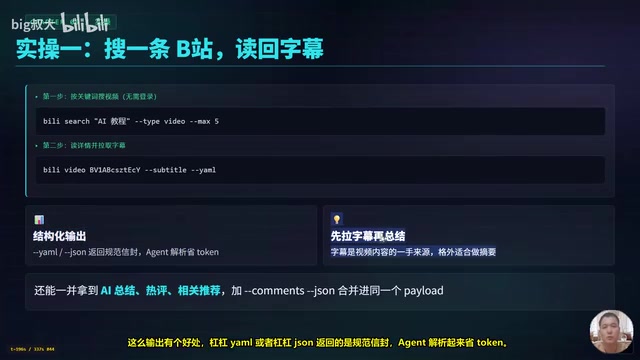
Step one: search for videos by keyword (no login needed) — run the search command in terminal, set the type to video, and limit results to five or fewer. Step two: fetch the details and pull the subtitles — run the video command with the BV number, add --subtitle to retrieve subtitles and --yaml for structured output.
Using --yaml or --json output has a clear advantage: it returns a well-structured "envelope" format that the Agent can parse with lower token consumption. Creator "Dashu Da" recommends pulling subtitles before summarizing — subtitles are the primary source of a video's content and are ideal for generating summaries. For even richer results, adding --comments pulls in top comments and related recommendations into the same payload, giving the AI everything it needs for a more comprehensive summary.
What is yt-dlp? yt-dlp is an open-source command-line tool for video downloading and metadata extraction, forked from youtube-dl with much more active maintenance. Beyond downloading videos, it can independently extract subtitle files (including auto-generated captions), video metadata, comments, and other structured data — which is exactly why Agent-Reach uses it for YouTube subtitle tasks. That said, yt-dlp's Bilibili support is limited, so Bilibili coverage is handled by the dedicated bili-cli instead, with clear division of responsibilities. On the structured output side,
--yamlor--jsonmeans subtitles, titles, descriptions, and other fields each land in their proper place. The Agent doesn't need to do any additional text parsing, which reduces token usage and minimizes parsing errors.
How to Connect the Three Platforms That Require Login
Bilibili, YouTube, webpages, and RSS work out of the box, but Twitter, Xiaohongshu, and Reddit each require login authorization.
For Twitter, twitter-cli is the recommended option — search has been tested and is stable; once cookies are configured, you can search tweets and browse timelines. For Xiaohongshu, open-cli can reuse your existing Chrome session; for server environments, use cookie-editor to export cookies instead. Reddit's anonymous endpoints are fully blocked, leaving login as the only viable path.
Setting these up is straightforward — no need to dig through documentation. Just tell your Agent "help me configure [platform name]" and it will walk you through each step. There's also a built-in fallback layer: multi-backend routing means every platform has a primary and a backup. If one path fails, it switches automatically, with no changes needed on your end.
What are cookies in this context? A cookie is an authentication credential that a browser saves locally after you log into a website. On subsequent visits, the browser sends it automatically to prove you're already logged in. In scripting scenarios, "reusing cookies" means exporting your existing browser session as a file and handing it to a command-line tool, bypassing the interactive login process entirely. The cookie-editor mentioned here is a browser extension that exports the current tab's cookies as JSON. The risk with this approach is real: a cookie is functionally equivalent to your login credentials. If it's leaked or if the platform detects unusual automated activity, your account could be banned — which is exactly why the article repeatedly recommends using a dedicated secondary account.
Key Design Decisions for Claude Code and Cursor Integration
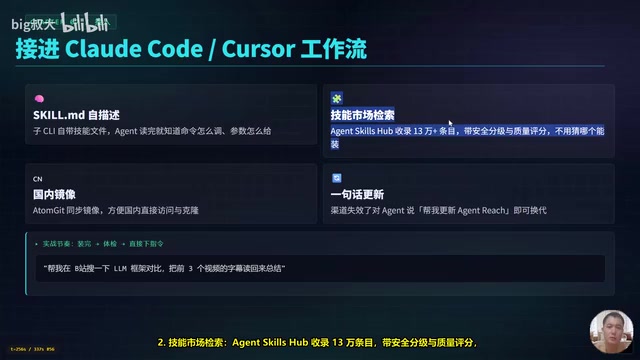
For Agent-Reach to genuinely fit into your workflow, four things are worth paying attention to. First, skill.md is self-describing — the CLI ships with a skill file so the Agent knows exactly which commands to call and how to structure the parameters after reading it. Second, the Agent Skills Hub indexes around 130,000 entries with safety ratings and quality scores, so you're not guessing what's available or safe to install. Third, domestic mirror support via atom git sync makes direct access and cloning straightforward for users in China. Fourth, updates are handled the same way as installation — just tell your Agent "help me update Agent-Reach."
The Limits of Free: What You Should Know Upfront
Free is great, but the boundaries and restrictions need to be clearly understood.
First, what's free is the scraping and retrieval channels — this is not a way to bypass any platform's official paid API. On the cost side, running locally is completely free; only server deployments need a proxy, which runs about $1 a month. Cookies are stored locally in config.yaml with 600 permissions — they are never uploaded or transmitted elsewhere, and the code is open source for anyone to verify.
Three safety reminders worth keeping in mind: use a dedicated secondary account, since automated calls carry the risk of platform detection and account bans — don't risk your main account; watch your request rate, and if you hit Bilibili's 412 block, back off or reduce the --max result count; and respect each platform's terms of service — pacing is your responsibility, so avoid aggressive high-frequency scraping.
Takeaways
Agent-Reach's core value comes down to three points: one-line installation, where copying a single instruction to your Agent gets you set up in minutes; six zero-configuration channels (webpages, YouTube, RSS, web search, open source repos, Bilibili) ready to use immediately; and multi-backend routing with primary and backup paths, where platform changes are tracked and maintained by the project team. In a single sentence: it transforms an Agent from "only able to chat" into "able to browse and research" — at nearly zero API cost.
Related articles

RAG Getting Started in Practice: From Principles to Building an Enterprise Knowledge Base
Bilibili RAG course highlights: from retrieval-augmented generation principles, document chunking and vectorization, to five accuracy factors and enterprise knowledge base boundaries, with fine-tuning vs RAG selection advice.

AI Model Selection Guide: DeepSeek vs. Qwen3 in Practice
How should AI developers choose models? Based on a Bilibili tutorial, this article breaks down the Function Calling differences between DeepSeek V3 and R1, Qwen3's programmatic thinking mode switching and agent capabilities, and outlines a multi-model learning path and practical selection logic.

Anchoring, Loss Aversion, and Nudges: 5 Psychological Tactics Retailers Use to Make You Spend
Behavioral economics reveals how retailers use anchoring, framing, loss aversion, and nudge theory to manipulate your spending decisions. This article breaks down 5 common psychological tactics and offers counterstrategies like slowing down decisions and setting your own anchors to see through the pricing design behind discounts.