Agent Skills Explained: Plug-and-Play Skill Packs for AI Agents

Agent Skills let AI agents gain specialized capabilities through modular, plug-and-play skill packs.
Agent Skills is an open standard that enables AI agents to dynamically load and unload modular capability packs instead of retraining models or deploying multiple agents. Using a lightweight folder-based format with SKILL.md files, it offers modular extensibility, lower token costs through progressive disclosure, and high flexibility. Unlike Multi-Agent architectures, Skills extends a single agent's abilities on demand, complementing tools like Function Calling and MCP in the modern AI stack.
What Are Agent Skills
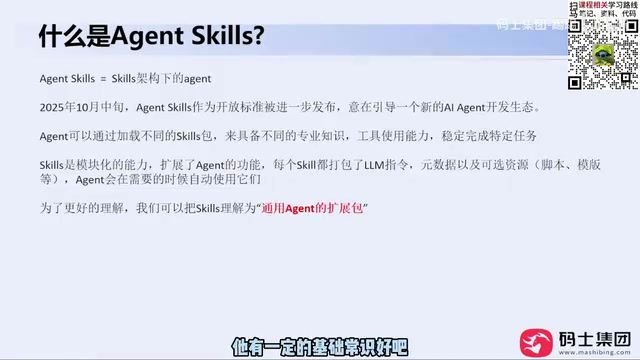
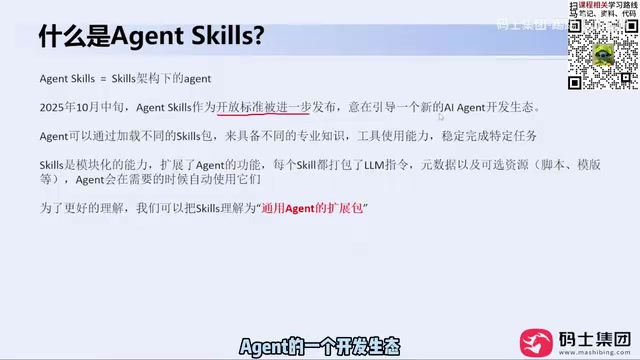
As AI Agent technology evolves rapidly, a new concept is becoming a key design principle for building intelligent agent applications — Agent Skills. According to tech content creators on Bilibili, Agent Skills was officially released as an open standard in mid-October 2025 and is now driving an entirely new Agent development ecosystem.
The release of this open standard has deep industry roots. Between 2024 and 2025, the fragmentation of the AI Agent ecosystem became increasingly severe. Different vendors defined their own approaches to extending agent capabilities, making it impossible to reuse skills across platforms. The core goal of the open standard is to establish a unified skill description format and discovery mechanism, so that any Agent framework compliant with the standard can recognize and load the same set of skill packs. This is similar to the HTML standard in the web domain or the OCI specification in the container world — reducing ecosystem barriers through standardized interfaces.
According to the official definition, a Skill is a lightweight, open-source format that extends the capabilities of AI agents with specialized knowledge and workflows. That might sound abstract, but it's actually quite straightforward when broken down: a skill is essentially a folder containing a SKILL.md file, along with metadata, instructions that guide the agent through specific tasks, and optional resources like scripts, references, and templates. Notably, the use of Markdown for the SKILL.md file is a deliberate design choice — LLMs excel at parsing Markdown, and human developers can also read and edit it directly, achieving dual compatibility for both machine readability and human readability. The structure typically includes the skill name and version number, a functional description, trigger conditions, detailed execution instructions, and reference paths to associated resource files. The metadata section is embedded in the Markdown header as YAML front matter. This "folder-as-skill" design philosophy dramatically lowers the barrier to creating skills.
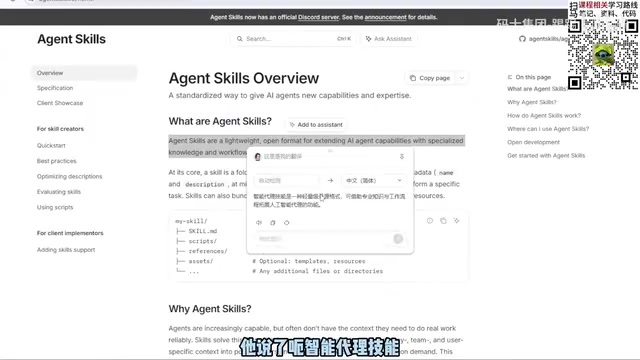
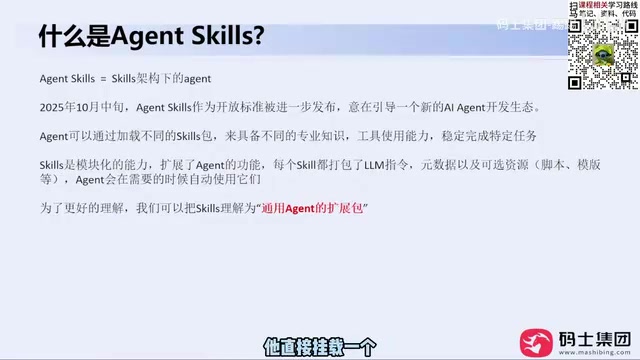
Put simply, we can think of Agent Skills as "Agents built on a Skills architecture." When developing an Agent project, you can choose from different architectural designs: single-agent, multi-agent, or the "Agent + Skills" pattern. When your Agent needs a specific professional capability, you simply load the corresponding skill pack — no need to retrain or restructure the entire system from scratch.
What Problem Do Agent Skills Actually Solve
To understand the value of Skills, let's use a very relatable analogy.
The Dilemma of a Capable Secretary
Imagine you're a company boss with a very capable secretary. They have general common sense and can handle everyday tasks, but specialized work exposes their limitations: ask them to draft a contract, and they don't really understand law; ask them to design a poster, and they can't use Photoshop; ask them to book flights, and they're unfamiliar with the booking systems.
Traditionally, you'd have two solutions:
- Option 1: Train the person. Spend months sending them to professional training — law school, Photoshop courses, etc. But this is both time-consuming and resource-intensive.
- Option 2: Hire specialists. Need a contract? Hire a lawyer. Need a design? Hire a designer. But this adds significant personnel costs.
The Third Way Agent Skills Provides
Agent Skills is considered an important architectural innovation precisely because it offers a third approach: you don't need to train anyone, nor do you need to hire additional specialists. Instead, you package various professional capabilities into usable plugins for plug-and-play use.
When the secretary needs to handle a lawsuit, simply load a "Legal Expert" skill pack. Need a poster? Attach a "Photoshop Design" skill pack. Need to arrange a business trip? Load a "Flight Booking" skill pack. Once the task is done, the skill can be unloaded to free up resources.
For the boss, this means no time spent learning skills and no money spent maintaining a talent reserve — a real stress-saver. This is exactly the core advantage Agent Skills brings to the table.
Core Design Philosophy: Modular, Low-Cost, Highly Flexible
The essence of Agent Skills can be summed up in one sentence — load what you need, unload what you're done with.
This reflects three key design principles:
- Modular capability extension. Each Skill independently packages instructions (Prompts), metadata, and optional resources. The Agent automatically uses them when needed, with no interference between skills.
- Low cost. No need to retrain large models or spin up additional agent instances — just introduce ready-made or custom skill packs to gain new capabilities. The cost advantage here is very concrete: taking GPT-4o as an example, the price per million input tokens is approximately $2.5–5. If an Agent naively loads the full instructions for 20 skills simultaneously, with each skill occupying 2,000 tokens, that's an extra 40,000 tokens of input cost per call. The Skills architecture, through on-demand loading, can reduce this overhead by an order of magnitude.
- High flexibility. Skills can be dynamically loaded and released on demand, avoiding long-term occupation of context and computational resources.
You can think of Skills as a "Swiss Army knife" for a general-purpose Agent — the knife body is the general-purpose agent, and the various blades are different skills. This also explains why more and more Agent products are integrating a wide variety of Skills internally.
Comparison with Traditional Learning Paths
The value of Skills is especially intuitive in the programming domain. Traditionally, becoming a programmer capable of project development requires a step-by-step learning journey: starting from basic programming syntax, then databases, frameworks, and finally complete project development. Only after completing this entire chain do you have full development capabilities.
Under the Skills model, this entire process is radically simplified. You no longer need to "learn from scratch." As long as ready-made skill packs exist on the market, or you can create a custom Skill, you can directly give an Agent the corresponding professional capability. The learning cost is dramatically reduced, and capability acquisition shifts from "cultivation" to "loading."
Progressive Disclosure and Skill Invocation Mechanism
In practice, Skills typically work in conjunction with a Progressive Disclosure mechanism. Progressive disclosure is originally a classic principle in user interface design, referring to the practice of showing complex information only when the user needs it. In the context of Agent Skills, this principle has been creatively applied as a context management strategy.
Specifically, the Agent doesn't stuff the complete contents of all skills into the context at once. Instead, it first identifies which skills are available (the skill list), and only when it determines that a task requires a specific skill does it load that skill's detailed instructions and resources. This staged loading design has solid technical justification: while current mainstream LLMs have expanded their context windows to 128K tokens or more, longer contexts mean higher inference costs, and models tend to exhibit the "Lost in the Middle" phenomenon in ultra-long contexts — where attention to information in the middle of the context drops significantly.
Therefore, at the initial stage, the Agent loads only summary information from the skill list (each skill might occupy just a few dozen tokens). Only after a task matches a specific skill are that skill's complete instructions and resources injected into the context. This two-stage loading strategy is typically implemented in engineering through RAG (Retrieval-Augmented Generation — a technique that first retrieves relevant content from an external knowledge base, then provides it as context for the model to generate answers) or dynamic Prompt concatenation.
This design effectively controls context length and token consumption, allowing the Agent to remain lightweight while being able to invoke deep professional capabilities at any time. Defining the Skills list and invoking Skills tools on demand are the core engineering components of building such systems.
Agent Skills vs. Multi-Agent: What's the Difference
It's worth clarifying that Agent Skills and Multi-Agent are two fundamentally different architectural approaches.
Multi-Agent is more like "hiring multiple specialists" — completing complex tasks through the collaboration and division of labor among multiple independent agents. Each Agent is a relatively complete entity that needs to communicate and coordinate with others, resulting in higher system complexity and costs. Typical Multi-Agent frameworks in the industry today include Microsoft's AutoGen, CrewAI, and LangGraph. In this architecture, each Agent has its own independent system prompt, memory space, and tool set, and they collaborate through message passing. The strength of this design lies in its powerful task decomposition and parallel processing capabilities, but it also introduces significant engineering challenges: communication latency between Agents, state synchronization, error propagation, and debugging difficulties. More critically, each Agent instance requires an independent LLM call, and the total token consumption for multiple Agents collaborating on a single task can be several times that of a single Agent.
Agent Skills, on the other hand, is more like "continuously mounting skills onto a generalist" — extending capability boundaries by loading different skill packs onto a single primary agent. By dynamically switching capability modules on a single Agent, many scenarios can achieve comparable results at lower cost and complexity.
The two are not mutually exclusive — in complex projects, you can absolutely combine "multi-agent" with "skill loading" to create a more powerful and flexible system architecture. For example, each Agent in a multi-agent system can load Skills specific to its domain, combining the global advantage of collaborative division of labor with the local flexibility of modular capability extension.
Conclusion
Agent Skills represents a paradigm shift in AI Agent development. It transforms "capabilities" from hard-to-reuse training outcomes into modular assets that can be packaged, distributed, and used plug-and-play. For developers, understanding the principles behind Skills and mastering how to define and invoke skill lists will be an essential competency for building next-generation intelligent agent applications.
Within the Agent technology stack — including Function Calling, MCP, tool invocation, and more — Skills is becoming the critical link connecting general-purpose capabilities with specialized scenarios. Function Calling is a capability introduced by OpenAI in 2023 that allows LLMs to identify user intent during conversations and generate structured function call requests, which are executed by external systems and the results returned to the model. MCP (Model Context Protocol) is an open protocol launched by Anthropic in late 2024, aimed at standardizing the connection between large models and external data sources and tools — often described as the "USB-C port" for AI applications. Agent Skills sits at a higher layer in this technology stack as a capability description layer — it doesn't directly define API interfaces or communication protocols, but rather defines "what the agent should know and how to do it" in terms of knowledge and workflows. During actual execution, the instructions in a Skill may guide the Agent to invoke Function Calling interfaces or connect to external tools via the MCP protocol, with all three forming a complementary layered architecture.
Related articles

AI Agent Skill Stack Fully Decoded: Building Professional Agents with 16 Pluggable Skills
Deep dive into 16 practical AI Agent Skills covering code review, evals, frontend design, communication, memory, and automation — revealing the modular methodology behind Agent engineering.

Hidden ComfyUI Bug: What Caused H3 Video Generation to Slow Down 4x and How to Fix It
A recent ComfyUI update introduced a hidden performance bug causing MiniMax H3 video generation to slow down ~4x. Learn the root cause — a v.clone() memory optimization side effect — and how to fix it.

Getting 'Hacked' by OpenAI: The Dark Humor and Hard Truths of the AI Developer Community
A Reddit joke about "getting hacked by OpenAI" reveals deep truths about AI's talent wars, compute barriers, and the tension between open-source ideals and industry consolidation.