Agent Skills Progressive Disclosure Architecture: The Secret Behind Giving LLMs Unlimited Capabilities

Agent Skills uses modular skill packages and progressive disclosure to let general-purpose Agents acquire specialized capabilities on demand.
The article focuses on Agent Skills, an emerging open standard that lets a single-responsibility general-purpose Agent extend capabilities on demand by loading skill packages, seen as key to Agents moving from "can chat" to "can get things done." Each Skill is a folder containing SKILL.md that packages instructions, metadata, and optional resources. It solves the conflict between generality and specialization and the high cost of specialized training, bringing low extension cost, clear responsibility boundaries, and reclaimable resources. Progressive disclosure reads metadata first and loads full content on demand, saving the scarce context window. Implementation involves defining the skill list and orchestrating tool calls, complementing Multi-Agent architectures.
Why Agent Skills Deserve Attention
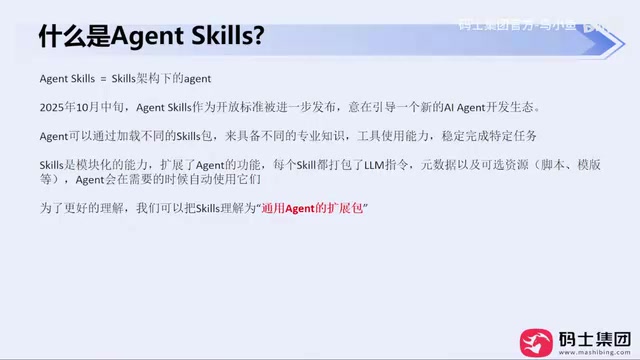
Large models are moving from "can chat" to "can get things done," and Agent Skills are a key design in this shift. In a live course, Bilibili creator Lian Pengju called it a "cross-era" technical point, arguing that it gives Agents "the secret to unlimited capabilities"—a single Agent with a single responsibility can, by loading different skill packages, expand and enhance a large number of additional capabilities.
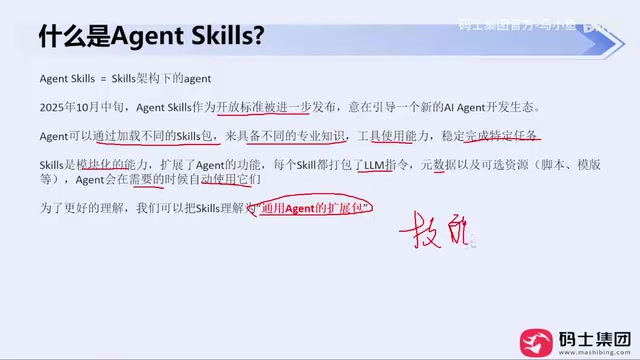
This judgment is not an isolated one. According to the course on Bilibili and analyses from multiple developer communities, Agent Skills, since being released as an open standard, is guiding a new Agent development ecosystem. Its core value lies in modularity: each Skill packages instructions, metadata, and optional resources, and the Agent automatically invokes them when needed.
What Exactly Are Agent Skills
Official Definition and a Plain Explanation
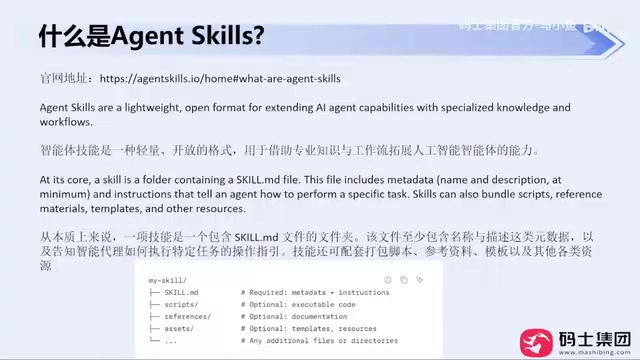
The official website describes Agent Skills as a lightweight open-source format that extends the functionality of AI agents with specialized knowledge and workflows. Specifically, a skill is a folder containing SKILL.md, which holds metadata and operational instructions that guide the agent to complete a specific task, and may also include scripts, reference materials, templates, and other resources.
This definition is not friendly to beginners. Lian Pengju used a more everyday analogy: imagine a general-purpose Agent as a secretary with decent basic abilities but clear shortcomings—drafting contracts without legal knowledge, making posters without Photoshop skills, booking flights without familiarity with the system. Traditional solutions are either to spend months sending them to training (high cost, long cycle) or to hire a lawyer or designer separately (extra labor cost). Agent Skills offers a third way: instead of training people or adding headcount, package specialized capabilities into plug-and-play plugins that are mounted when needed and unmounted when done.
Understanding from a Programmer's Perspective
From a developer's perspective, in the past, to have Java development capabilities, one had to learn everything from syntax, databases, and frameworks all the way to project practice; with Skills, as long as there is a ready-made skill package on the market, or you define a Skill yourself, the Agent can directly possess the corresponding capability. This "load whatever you need" mechanism is precisely the essence of its modularity, low cost, and high flexibility.
SKILL.md is the entry file for each skill package, typically consisting of two parts: YAML frontmatter and a Markdown body. The metadata section generally includes fields such as the skill name, a one-sentence description, and applicable scenarios; it is very small and is exactly the "first layer" content that is read first in progressive disclosure. The body carries detailed operational steps, caveats, and examples, and can also reference scripts, templates, and reference materials in the same directory via relative paths when necessary. This convention of "one folder + one entry file" naturally makes skills version-manageable, distributable, and reusable, and also allows skills from different sources to follow the same loading specification.
What Problem Do Agent Skills Solve
Traditional Agent development faces a structural contradiction: the more general the capability, the harder it is to guarantee specialization; and training or fine-tuning separately for each professional scenario is prohibitively expensive. Agent Skills decouples "capability" from the model's internals, turning it into composable, replaceable external modules.
This brings three direct benefits. First, the cost of extension is greatly reduced—adding a new specialized capability no longer requires retraining the model. Second, responsibility boundaries are clear—a single-responsibility Agent gains capabilities by stacking skill packages, but its core logic is not polluted. Third, resources are reclaimable—skills are unloaded when done, avoiding long-term occupation of context or compute resources. In multi-source analyses, the developer community has a high degree of consensus on this "plug-and-play" model, considering it important infrastructure for the engineering implementation of Agents.
Progressive Disclosure: The Key Mechanism of Skill Invocation
"Progressive disclosure" in the course title is the key to understanding how Agent Skills work. The Agent does not load all the full content of all skills at once; instead, it first reads the skill's metadata (name, description, applicable scenarios) to determine whether the current task requires that skill; only when it confirms it is needed does it further load the complete operational instructions and resources.
The benefit of this layered loading is very practical: the context window is a scarce resource, and progressive disclosure prevents irrelevant skills from taking up space and makes the Agent's decision path clearer. You can think of it as an experienced assistant—first scanning the list of skills, then deciding which manual to open, rather than spreading all the manuals on the desk at once.
Context Window is the maximum number of tokens a large model can process in a single inference, covering user input, system prompts, historical conversation, and tool return results. It is both a hard limit and a source of cost—the more tokens, the slower and more expensive the inference, and the more easily the model's attention to key information is diluted. Therefore, in Agent scenarios, how to reserve the limited window for truly relevant information is one of the core constraints of engineering design. Progressive disclosure is precisely the strategy to address this constraint: layer skill content into metadata, operational instructions, and attached resources, and expand layer by layer only when necessary, thereby balancing capability richness and context usage. Understanding this also helps you understand why Skills emphasize "unload when done."
How to Define the Skills List and Invoke Tools
At the implementation level, the course covers two engineering issues: how to define the Skills list, and how the Agent invokes Skills tools. On the definition side, each skill needs a clear metadata description so the Agent can accurately determine applicable scenarios; on the invocation side, it involves the orchestration logic of tool calling to ensure that the processes of skill loading, execution, and unloading are controllable.
This part is combined with project practice, and the course also compares the differences among three architectures: B2B network, Multi-Agent, and Skills Agent. Simply put, Multi-Agent relies on multiple agents dividing work and collaborating, with higher communication and coordination costs; Skills Agent lets a single Agent mount capabilities on demand, making the structure lighter. The two are not substitutes; in actual projects, they are often used in combination according to task complexity.
Tool Calling / Function Calling is the standard mechanism for large models to interact with the outside world: developers declare available tools with structured descriptions (name, purpose, parameter schema), the model outputs invocation intent and parameters during inference, and the runtime executes them and passes the results back to the model to continue reasoning. The loading, execution, and unloading process of Agent Skills is essentially orchestration built on this mechanism—the metadata in SKILL.md is equivalent to the skill's "tool declaration," based on which the model determines whether to invoke, and the runtime is then responsible for injecting the complete instructions into the context. For this reason, whether the skill description is clear and accurate directly determines whether the Agent can select the correct skill at the right time.
Practical Significance for Developers
Lian Pengju repeatedly emphasized a judgment in the course: skills related to large models have become a common assessment point in interviews for various IT positions, including frontend, backend, and mobile. This view is consistent with current observations in the job market—companies value whether candidates can engineer large model capabilities into business operations, not just whether they can call basic tools.
The value of Agent Skills lies precisely here: it provides a reusable paradigm for capability extension, allowing developers to build specialized agent applications without training models from scratch. For developers who want to enter the large model field, understanding the modular design of Skills and the progressive disclosure mechanism is a highly cost-effective starting point.
FAQ
What is the difference between Agent Skills and Multi-Agent? Multi-Agent completes tasks through multiple agents dividing work and collaborating, with higher coordination costs; Skills Agent lets a single Agent load skill packages on demand, making the structure more lightweight. The two can be used together according to task complexity.
Why is progressive disclosure important? It lets the Agent first read skill metadata and then decide whether to load the full content, preventing irrelevant skills from occupying the context window and improving decision efficiency.
Can developers without a large model background learn this? Yes. The course itself assumes a "complete beginner" starting point, gradually unfolding from concepts and mechanisms to project practice, with the focus on understanding the idea of modular extension.
One-line Summary
Agent Skills uses modular skill packages and a progressive disclosure mechanism to let general-purpose Agents acquire specialized capabilities on demand.
Paragraph Summary
The article focuses on Agent Skills, an emerging open standard, pointing out that it allows a single-responsibility general-purpose Agent to extend capabilities on demand by loading skill packages, and is regarded as a key design in the shift of Agents from "can chat" to "can get things done." It uses the analogy of a "secretary with specialized plugins" to explain its essence: each Skill is a folder containing SKILL.md, packaging instructions, metadata, and optional resources. It resolves the contradiction in traditional Agent development between generality and specialization, and the high cost of specialized training, bringing three benefits: low extension cost, clear responsibility boundaries, and reclaimable resources. The progressive disclosure mechanism first reads metadata and then loads the full content on demand, saving the scarce context window. At the implementation level, it involves defining the skill list and orchestrating tool calls, and forms a lightweight complement to the Multi-Agent architecture.
Related articles

M&M's Spent Millions Replacing Artificial Blue Dye — Why Is It So Hard?
Mars spent millions trying to replace artificial blue dye in M&M's with spirulina, but thick material clogs pipes and residue risks mold, forcing a full production-line rebuild. Here's the engineering behind the reformulation.
Teammate Wanted for Meta Global AI Developer Hackathon: Computer Vision & Medical AI
A Reddit developer seeks teammates for the Meta Global AI Developer Hackathon, focusing on computer vision and medical AI. This article analyzes the track logic, skills-complementarity needs, and topic selection strategy behind this teaming signal.
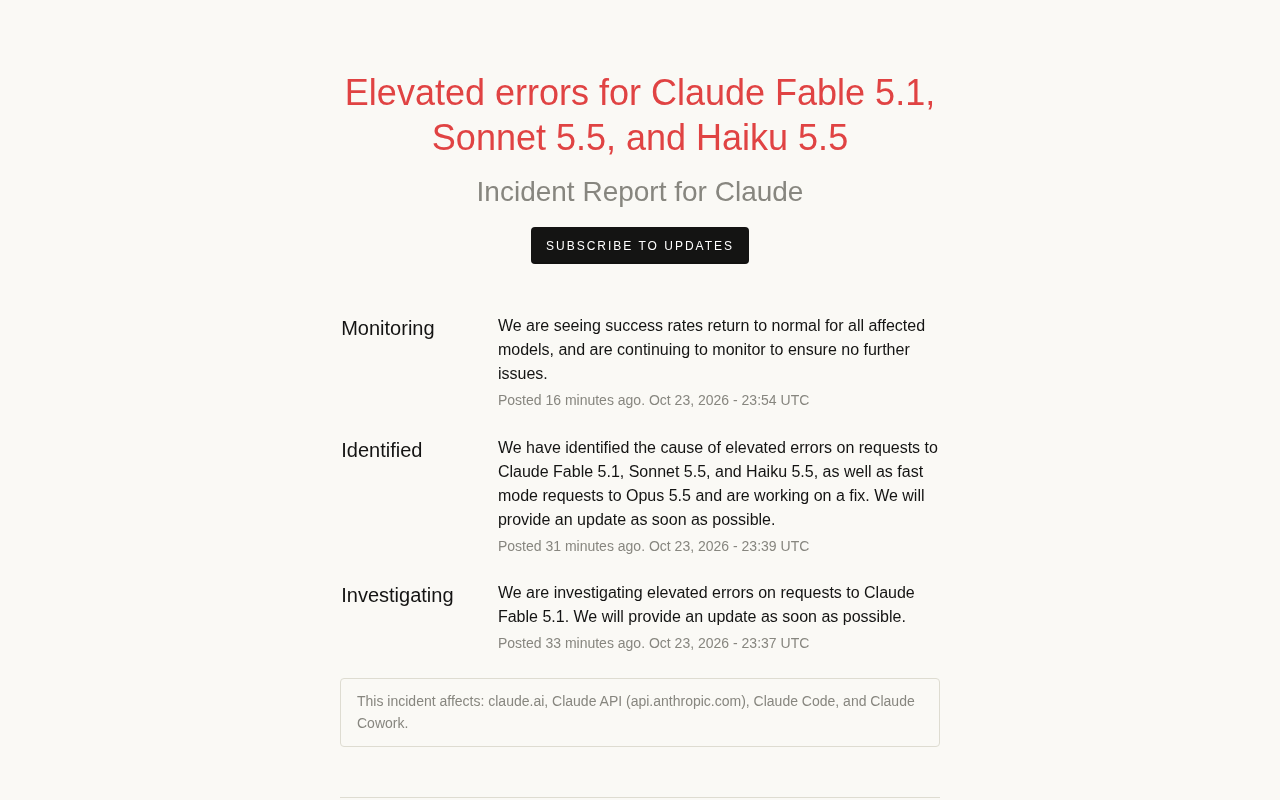
Multiple Claude Models Hit by Errors: A Postmortem of Fable 5.1, Sonnet 5.5, and Haiku 5.5
Claude Fable 5.1, Sonnet 5.5, Haiku 5.5, and Opus 5.5 fast mode saw elevated errors; Anthropic identified and resolved the issue in 17 minutes. This postmortem covers the timeline, the technical reasons for the multi-model cascading failure, and practical lessons for retry and degradation strategies.