Agentic AI in Production: The Trilemma of Speed, Cost, and Accuracy

The core of deploying Agentic AI in production is finding the right business balance within the speed, accuracy, and cost triangle.
This article systematically lays out the core challenges and coping strategies for moving Agentic AI from prototype to production. It points out that the sequential reasoning loop of Agentic workflows inherently brings latency, and developers must clarify the trade-off between speed and depth early in design. Speed, accuracy, and cost form a triangle that is hard to optimize simultaneously; successful deployments usually choose to win on two and compromise on the third, setting an accuracy floor first. The article introduces practical techniques such as server-side prompt caching, model scale selection, orchestrator simplification, parallel processing, and confidence gating, while warning that AI auditing tools can find problems but often misjudge the impact of fixes — human domain experts and red-teaming review mechanisms are essential. The final conclusion: enterprises must face the fact that the technology is still evolving, and build reliable long-term business tools through accuracy floors and expert intervention.
Enterprises are racing to move Agentic AI from prototype to production, but the real challenge isn't model capability itself — it's finding a workable balance between response speed, reasoning precision, and operational cost. A technical analysis article from an RSS feed, "Agentic AI Production Strategies and Performance Trade-offs," systematically lays out the core tensions and coping strategies in this process.

The Latency Dilemma of the Reasoning Loop
Users of traditional SaaS applications are used to getting a response within a second or two, but the essence of Agentic workflows is sequential reasoning: formulate a plan, select tools, execute calls, validate output, retry on failure. This loop is what guarantees accuracy, yet it inherently drives up latency.
Developers face a clear fork in the road — pursue lightning-fast responses, or allow the system time to verify its own logic. A project targeting a two-second response and a system designed for twenty-second deep reasoning tasks are completely different in architecture and user experience. Acknowledging this expectation gap at the design stage can prevent a huge disappointment at launch.
The Trade-off Principle of the Optimization Triangle
Optimizing speed, accuracy, and cost simultaneously is nearly impossible. Most successful production deployments choose to win on two and compromise on the third. A more pragmatic approach: first set the business-acceptable accuracy floor, then adjust the architecture above that floor to find the best combination of speed and cost.
Server-Side Prompt Caching to Cut Costs
High token costs can sink a project before it even scales. One effective technique is server-side prompt caching: place static information at the front of the prompt and leverage framework features to cache those segments, reducing the number of tokens processed per request. Over the long term this yields significant savings without sacrificing model intelligence.
Prompt Caching is a technique that reuses intermediate states of large language model inference on the server side. The principle: when an LLM processes input, it converts the prompt token by token into a key-value cache (KV Cache), a process that consumes a substantial proportion of compute and time. When multiple requests share the same prefix text (such as system prompts, role definitions, knowledge base summaries), the framework can reuse the already-computed KV Cache and skip redundant encoding. Anthropic's Claude, OpenAI's GPT series, and Google's Gemini all support this feature, typically billing cache-hit tokens at a lower rate. It is especially critical for Agentic scenarios, because Agents often carry the same system instructions and tool definitions in every loop iteration — prefix caching can simultaneously reduce latency and cost. Practical tips: put static content first and dynamic content last, and note that caches have TTL limits, requiring re-warming after long idle periods.
Choosing Model Scale and Architecture Patterns
There is a common default assumption in the industry — bigger models are always better. But in production, while large models bring more parameters and stronger reasoning, they also mean higher latency and higher per-token cost. Small models aren't a design failure; they're a deliberate choice for specific scenarios.
Small models excel at simple tasks like basic customer service Q&A, FAQs, and real-time chat, delivering the instant feedback users expect. Problems arise when they're forced to handle complex logic, where they often fall short. Test data shows that switching from Sonnet 3.5 to the lighter Haiku can save several seconds of waiting time, but accuracy may drop by double digits.
The Tension Between Autonomy and Performance
The internal architecture of an Agentic system directly determines speed. The common orchestrator pattern — where an orchestrator identifies intent and routes to specialized Agents — is clear in structure and resilient, but requires multiple LLM calls. Each additional call adds seconds of response time. Cutting calls from four to two can make the system feel much faster, at the cost of reduced Agent autonomy.
In a simplified two-call system, the orchestrator must decide every step in advance, and the Agent loses the ability to adjust its plan mid-course when it encounters an error. To mitigate this loss of flexibility, developers can replace sequential chains with parallel processing, use cheap models for intent recognition, and reserve expensive models for final output generation.
The Orchestrator Pattern is a classic architecture in Agentic systems: a central orchestrator handles task decomposition, intent recognition, and sub-Agent scheduling, while specialized Agents handle execution in specific domains. The counterparts are the Peer-to-Peer pattern and the Blackboard pattern — the former has Agents negotiate with each other, the latter collaborates through a shared state space. The orchestrator pattern's advantage is strong observability and clear fault isolation, but each routing involves an extra LLM call, creating latency stacking. In contrast, parallel processing spreads total time by initiating multiple tool calls or subtasks simultaneously, while sequential chains must wait for the previous step's result. Reducing call counts is essentially trading "pre-planning" for "runtime adaptivity," which is the technical root of the autonomy loss.
Dynamic Routing and Confidence Gating
Another way to balance autonomy is confidence-gated routing. The system first attempts a fast two-step flow to handle the request; if the model reports a high confidence score, the flow completes quickly; if confidence is low, the system automatically switches to a more comprehensive four-step workflow. This way simple tasks stay fast, and complex problems get the computational depth they need.
Confidence Gating relies on confidence signals from model output to make routing decisions. Common implementations include: having the model attach a 0-1 confidence score when answering, using logprobs to infer certainty, or training a lightweight classifier to judge request difficulty. Note that LLM self-reported confidence has calibration bias — models are often overconfident about wrong answers. Therefore production systems typically combine external signals such as retrieval hit rates, tool call success rates, and historical performance on similar requests to form a composite confidence score. The choice of gating threshold directly affects cost: too high a threshold will misroute simple requests into expensive flows, while too low a threshold may cause complex problems to be handled carelessly in the fast track. It's recommended to tune the threshold gradually through A/B testing and staged rollouts.
AI Auditing and the Boundaries of Human Oversight
Many enterprises are starting to use automated AI tools for system auditing — scanning for security vulnerabilities, measuring latency, checking accuracy. These tools are highly efficient at identifying specific problems and proposing fixes, and technical teams often use them to quickly get improvement directions.
But relying entirely on AI to fix AI is dangerous. Automated auditing tools may correctly identify the bottleneck but frequently misjudge the actual impact of a fix. There are documented cases where an AI tool predicted a modification would improve speed by five seconds, while the actual change in production was only a few tenths of a second. This kind of bias can lead product teams to prioritize the wrong updates based on incorrect data.
Domain Experts Are Irreplaceable
Technical reviews must involve human experts. Domain experts can review AI-generated reports and judge whether the suggested metrics and benefits are realistic. They provide the context that models lack. Additionally, teams should establish red-teaming processes, using another LLM to critique the main model's suggestions, helping to catch hallucinations, math errors, or logical flaws.
Charting the Final Production Roadmap
Successful deployment of Agentic AI requires a clear-eyed recognition that the technology is still evolving. Speed, cost, and accuracy are always in competition, and developers must decide which two sides of this triangle matter most for their use case. By setting an accuracy floor and preparing expert intervention mechanisms, enterprises can build systems that are not just impressive prototypes but reliable long-term business tools.
One-line Summary
The core of deploying Agentic AI in production is finding the right business balance point within the speed, accuracy, and cost triangle.
Paragraph Summary
This article systematically lays out the core challenges and coping strategies for moving Agentic AI from prototype to production. It points out that the sequential reasoning loop of Agentic workflows inherently brings latency, and developers must clarify the trade-off between speed and depth early in design. Speed, accuracy, and cost form a triangle that is hard to optimize simultaneously; successful deployments usually choose to win on two and compromise on the third, setting an accuracy floor first. The article introduces practical techniques such as server-side prompt caching, model scale selection, orchestrator simplification, parallel processing, and confidence gating, while warning that AI auditing tools can find problems but often misjudge the impact of fixes — human domain experts and red-teaming review mechanisms are essential. The final conclusion: enterprises must face the fact that the technology is still evolving, and build reliable long-term business tools through accuracy floors and expert intervention.
Related articles
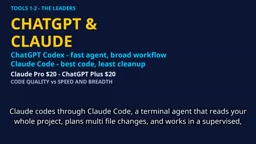
2026 AI Coding Tools Comparison: Claude, ChatGPT, Gemini — Which Is the Best?
A 2026 comparison of five mainstream AI coding tools — Claude Code, ChatGPT Codex, Gemini, DeepSeek, and GitHub Copilot — on real projects, pricing, and code quality, to help you decide where that $20/month should go.

ChatGPT Codex Can Clone Any Software? Testing the Risks and the Truth
YouTube shorts claim ChatGPT Codex or Claude Code can clone Adobe, Excel, and Figma for lifelong free use. We break down the feasibility, legal risks, and DM-funnel tactics—and explain what AI coding tools are truly good for.

Kilo Code Is Free to Install but Charges for API: Cost Estimation and Configuration Guide
Kilo Code is free to install, but connected AI models are billed per token. This guide covers VS Code extension and CLI setup and shows how to estimate API costs.