Agentic AI Takes On Analog Synthesizer Design: A New Frontier in Autonomous Agent Hardware Design
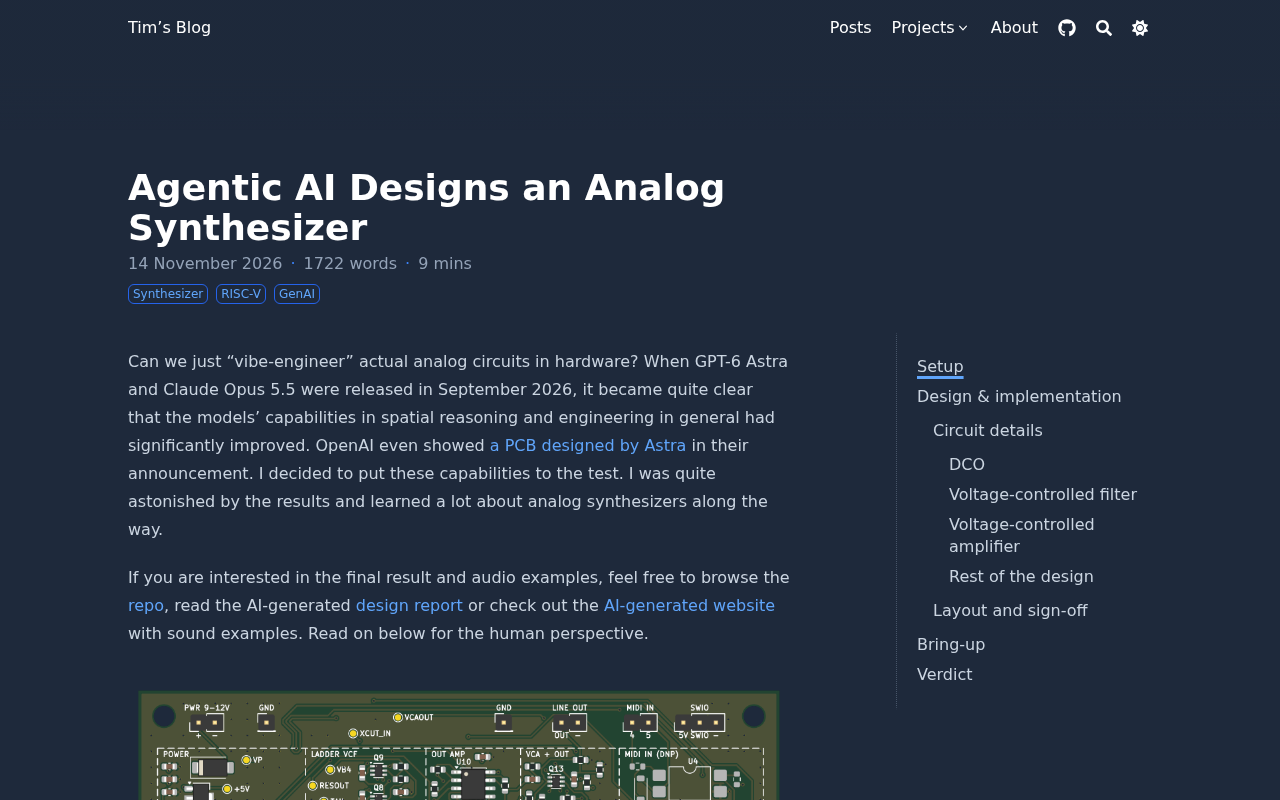
A Hacker News post sparks discussion on Agentic AI designing an analog synthesizer, exploring AI's capabilities and limits in hardware design.
The article centers on a brief Hacker News discussion about "Agentic AI designing an analog synthesizer," noting that analog synthesizers involve circuit topology, component selection, signal chains, and other real constraints, making them a suitable test of agents' cross-domain reasoning. The key difference between Agentic AI and ordinary code generation lies in task decomposition and multi-round execution, enabling cross-checking of design conflicts at the submodule level. However, AI-generated design drafts still require simulation and actual build verification; the original post discloses no prototyping or measurement results, so it should be viewed as process exploration rather than an engineering outcome. The article argues that such concrete experiments reflect the real progress and limits of AI in hardware design better than broad capability claims.

Once large language models proved adept at writing code, building spreadsheets, and organizing information, a new question emerged: can they handle hardware design, which demands interdisciplinary knowledge and involves physical constraints? A discussion on Hacker News—"Agentic AI Designs an Analog Synthesizer"—is exactly the kind of attempt exploring this direction.
A brief but thought-provoking post
The Hacker News post itself is tiny, containing only a title, 3 upvotes, and 1 comment. It includes no lengthy technical explanation and no public design documentation. The only core fact confirmed by the title and screenshot is this: a creator involved Agentic AI (an intelligent agent with autonomous planning and tool-calling capabilities) in the design of an analog synthesizer.
Information is limited, but the direction is clear enough. An analog synthesizer is not a purely digital product; it involves circuit topology, component selection, signal chains, power supply, and noise—a whole series of real-world constraints. Handing this kind of task to AI tests more than language ability: it tests whether the AI can reason and connect across multiple specialized domains.
Why an analog synthesizer
An analog synthesizer is a highly representative testbed for AI. Its principles are not mysterious: oscillators generate waveforms, filters shape them, envelopes and amplifiers control dynamics, and finally an audible signal is output. But turning a schematic into something that actually works requires handling component parameter dispersion, drift and interference in analog circuits, and impedance matching between modules.
What these problems share is that there is no single correct answer—you must make trade-offs among constraints. This is exactly where "agents" diverge from "one-shot Q&A": an agent can break down tasks, advance module by module, and call tools to verify hypotheses along the way, rather than generating a plausible-sounding block of text that cannot be implemented in one shot.
The core difference between analog and digital synthesizers lies in how signals are processed. Digital synthesizers use algorithms to compute waveforms at discrete time points; output precision is determined by sample rate and bit depth, and behavior is fully reproducible. Analog synthesizers let voltage and current pass directly through physical components such as resistors, capacitors, and transistors; sound generation is a continuous physical process. This brings characteristics that digital systems struggle to fully emulate: individual differences caused by component tolerances, pitch instability caused by temperature drift, and harmonic coloration produced by circuit nonlinearity. For this reason, analog synthesizer design cannot be judged solely by logical correctness; it must also weigh timbre, stability, and manufacturability under real physical constraints.
The watershed between Agentic AI and traditional code generation
From "generating content" to "advancing tasks"
A typical LLM call is more like one-shot generation: given a prompt, output a result. The difference with Agentic AI is that it introduces goal decomposition and multi-round execution. Facing a synthesizer design, it can first break the whole into subproblems such as oscillator, filter, envelope, and output stage, handle them separately, and finally integrate them into a complete solution.
The value of this working style is especially obvious in hardware. Many errors in hardware design do not surface at the text level; they hide in details such as component values, power supply schemes, and signal levels. If an agent can reason about each submodule separately and cross-check them, it has a chance to catch conflicts early, rather than exposing mismatches only after the whole solution is assembled.
Agentic AI refers to LLM systems with autonomous planning, tool-calling, and multi-step execution capabilities, fundamentally different from single-turn Q&A calls. A typical agent runtime maintains a task goal, decomposes it into subtasks, calls external tools as needed—such as retrieving information, running simulations, or executing calculation scripts—and adjusts subsequent steps based on intermediate results. This "plan—execute—observe—revise" loop enables it to handle complex tasks requiring multiple iterations and external verification, not just generate text. In hardware design scenarios, an agent can advance a solution module by module and introduce tool-based verification at each step, thereby reducing the probability of hidden errors in the overall solution.
The verification step that cannot be skipped
What needs to be viewed soberly is that an AI-generated design draft does not equal a manufacturable product. Analog circuits are highly sensitive to layout and routing, component tolerances, and actual measurement, and any paper design must pass simulation and real-world build testing. The post itself does not disclose whether prototyping or measurement was completed, so a more reasonable judgment is: this is an exploration at the design-process level, not an already-validated engineering outcome.
Simulation and measurement of analog circuits are indispensable steps in the design process. Common tools such as SPICE-like simulators can numerically simulate a circuit's DC operating point, AC frequency response, transient behavior, and noise characteristics before a paper design enters physical construction, helping identify defects such as bias errors, stability problems, or insufficient bandwidth. But simulation depends on component models, and the tolerances, parasitic parameters, and temperature characteristics of real components often cannot be fully modeled. Therefore, after simulation passes, actual construction and measurement are still required, using oscilloscopes, spectrum analysis, and other means to verify circuit performance under real conditions. For AI-generated design drafts, this verification chain is especially critical, because plausibility at the language level does not guarantee feasibility at the circuit level.
What this means for hardware design
Lowering the cross-domain barrier
Synthesizer design usually requires experience in both electronic engineering and musical acoustics. If Agentic AI can take on information retrieval, scheme comparison, preliminary parameter calculation, and similar steps, it can help more people with creative ideas but lacking a hardware background take the first step. The practical significance of such tools is not to replace engineers, but to compress the distance from an idea to a discussable solution.
Reusability of design knowledge
The agent's execution process itself leaves a record: how it decomposed the problem, what basis it used to choose a certain circuit structure, and where it made trade-offs. If these processes are preserved, they form a reusable trajectory of design reasoning that has reference value for similar future projects. Compared with receiving only a final schematic, understanding the derivation path is often more helpful.
A sober view of the current stage
The low engagement on this discussion suggests it is more of an early signal than a mature practice with established consensus. Around AI participation in hardware design, several real questions remain unanswered: how to quantify the reliability of generated solutions, how to define responsibility when errors occur, and to what extent agents can understand the non-ideal characteristics of analog circuits.
From "AI can write a description related to a synthesizer" to "AI can lead the design of a working analog synthesizer," there is still a great deal of verification work in between. What makes this post worth noting is precisely that it makes the question concrete: rather than vaguely discussing whether AI can do hardware, it tries a clearly bounded object with real constraints. For those watching AI applications move into practice, this kind of small but specific experiment is more informative than grand claims about capabilities.
What is worth watching next is whether more complete process records or measurement results will be made public. Only when a design draft is actually built and verified by measurement will judgments about Agentic AI's hardware design capabilities have a reliable basis.
Related articles
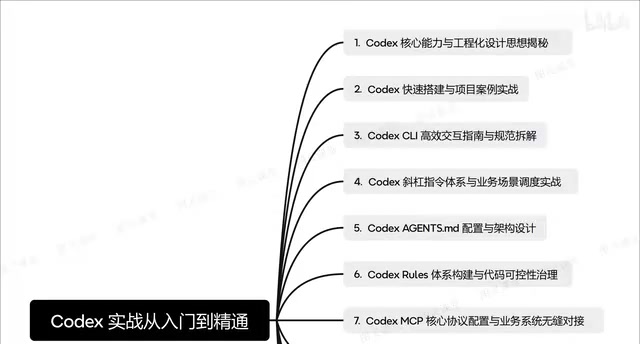
Codex in Practice: From Installation and Configuration to Multi-Agent Collaboration
Based on a Bilibili Codex course overview, this guide maps the full path of AI coding assistants from installation and agents.md context design to CLI commands, MCP integration, and multi-agent collaboration.

Claude Code Installation and Model Switching Guide for Users in China
How can developers in China install Claude Code reliably? This article compiles a Bilibili creator's hands-on solution: install via NPM, skip official login, use CC Switch to configure API Keys and freely switch between DeepSeek, Kimi, and other models to avoid account bans.

AI Supply Chain Security: What Canary Tokens Reveal
Starting from a Hacker News discussion, this article analyzes the role of canary tokens in AI supply chain security: how they detect abnormal access to model weights, training data, and credentials, as well as coverage blind spots and cost constraints during implementation.