Agentic RAG Design Guide: When to Retrieve, Which Data to Select, and Full Traceability Explained

Agentic RAG lets agents autonomously decide when to retrieve, what to retrieve, and how to trace sources, with a four-layer implementation architecture.
This article addresses three core design questions of Agentic RAG: when to use RAG, which data to retrieve, and how to trace sources. For trigger conditions, it recommends rule+semantic routing, confidence thresholds, or tool-calling paradigms so agents retrieve on demand rather than every time; for data selection, it supports routing across heterogeneous multi-source data, combining dense retrieval, sparse retrieval, and metadata filtering, followed by cross-encoder reranking and context compression under a "broad first, precise later" principle; for traceability, it ensures accountability through three mechanisms: enforced citations during generation, complete retrieval trajectory logging, and post-hoc NLI verification. Finally, it proposes a four-layer engineering architecture (routing, retrieval, generation, verification) and compares frameworks like LangGraph and LlamaIndex AgentRunner.
Agentic RAG Design Guide: When to Retrieve, Which Data to Select, and Full Traceability Explained
Traditional RAG (Retrieval-Augmented Generation) works like an assembly line: user asks a question → retrieve documents → generate an answer. But real-world questions are often more complex—some don't need retrieval, some span multiple data sources, and some answers must be traceable to their original sources. Enter Agentic RAG: letting AI agents autonomously decide when to retrieve, what to retrieve, and how to cite sources.
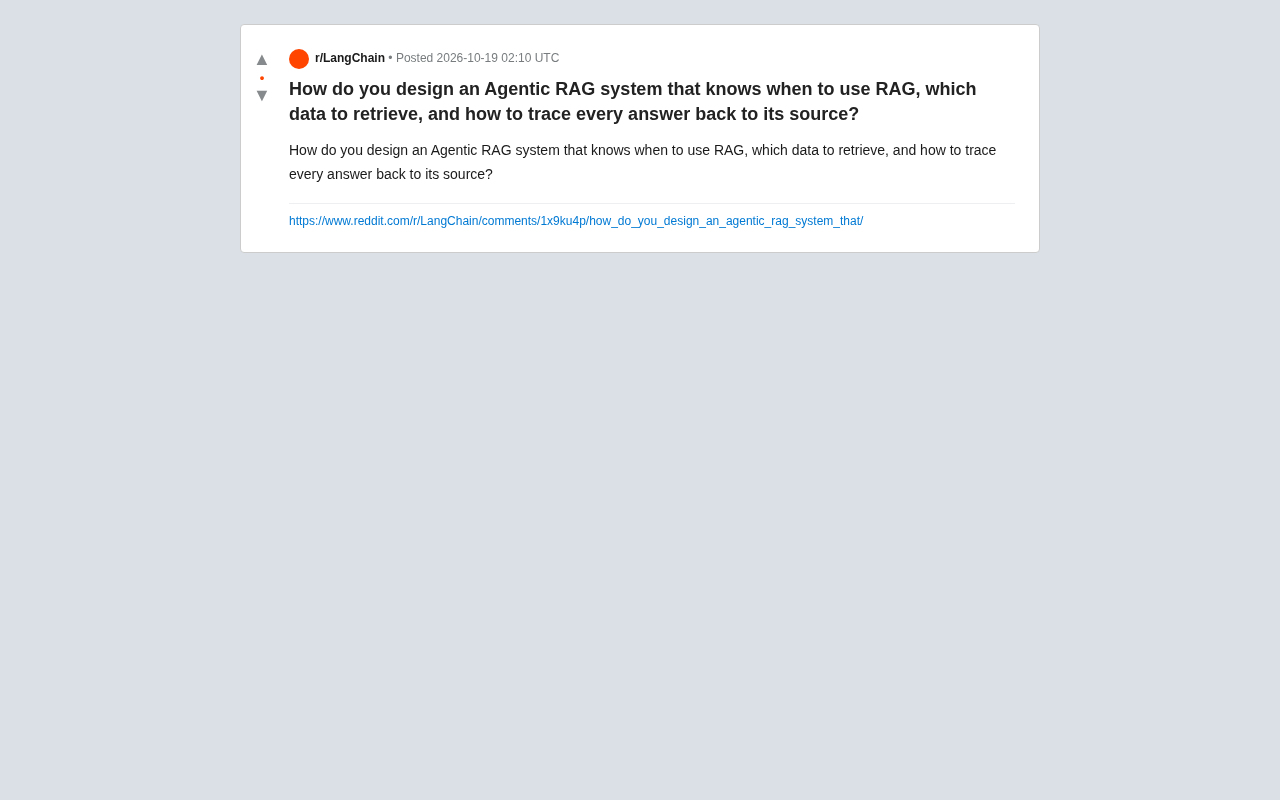
A recently widely-discussed Reddit post (original thread) raised three core design questions: when to use RAG, which data to retrieve, and how to trace each answer's source. This article combines community discussion with engineering practice to break down solutions to these three questions.
1. When to Use RAG: Teaching the Agent to "Retrieve on Demand"
The first decision point in Agentic RAG is the trigger condition. Retrieving on every question not only wastes compute but may introduce irrelevant noise; never retrieving means the model may fabricate facts. In the Reddit discussion, multiple developers recommended a routing mechanism: using a small classifier or LLM to determine question type.
Common strategies include:
- Rule + semantic routing: Force retrieval for time-sensitive questions like "today's weather" or "latest news," and skip retrieval for purely logical questions like math calculations or code syntax.
- Confidence thresholds: Let the base model attempt an answer first; if its own confidence falls below a threshold (e.g., assessed via logprob or self-consistency sampling), trigger retrieval.
- Tool-calling paradigm: Wrap the retriever as a tool, letting the agent autonomously decide within its reasoning chain whether to invoke it. LangChain's
create_react_agentand LlamaIndex'sRouterQueryEngineboth support this pattern.
The original poster mentioned they trained a lightweight classifier using a "retrieval necessity score," achieving over 85% accuracy.
Confidence assessment is a key component of the routing mechanism. An LLM's logprob (log probability) reflects the model's certainty for each generated token; the average logprob across the answer sequence can serve as a proxy for overall confidence. Self-consistency sampling, on the other hand, samples the same question multiple times and observes answer consistency—if results diverge significantly across samples, the model lacks confidence on that question. Both signals can serve as threshold criteria for triggering retrieval. Note that logprob thresholds need calibration for specific models and task distributions; probability distribution scales vary widely across models, so directly applying fixed thresholds often performs poorly. In practice, it's advisable to first plot a confidence-accuracy curve using labeled data, then select the optimal cut point balancing recall and precision.
2. Which Data to Select: Multi-Source Retrieval and Reranking
Once retrieval is deemed necessary, the next question is what to retrieve. Agentic RAG should not rely solely on a single vector store but should support on-demand selection across heterogeneous multi-source data (documents, databases, APIs, web pages).
2.1 Data Source Routing
The agent can select data sources based on question domain: technical questions query the code repository, product questions query help documentation, real-time questions query search APIs. Reddit user u/rag_enthusiast shared a practical tip: maintain an embedding centroid vector for each data source, compute similarity between the question and each centroid, and select the top-2 data sources for retrieval.
2.2 Combining Retrieval Strategies
A single retrieval method easily misses results. Recommended combination:
- Dense retrieval (vector similarity) captures semantic matches;
- Sparse retrieval (BM25) ensures precise keyword hits;
- Metadata filtering (time, author, document type) narrows the scope.
After retrieval, use a cross-encoder to rerank and take the top-K results. Community experience suggests: broad first, precise later—recall 20 items per source first, then keep 3-5 after reranking.
Cross-encoder reranking is fundamentally different from the common bi-encoder. A bi-encoder encodes the query and document separately into vectors and computes cosine similarity—extremely fast but loses fine-grained interaction information between query and document. A cross-encoder concatenates query and document and feeds them together into a Transformer, allowing the attention mechanism to fully model word-level associations between the two, resulting in significantly higher ranking precision but much greater computational cost—each query-document pair requires an independent forward pass. This is precisely the engineering logic behind the "broad first, precise later" strategy: use low-cost bi-encoders or BM25 for large-scale coarse recall, then use cross-encoders to precisely rank a small set of candidates, balancing effectiveness and latency. Common cross-encoder models include the BGE-Reranker series and Cohere Rerank.
2.3 Context Compression
Retrieved passages may be redundant. Using an LLM for context compression (e.g., LangChain's ContextualCompressionRetriever) to keep only sentences directly relevant to the question can significantly improve generation quality and reduce token consumption.
3. How to Trace: Making Every Answer Traceable
Traceability is the trust foundation of Agentic RAG. In the Reddit discussion, the most endorsed approach is citation annotation + verification chain.
3.1 Enforce Citations During Generation
In the prompt, require the model to annotate source IDs after each sentence, e.g., [doc_123]. A stricter approach uses structured output (e.g., JSON), having the model return {answer, citations: [{text, source_id}]}. OpenAI's Function Calling and the Instructor library can both achieve this.
3.2 Retrieval Chain Logging
The agent should record the complete retrieval trajectory: which query was used, which data sources were queried, which documents were returned, and what the reranking scores were. This metadata serves not only for debugging but can also be displayed in the final answer as "reasoning basis."
3.3 Post-hoc Verification
After generation, use a small model or rules to check whether each citation actually supports the corresponding statement (NLI task). Reddit user u/traceable_ai mentioned they use DeBERTa for entailment judgment, filtering out unsupported citations, improving accuracy by about 12%.
NLI (Natural Language Inference) is the task of judging the logical relationship between two text fragments, with standard labels including entailment, contradiction, and neutral. In citation verification scenarios, the "cited document passage" can serve as the premise and the "statement in the answer" as the hypothesis. If the model judges entailment, the citation indeed supports the statement; if contradiction or neutral, the citation should be filtered or marked as unreliable. Pretrained models like DeBERTa perform excellently on NLI benchmarks (such as MNLI), with inference latency far lower than having a large model judge on its own. Compared to having the generative model "self-check," an independent NLI model as verifier effectively avoids the same model's self-consistency bias, forming a true cross-validation.
4. Engineering Implementation Recommendations
Synthesizing community discussion, a practical Agentic RAG architecture comprises four layers:
- Routing layer: determine whether to retrieve and which data sources to select;
- Retrieval layer: multi-path recall + reranking + compression;
- Generation layer: structured generation with citations;
- Verification layer: citation validation and trajectory logging.
For framework selection, LangGraph suits orchestrating stateful multi-step agents, while LlamaIndex's AgentRunner has built-in tool calling and traceability support. For a lightweight approach, use smolagents or build directly on the OpenAI Assistants API.
The original poster concluded: "Agentic RAG doesn't replace traditional RAG; it adds a layer of decision intelligence on top. What matters most isn't how powerful the model is, but the design of retrieval decisions and traceability mechanisms."
LangGraph and LlamaIndex AgentRunner represent two different orchestration philosophies. LangGraph organizes agent workflows as graph structures, where nodes represent processing steps and edges represent state transition conditions—naturally suited to expressing multi-step workflows with branches and loops like "routing→retrieval→generation→verification," and supports checkpoint mechanisms for interruption recovery. LlamaIndex AgentRunner leans more toward the tool-calling paradigm, wrapping retrievers, query engines, etc. as tools the agent can invoke, with the LLM autonomously deciding invocation order during reasoning—lower development barrier but relatively weaker process controllability. For selection: scenarios with fixed workflows requiring strict audit trails should prioritize LangGraph; exploratory scenarios with flexible tool combinations may consider AgentRunner. The two can also be mixed—using LangGraph to orchestrate the outer state machine while internal nodes call LlamaIndex retrieval components.
Related articles

Random Pruning of the DPO Computation Graph: 1.4x Training Speedup and Lower Peak Memory
DPO training too slow and memory-hungry? This paper proposes a random pruning framework for the DPO computation graph, sampling independently across position, sequence, and branch dimensions; branch pruning achieves a 1.426x step-time speedup and cuts training time by about 30%, with in-depth attribution of memory and time gains.

Why Does JEPA Underperform MLM in Longitudinal EHR Representation Learning?
New study compares JEPA and MLM for longitudinal EHR representation learning on MIMIC-IV: three JEPA variants train stably without collapse but underperform MLM; target size, not heterogeneity, drives prediction error.

Transfer Learning + Visible Light Communication: A New Approach to Energy-Efficient Indoor Positioning
A study proposes a transfer learning-based visible light communication indoor positioning method, achieving 47% accuracy improvement on the BOSCH factory dataset, 67.5% model efficiency under high noise, and introducing the ME composite metric for energy-efficient positioning in energy-constrained industrial IoT scenarios.