AgentRoboCritic: Capabilities and Bottlenecks of Frontier Agents in Direct Robot Control

AgentRoboCritic uses intent-anchored action-level analysis to reveal the capabilities and physical execution bottlenecks of frontier robot agents.
This article introduces AgentRoboCritic, an intent-anchored critic framework for action-level analysis of frontier multimodal language agents' robot control. Addressing benchmarks that only report episode-level success rates and cannot locate failures, the framework has the policy declare local intent for each action, with the critic evaluating outcomes and failure modes. Covering 12 manipulation benchmarks, it produces 12,844 annotated actions and fine-tunes the open-source Muse-Glimmer-30B critic, raising failure-mode accuracy from 32.58% to 74.24%. Agents show closed-loop recovery, reliable semantic anchoring, and strong zero-shot manipulation, but grasping and alignment remain bottlenecks, with uneven recovery across failure modes.
Why Do We Need Action-Level Analysis?
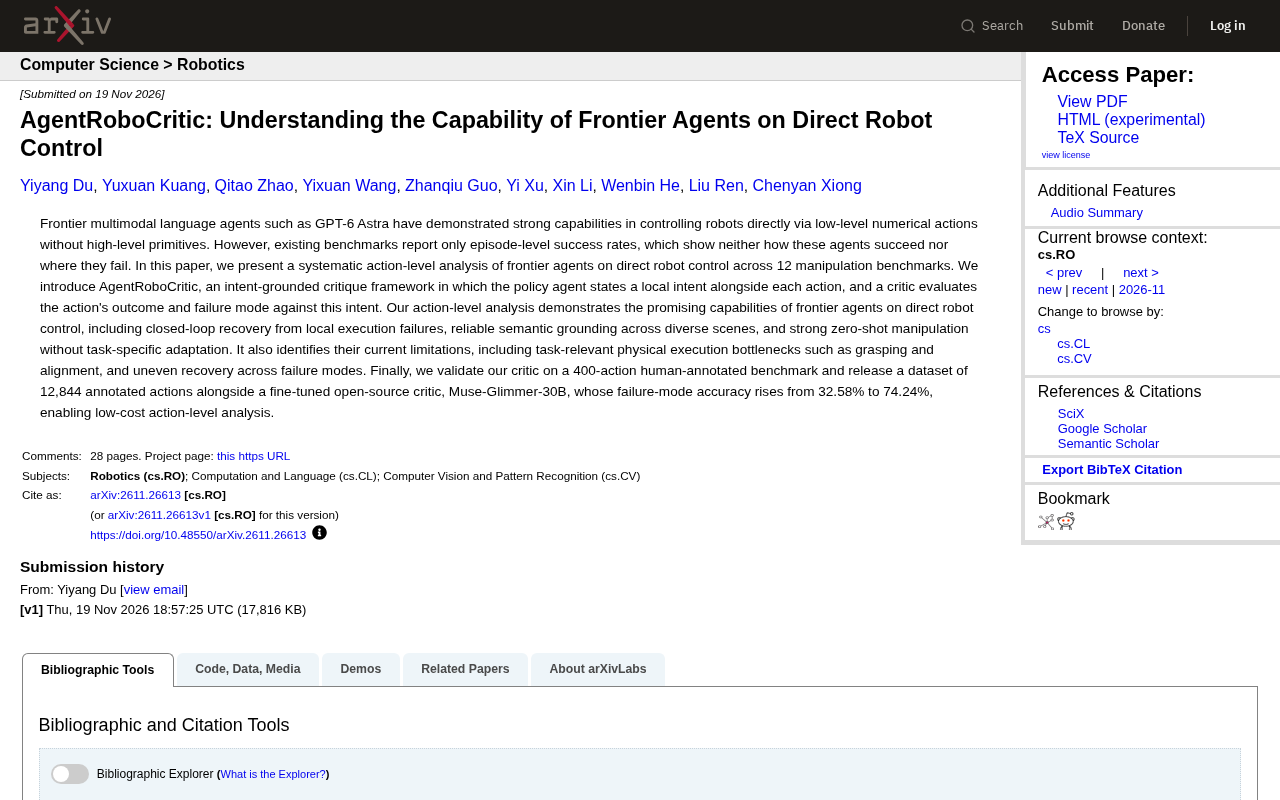
Frontier multimodal language agents (such as GPT-6 Astra) have demonstrated the ability to control robots directly through low-level numerical actions, without relying on high-level primitives. However, existing benchmarks only report episode-level success rates, and this coarse-grained metric can neither reveal how agents succeed nor pinpoint where failures occur. To address this, researchers proposed AgentRoboCritic—an intent-anchored critic framework that performs systematic action-level analysis across 12 manipulation benchmarks.
Episode-level success rate is a common evaluation metric in robot learning: a single task attempt is called an episode, and success is typically a binary judgment of whether the final task was completed. It is simple to compute and convenient for cross-benchmark comparison, but it obscures critical process information—for example, whether the agent completed the task smoothly or succeeded by luck after repeated trial and error, and whether failures occurred in perception, planning, or execution. For low-level action control that requires fine-grained debugging, this coarse-grained metric provides almost no actionable improvement signals—this is the direct motivation for proposing action-level evaluation.
How Does the Intent-Anchored Critic Framework Work?
The core design of AgentRoboCritic is: the policy agent declares a local intent when executing each action, and the critic evaluates the action outcome and failure mode against that intent. This "intent-action-evaluation" loop shifts analysis from "whether the task was completed" down to "why each step succeeded or failed."
The framework's outputs include:
- A dataset containing 12,844 annotated actions
- A critic validated on a human-annotated benchmark of 400 actions
- A fine-tuned open-source critic model Muse-Glimmer-30B, whose failure-mode recognition accuracy improved from 32.58% to 74.24%
Low-cost action-level analysis thus becomes possible, and researchers no longer need to rely on expensive manual frame-by-frame inspection.
A critic in reinforcement learning and agent research typically refers to an evaluation model independent of the policy: it is not responsible for generating actions, but instead provides value judgments or quality scores for actions or states produced by the policy. Unlike external reviewers that only evaluate final outcomes, a critic can intervene at each decision step and provide dense feedback signals. The critic in AgentRoboCritic is further "intent-anchored"—rather than evaluating actions abstractly as good or bad, it uses the local intent declared by the policy itself as the reference to judge whether the action serves that intent and whether the outcome is achieved, thereby giving the score a clear semantic context.
What Capabilities Do Frontier Agents Demonstrate?
Action-level analysis reveals several standout capabilities of frontier agents in direct robot control:
Closed-loop recovery: Agents can recover from local execution failures, adjusting their action sequences to continue advancing the task.
Reliable semantic anchoring: Across different scenes, agents' semantic understanding of objects and space remains stable.
Strong zero-shot manipulation: Without task-specific adaptation, agents can complete a variety of manipulation tasks.
These findings indicate that frontier models already possess considerable plasticity in low-level control, rather than merely "cutting corners" through high-level planning.
Zero-shot manipulation refers to an agent completing manipulation directly based on language instructions or visual input without fine-tuning or demonstration learning for the target task. This contrasts with few-shot fine-tuning or task-specific training. Zero-shot capability is an important yardstick for measuring model generalization: if an agent can directly execute low-level actions on unseen objects, scenes, and tasks, it indicates that a transferable semantic-action mapping has formed internally, rather than memorizing action sequences for specific tasks. The findings in this article show that frontier models can still maintain strong manipulation performance under zero-shot conditions.
Where Are the Current Bottlenecks?
The analysis also exposes clear limitations. The most prominent issue is task-related physical execution bottlenecks, such as grasping and alignment—these actions demand high physical precision, and agents are prone to errors at the action level. In addition, recovery capability is uneven across different failure modes: after some failures, agents can effectively correct themselves, while in others they repeatedly fall into the same type of error.
These bottlenecks point to a key conclusion: there is a gap between semantic understanding and physical execution, and simply scaling up model size may not automatically close it.
Significance for the Robot Learning Field
The value of AgentRoboCritic lies not only in evaluation but also in providing a reusable analysis paradigm. Through the open-source critic Muse-Glimmer-30B and the annotated dataset, researchers can perform failure-mode attribution on any agent's action sequences at low cost, enabling more targeted model improvements.
For teams building robot agents, this means shifting from "looking only at success rates" to "checking whether each step's intent matches its outcome," refining debugging granularity from the episode level to the action level.
Conclusion
Frontier agents' ability to directly control robots is advancing rapidly, but the physical execution bottlenecks revealed by action-level analysis remind us that true general-purpose manipulation capability still requires continuous refinement at the interface between semantics and physics. AgentRoboCritic provides a quantifiable tool for this refinement process.
One-line Summary
AgentRoboCritic uses intent-anchored action-level analysis to reveal the capabilities and physical execution bottlenecks of frontier robot agents.
Paragraph Summary
This article introduces AgentRoboCritic—an intent-anchored critic framework for action-level analysis of frontier multimodal language agents' robot control. Addressing the problem that existing benchmarks only report episode-level success rates and cannot locate failures, the framework has the policy declare a local intent when executing each action, and the critic evaluates action outcomes and failure modes accordingly. The study covers 12 manipulation benchmarks, produces a dataset of 12,844 annotated actions, and fine-tunes the open-source critic model Muse-Glimmer-30B, improving failure-mode recognition accuracy from 32.58% to 74.24%. Analysis shows that agents possess closed-loop recovery, reliable semantic anchoring, and strong zero-shot manipulation capabilities, but physical execution stages such as grasping and alignment remain major bottlenecks, and recovery capability is uneven across different failure modes.
Related articles

The Safety Blind Spot in Multimodal Image Editing: Text-Sensitive, Visually Blind
EditSafetyBench benchmarks image editing systems like Gemini, GPT, and Qwen, revealing a text-visual safety mismatch: high rejection of unsafe prompts but lax handling of unsafe images, calling for joint multimodal safety guardrails.

GLiDE: Fast, Calibrated Decision Models Distilled from Reasoning Teachers
GLiDE is a family of decision models distilled from reasoning teachers, ranging from 0.4B to 27B, achieving fast calibrated decisions in a single forward pass by removing causal masks and using soft-target distillation. The 27B model scores 71.52 on the hidden set with 2.0% calibration error and 92.9ms latency.

Build a Professional Website with Claude Code in Minutes: A Five-Step Practical Guide
Learn how to build a professional website with Claude Code in minutes: the complete five-step process from planning prompts and precise iteration to MCP image generation, design redos from reference images, and one-click deployment.