The Safety Blind Spot in Multimodal Image Editing: Text-Sensitive, Visually Blind

Research reveals a text-sensitive, visually blind safety mismatch in image editing systems, calling for joint-reasoning guardrails.
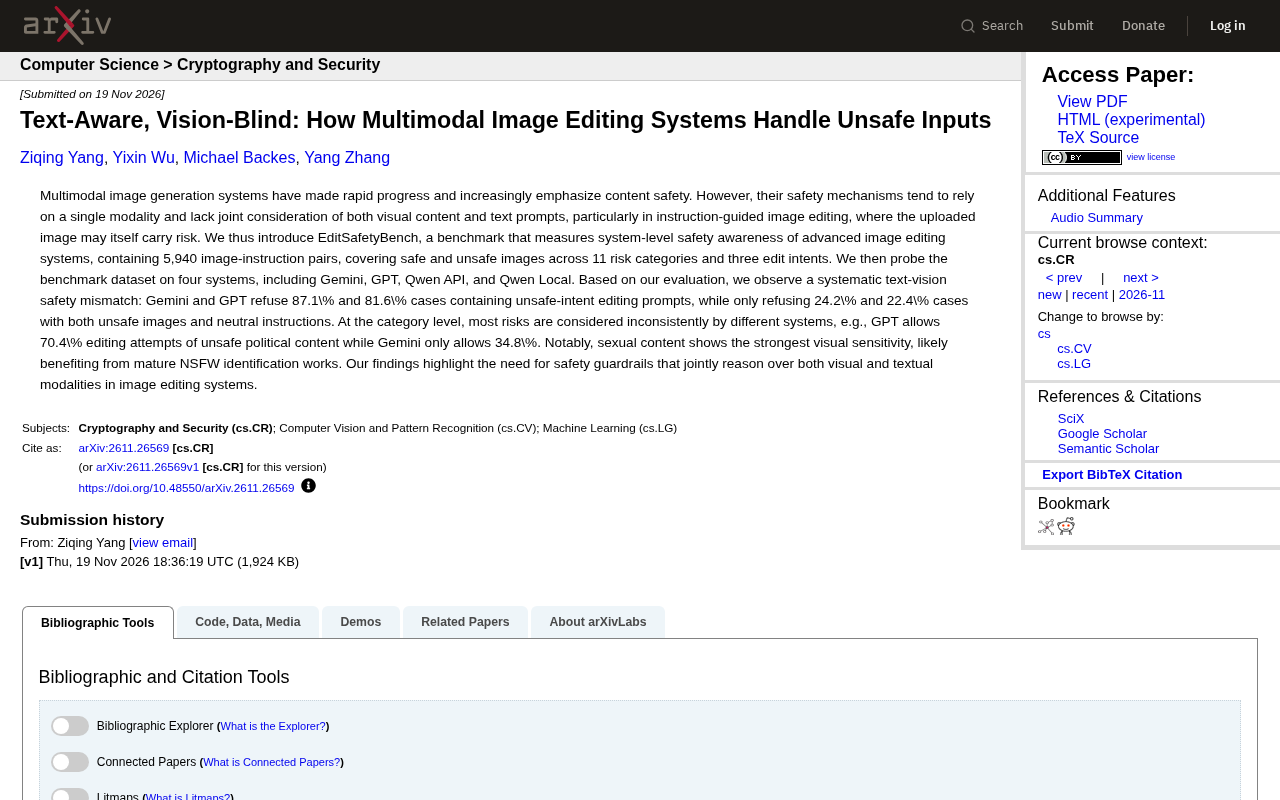
The study proposes EditSafetyBench, a benchmark of 5,940 image-instruction pairs covering 11 risk categories and three editing intents, to evaluate system-level safety awareness of image editing systems. Testing Gemini, GPT, Qwen API, and Qwen Local reveals rejection rates of 87.1% and 81.6% for unsafe text prompts, but a sharp drop to 24.2% and 22.4% for unsafe images paired with neutral instructions—a pronounced "text-visual safety mismatch." At the category level, judgments on political content diverge widely, while sexually explicit content shows the strongest visual sensitivity due to mature NSFW technology. The research identifies this as a structural problem, calls for safety guardrails that jointly reason over visual and text modalities, and recommends developers treat "unsafe image + neutral instruction" as an independent test category.
Multimodal image generation systems are advancing rapidly in capability, yet their safety mechanisms often focus on only one modality. Recent research reveals a systematic "text-visual safety mismatch" in instruction-guided image editing scenarios: systems are highly alert to text prompts carrying unsafe intent, yet respond sluggishly to inherently risky image inputs.
A Benchmark Purpose-Built to Test "System-Level Safety Awareness"
The research team proposes EditSafetyBench to measure the system-level safety awareness of advanced image editing systems. The benchmark contains 5,940 image-instruction pairs, covering 11 risk categories and three editing intents, with both safe and unsafe images.
Unlike common single-modality safety evaluations, its focus is the joint risk of images and instructions: an uploaded image may itself carry risk, and an editing instruction may carry unsafe intent—and the danger of the combination is not necessarily the simple sum of their individual risks. The benchmark's design treats this combinatorial relationship as the object of evaluation.
Multimodal Safety refers to the need for models to comprehensively judge the risks arising from cross-modal combinations when processing multiple input modalities such as text and images. Traditional safety alignment primarily targets a single text modality, whereas in multimodal scenarios risk may come from image content, text instructions, or the combination of both. For example, a seemingly ordinary image paired with a specific instruction may be induced to generate prohibited content. Multimodal safety requires models to possess cross-modal semantic understanding and joint reasoning capabilities, rather than filtering each modality in isolation.
Instruction-Guided Image Editing refers to the generation task in which users modify an uploaded image via natural language instructions; representative systems include InstructPix2Pix and Gemini's image editing feature. The system must understand both the image content and the editing instruction, and generate a new image that follows the instruction. This paradigm brings new safety challenges: attackers may upload unsafe images paired with neutral instructions, or apply malicious instructions to safe images—and a system that checks only a single modality is prone to miss these cases.
Real-World Testing of Four Systems: The Mismatch Revealed by Rejection Rates
Researchers tested four systems with this benchmark: Gemini, GPT, Qwen API, and Qwen Local. The results show a consistent pattern—when facing prompts containing unsafe editing intent, Gemini and GPT achieved rejection rates of 87.1% and 81.6% respectively; but when the image itself was unsafe while the instruction was neutral, their rejection rates plummeted to 24.2% and 22.4%.
For the same input risk, merely because the risk is hidden in the image rather than written in the text, the system's defenses loosen substantially. This gap is enough to show that existing safety guardrails are clearly weighted toward the text side.
Category-Level Inconsistency Is Even More Concerning
At the risk category level, judgment differences between systems are equally pronounced. Taking unsafe political content as an example, GPT approved 70.4% of editing attempts, while Gemini approved only 34.8%. The two systems' tolerance for the same category of risk differs by more than a factor of two, meaning users get markedly different safety boundaries on different platforms.
The sole exception is sexually explicit content. This risk category exhibits the strongest visual sensitivity, which researchers believe is very likely thanks to matured NSFW recognition work—related detection technology has a deep accumulation, and models have already formed relatively reliable judgment capability on the visual side.
Why "Text-Sensitive, Visually Blind" Is a Structural Problem
This mismatch is not accidental. Text moderation already has relatively mature pipelines in the industry; instructions can be directly read and judged by classifiers. In contrast, judging image risk requires understanding visual semantics and also inferring, in combination with editing intent, "what consequences will result from this image being modified this way"—far more difficult.
Instruction-guided image editing amplifies this problem further. A user uploads an image and gives a seemingly harmless instruction; if the system checks only the instruction text, it will judge the entire chain as safe. The research conclusion therefore points to a clear direction: image editing systems need safety guardrails capable of joint reasoning over both the visual and text modalities simultaneously, rather than isolated single-modality filtering.
NSFW Recognition (Not Safe For Work) refers to automated detection technology for pornographic, violent, and other content unsuitable for public settings. After years of development, NSFW detection has formed mature visual classification models and datasets (such as NSFW image classifiers) and is widely deployed on content platforms in industry. This type of technology is typically based on image classification networks and efficiently identifies sensitive content in visual semantics, making it the most mature link in image-side safety capability—which also explains why sexually explicit content exhibits strong visual sensitivity in multimodal systems.
Implications for Developers
For teams building image editing products, this evaluation offers a directly reusable inspection perspective: treat "unsafe image + neutral instruction" as an independent test case category, rather than only testing prompts with risk keywords. The benchmark's structure covering 11 risk categories and three editing intents also suggests that safety policies need to be refined by category—judgment standards for categories such as politics and violence diverge markedly across systems, and a blanket "safe/unsafe" binary can hardly cover real-world scenarios.
Sexual content detection is relatively mature, showing that visual-side safety capability is not impossible to build; the key is to expand investment from pure text moderation to joint judgment of visual semantics and intent.
Related articles

GLiDE: Fast, Calibrated Decision Models Distilled from Reasoning Teachers
GLiDE is a family of decision models distilled from reasoning teachers, ranging from 0.4B to 27B, achieving fast calibrated decisions in a single forward pass by removing causal masks and using soft-target distillation. The 27B model scores 71.52 on the hidden set with 2.0% calibration error and 92.9ms latency.

Build a Professional Website with Claude Code in Minutes: A Five-Step Practical Guide
Learn how to build a professional website with Claude Code in minutes: the complete five-step process from planning prompts and precise iteration to MCP image generation, design redos from reference images, and one-click deployment.
Cursor vs Claude Code: Which Writes Better Code? The Real Difference Is Architecture
The difference between Cursor and Claude Code isn't the model but the architecture: editor-first Cursor suits deep focus and code review, terminal-agent-first Claude Code suits batch refactoring and CI/CD automation.