GLiDE: Fast, Calibrated Decision Models Distilled from Reasoning Teachers

GLiDE distills reasoning capability and removes causal masks to enable fast, confidence-aware decisions in a single forward pass.
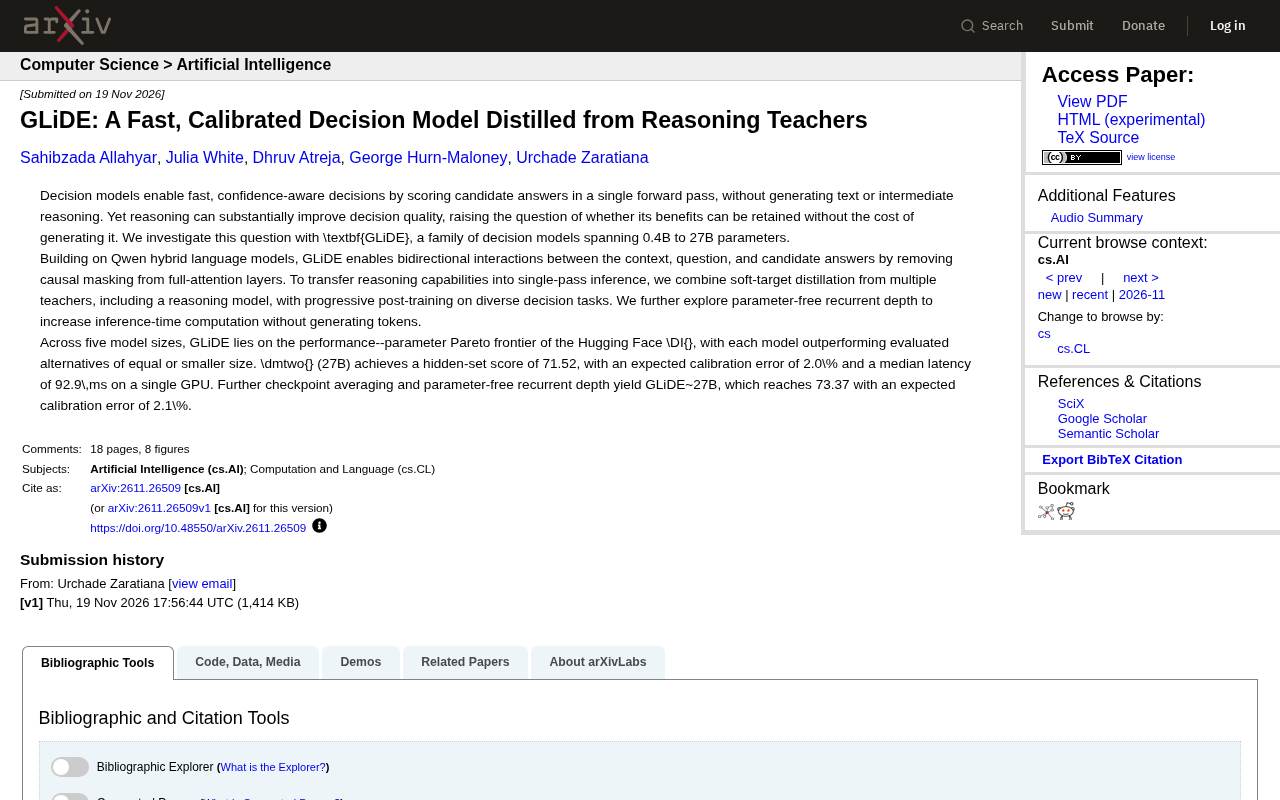
GLiDE is a family of decision models ranging from 0.4B to 27B parameters, designed to retain the decision benefits of reasoning without generating reasoning text. Built on Qwen hybrid language models, it removes the causal mask in full-attention layers to enable bidirectional interaction among context, question, and candidate answers, and combines multi-teacher soft-target distillation with progressive post-training to compress reasoning into a single forward pass. GLiDE 27B achieves 71.52 on the hidden set with 2.0% expected calibration error and 92.9ms single-GPU median latency; checkpoint averaging and parameter-free recurrent depth further raise the score to 73.37. The models sit on the Hugging Face decision model leaderboard's performance-parameter Pareto frontier, though the data come from a single research source and await independent reproduction.
A New Paradigm for Decision Models: Single Forward Pass, Confidence-Aware
Decision models score candidate answers in a single forward pass, enabling fast and confidence-aware decisions without generating text or intermediate reasoning. However, reasoning processes often significantly improve decision quality, raising a key question: can we retain the benefits of reasoning without paying the cost of generating it? According to recent research, GLiDE is a family of decision models designed to answer exactly this question, with parameter sizes ranging from 0.4B to 27B.
GLiDE's core idea is to "distill" reasoning capability into a single-inference decision model. Built on Qwen hybrid language models, it removes the causal mask in full-attention layers, enabling bidirectional interaction among context, question, and candidate answers. This change allows the model to more fully exploit the association information between candidate answers and the question, rather than only attending in one direction as traditional causal models do.
Causal Mask is a standard mechanism in autoregressive language models: during attention computation, each position can only attend to preceding positions, ensuring the generation process follows left-to-right order. GLiDE removes the causal mask in full-attention layers, meaning context, question, and candidate answers can attend to each other bidirectionally. This is similar to how BERT-style encoder models work, but GLiDE applies it within a Qwen-based hybrid architecture. For decision tasks, bidirectional interaction is reasonable—candidate answers and questions are inputs visible simultaneously, with no constraint that "future tokens cannot be seen." Removing the mask allows the model to more fully model fine-grained associations between candidate answers and questions, which is the architectural foundation for improved single-forward-pass decision quality.
Distillation and Progressive Training: Compressing Reasoning into a Single Forward Pass
To transfer reasoning capability into single-pass inference, GLiDE combines soft-target distillation from multiple teachers (including a reasoning model) with progressive post-training on diverse decision tasks. Soft-target distillation lets the decision model learn the probability distributions output by teacher models rather than just hard labels, thereby capturing richer decision boundary information. Progressive post-training adapts the model to decision tasks of varying difficulty in stages, gradually improving decision quality.
The key to this training strategy is that it does not require the decision model to generate any intermediate steps at inference time, yet it can embody the decision advantages brought by the reasoning teacher in its outputs. In other words, GLiDE shifts the cost of "thinking" to the training stage while keeping inference lightweight.
Soft-target Distillation is a form of knowledge distillation: instead of directly fitting hard labels (correct/incorrect) provided by the teacher, the student model learns the teacher's full output probability distribution (soft targets). Soft targets carry information about relative similarities between classes and the teacher's uncertainty, typically providing richer supervisory signals than hard labels. GLiDE uses multiple teachers (including a reasoning model) to produce soft targets, enabling the student decision model to capture the decision boundaries implicitly encoded by the reasoning teacher during training. Compared with hard-label training, soft-target distillation can compress the teacher's "thinking process" into the student model's parameters without increasing inference cost—this is the key element of GLiDE's "heavy at training, light at inference" strategy.
Performance and Calibration: Standing on the Pareto Frontier
Across five model sizes, GLiDE sits on the performance-parameter Pareto frontier of the Hugging Face decision model leaderboard, with each model outperforming comparable or smaller alternatives. Among them, GLiDE 27B achieves a score of 71.52 on the hidden set, an Expected Calibration Error (ECE) of 2.0%, and a single-GPU median latency of just 92.9 ms. Further, through checkpoint averaging and parameter-free recurrent depth, GLiDE 27B's score rises to 73.37 with an ECE of 2.1%.
These figures show that GLiDE achieves good confidence calibration while maintaining low latency—calibration error is at a low level, meaning the model's stated confidence is fairly consistent with its actual accuracy. This is particularly important for downstream applications requiring reliable confidence estimates (such as automated decision-making and risk control).
Expected Calibration Error (ECE) measures the deviation between model confidence and actual accuracy. Specifically, predictions are bucketed by confidence, and a weighted average of the difference between average confidence and average accuracy within each bucket is computed. The lower the ECE, the more the model is "as accurate as it claims to be confident." For example, an ECE of 2.0% means confidence deviates from accuracy by only two percentage points on average. For downstream scenarios such as automated decision-making and risk control, well-calibrated confidence is as important as raw accuracy—a high-scoring but overconfident model could lead to erroneous risk judgments. GLiDE 27B achieving 71.52 while maintaining 2.0% ECE shows that its performance gains do not come at the expense of confidence reliability.
Parameter-Free Recurrent Depth: Adding Compute Without Generating Tokens
GLiDE also explores parameter-free recurrent depth, increasing inference-time computation without generating additional tokens. Traditionally, increasing inference compute often means generating more intermediate steps, which incurs latency overhead. Parameter-free recurrent depth improves decision quality by reusing the model's internal layers without increasing parameter count. Building on checkpoint averaging, this design further raises the 27B model's score from 71.52 to 73.37, demonstrating another path for scaling inference-time compute.
Checkpoint Averaging is a model-ensemble-style weight post-processing technique: multiple checkpoints saved at different points during training are averaged directly to produce a fused model. Since the loss surface of deep networks tends to flatten in later training, different checkpoints often land at different positions within the same basin, and weight averaging frequently yields better generalization and smoother predictions than any single checkpoint. This method adds no inference overhead and requires no additional training. GLiDE applies checkpoint averaging to the 27B model, raising the hidden-set score from 71.52 to 73.37, reflecting the combined gains of this low-cost post-processing with parameter-free recurrent depth.
Multi-Source Cross-Validation and Limitations
Currently, information about GLiDE comes primarily from a single research source, with no independent third-party reproduction or comparative analysis yet available. Its performance data (such as hidden-set scores of 71.52 and 73.37, calibration errors of 2.0% and 2.1%, and 92.9 ms latency) all come from the original paper's reports, and actual performance may vary with hardware environment, task distribution, and evaluation protocol. In addition, GLiDE is built on Qwen hybrid language models, and its generalization to other base models remains to be validated.
Nevertheless, GLiDE's idea of "distilling reasoning capability into single-pass decisions" provides a valuable reference for building fast, well-calibrated decision models. For scenarios requiring low latency and reliable confidence, this direction is worth continued attention.
One-line Summary
GLiDE distills reasoning capability and removes causal masks to achieve fast, confidence-aware decisions in a single forward pass.
Paragraph Summary
GLiDE is a family of decision models ranging from 0.4B to 27B parameters, designed to retain the decision benefits of reasoning without generating reasoning text. Its core approach removes the causal mask in full-attention layers of Qwen hybrid language models to enable bidirectional interaction among context, question, and candidate answers, and combines multi-teacher soft-target distillation with progressive post-training to compress reasoning into a single forward pass. In terms of performance, GLiDE 27B achieves 71.52 on the hidden set, an expected calibration error of 2.0%, and a single-GPU median latency of 92.9 ms; with checkpoint averaging and parameter-free recurrent depth, the score further rises to 73.37. The models sit on the performance-parameter Pareto frontier of the Hugging Face decision model leaderboard, but the reported data all come from a single research source and await independent reproduction.
Related articles

The Safety Blind Spot in Multimodal Image Editing: Text-Sensitive, Visually Blind
EditSafetyBench benchmarks image editing systems like Gemini, GPT, and Qwen, revealing a text-visual safety mismatch: high rejection of unsafe prompts but lax handling of unsafe images, calling for joint multimodal safety guardrails.

Build a Professional Website with Claude Code in Minutes: A Five-Step Practical Guide
Learn how to build a professional website with Claude Code in minutes: the complete five-step process from planning prompts and precise iteration to MCP image generation, design redos from reference images, and one-click deployment.

Cursor vs Claude Code: Which Writes Better Code? The Real Difference Is Architecture
The difference between Cursor and Claude Code isn't the model but the architecture: editor-first Cursor suits deep focus and code review, terminal-agent-first Claude Code suits batch refactoring and CI/CD automation.