Agriculture: The Overlooked Self-Replicating Nanotechnology

The tweet redefines agriculture as a self-replicating, recursively improving, open-source nanotechnology system in the physical world.
Through a cross-disciplinary analogy, the tweet describes agriculture as self-replicating, recursively self-improving, and completely open-source nanotechnology in the physical world. Seeds are seen as nanoscale self-replicating units that can use environmental materials and energy to build copies of themselves, ultimately achieving super-exponential growth. The open-source property is reflected in the accessibility and modifiability of genetic information, with recursive improvement achieved through distributed selection and reproduction, akin to a global evolutionary algorithm running on a physical substrate. The article notes that the San Francisco tech community may therefore underestimate agriculture's reference value as a self-replicating manufacturing platform. Despite controversies over scale, agriculture is highly similar in functional logic to synthetic biology and molecular nanotechnology, and having run for tens of thousands of years, it provides a ready-made model for scalable, distributed, and sustainable technology.
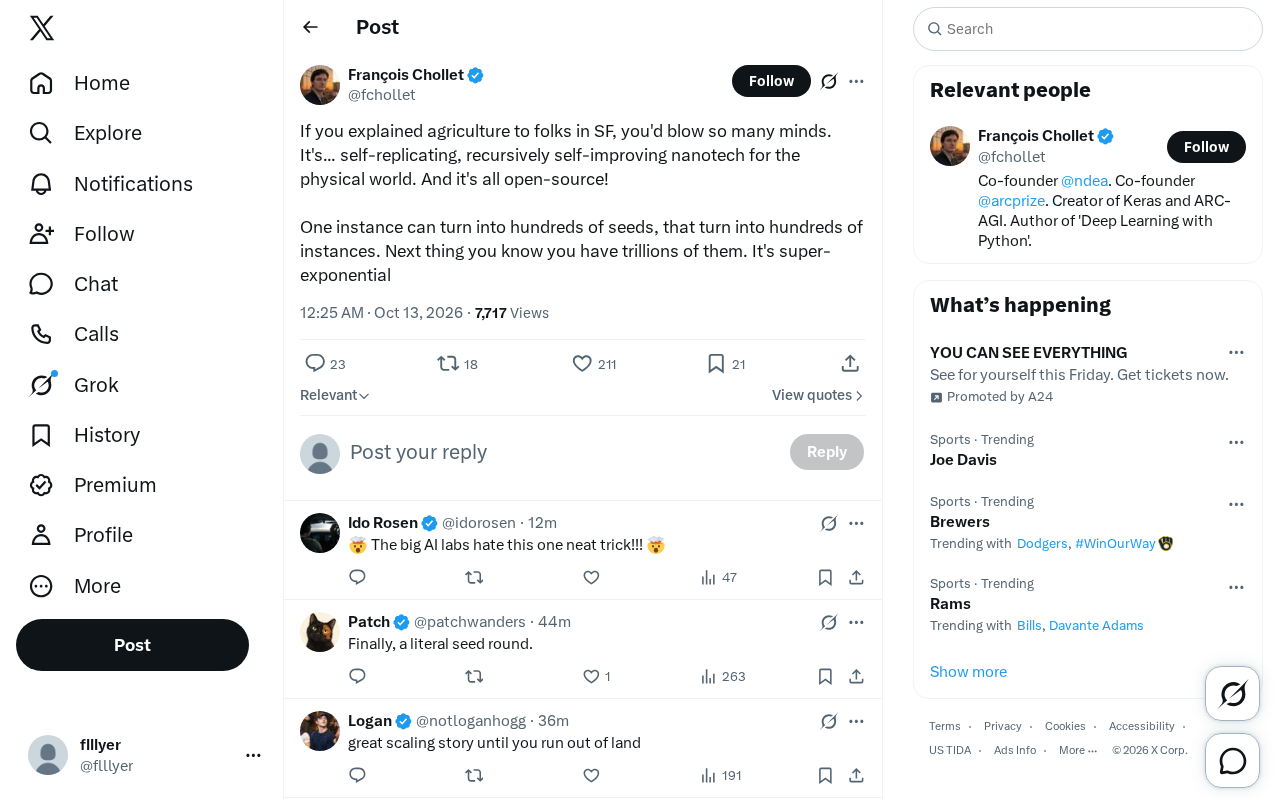
A tweet from Twitter offers a thought-provoking analogy: if you explained agriculture to tech workers in San Francisco, it would blow a lot of minds. It is described as self-replicating, recursively self-improving nanotechnology in the physical world, and it is completely open source. This perspective repositions agriculture from a traditional industry into a foundational technology paradigm.
Agriculture as a Self-Replicating Nanotechnology System
The core insight of the tweet is that agricultural systems possess properties typically attributed to cutting-edge nanotechnology. A seed is a nanoscale self-replicating unit that can use materials and energy from its environment to build more copies of itself. According to the tweet, "one instance can become hundreds of seeds, which become hundreds of instances." The final count can reach into the trillions, which the tweet calls "super-exponential" growth.
This overlaps heavily with the visions of synthetic biology and molecular nanotechnology. The difference is that agriculture has been running for tens of thousands of years, while nanoscale replication systems in the lab are still in their early stages. From this angle, agriculture is not low-tech—it is a widely deployed, long-validated self-replicating manufacturing platform.
The von Neumann self-replicating automaton is the key theoretical backdrop for understanding this analogy. In the 1940s, mathematician John von Neumann, while studying whether machines could self-replicate, proposed that a self-replicating system must carry two things at once: a "blueprint" describing its own construction, and a "mechanism" that executes construction according to that blueprint. These two functions can be unified in a single physical entity. A seed fits this model perfectly: DNA is the blueprint, the ribosomes and enzyme systems within the cell are the execution machinery, and the seed itself is an instance of the "automaton." Von Neumann also proved that self-replicating machines can in theory possess universal construction capability—that is, the ability to construct any object given its description. In agricultural systems, humans act as external selectors who "modify the blueprint," but the core loop of replication and construction is carried out entirely autonomously by biological systems.
The distinction between exponential growth and logistic growth is also worth clarifying. The "super-exponential" growth mentioned in the tweet is constrained by resources in real agricultural systems and ultimately follows a logistic curve: approximately exponential at first, then leveling off due to limitations in light, water, nutrients, or space. What truly has "super-exponential" characteristics is the theoretical replication rate under ideal conditions, not actual field yields. Understanding this distinction helps assess the real scalability of agriculture as a manufacturing platform.
Open-Source Properties and Recursive Self-Improvement
The tweet emphasizes that agriculture is "completely open source." Open source here refers to the accessibility and modifiability of genetic information. Anyone with seeds can improve the traits of the next generation through selective breeding, hybridization, or modern gene editing. Each generation of plants is an iteration, and successful improvements are retained and spread.
This recursive self-improvement does not require central control; it is achieved through distributed selection and reproduction. Compared to the software world, this is like a planet-scale evolutionary algorithm running on a physical substrate. According to the tweet, this mechanism gives agriculture "super-exponential" scaling potential.
The accessibility of genetic information versus intellectual property is a tension point in the "open-source agriculture" analogy that is easily overlooked. Although seeds biologically carry replicable, modifiable genetic information, modern commercial seeds are often protected by patents and plant variety rights, and some varieties are designed to be non-saveable (such as terminator technology). Therefore, "completely open source" is closer to an ideal state or a historical norm than the current global reality of agriculture. The traditional practice of farmers saving and exchanging seeds does constitute a distributed open-source system, but the property rights regime of industrial agriculture substantially limits this property. The rate of recursive self-improvement is also constrained by the biological limits of mutation, recombination, and selection intensity—it does not accelerate indefinitely.
Cognitive Shock from a San Francisco Perspective
The tweet chooses San Francisco as its comparison scenario, suggesting that the tech community's perception of agriculture may be skewed. In circles where software, AI, and nanotechnology are core topics, agriculture is often seen as a traditional industry rather than cutting-edge technology. If reinterpreted through the tweet's framework, agriculture is in fact a nanotechnology system that has already achieved self-replication, self-improvement, and open source.
This cognitive mismatch may have practical consequences. When technologists explore self-replicating systems, distributed manufacturing, and open-source hardware, agriculture offers a ready-made reference model. Ignoring this model means abandoning an engineering case library that has been running for thousands of years.
Intersections with Synthetic Biology
The tweet's use of "nanotechnology" is prone to controversy. Strictly speaking, seeds and plants operate at scales ranging from micrometers to meters, not nanometers. But from the perspective of functional analogy, their logic of self-replication and self-improvement is highly similar to nanotechnology visions. The field of synthetic biology is attempting to engineer this logic, for example by designing self-replicating artificial cells or molecular machines.
Agriculture provides a naturally existing implementation. According to the tweet, this self-replicating system can not only sustain itself but also expand at super-exponential speed. For those studying scalable manufacturing, distributed energy, and closed-loop systems, agriculture's operating model deserves renewed scrutiny.
The scale difference between molecular nanotechnology and synthetic biology needs further clarification. Molecular nanotechnology (such as Drexler's envisioned assemblers) typically operates on individual molecules at the 0.1 to 100 nanometer scale, whereas plant cells are 10 to 100 micrometers and whole plants can reach the meter scale. Strictly speaking, therefore, agriculture is a "micrometer-scale self-replicating system," not a nanoscale one. But the core of the functional analogy lies not in absolute scale, but in the three features of self-replication, programmability, and distributed manufacturing. Synthetic biology is trying to engineer these features at smaller scales, for example by building self-replicating artificial cells or bacteriophages. The value of agriculture is that it provides a highly robust self-replicating architecture validated by tens of thousands of years of selection pressure, which can serve as a reference frame for engineering design.
Conclusion
The contribution of this tweet lies in providing a cross-disciplinary analogical framework. It redefines agriculture as a self-replicating, recursively self-improving, open-source nanotechnology system in the physical world. Whether or not the analogy is literally precise, it prompts the tech community to rethink what truly scalable, sustainable, and distributed technology looks like. Agriculture has been running for tens of thousands of years, and its self-replication logic may be closer to the ideal form of future manufacturing than many modern technologies.
One-line Summary
The tweet redefines agriculture as a self-replicating, recursively improving, open-source nanotechnology system in the physical world.
Paragraph Summary
Through a cross-disciplinary analogy, the tweet describes agriculture as self-replicating, recursively self-improving, and completely open-source nanotechnology in the physical world. Seeds are seen as nanoscale self-replicating units that can use environmental materials and energy to build copies of themselves, ultimately achieving "super-exponential" growth. The open-source property is reflected in the accessibility and modifiability of genetic information, with recursive improvement achieved through distributed selection and reproduction, akin to a global evolutionary algorithm running on a physical substrate. The article notes that the San Francisco tech community may therefore underestimate agriculture's reference value as a self-replicating manufacturing platform. Despite controversies over scale, agriculture is highly similar in functional logic to synthetic biology and molecular nanotechnology, and having run for tens of thousands of years, it provides a ready-made model for scalable, distributed, and sustainable technology.
Related articles

Free Unlimited Claude Code Solution: Agnes AI + CC Switch Setup Guide
No paid subscription needed — pair the free AI platform Agnes AI with the open-source tool CC Switch to provide a backend for Claude Code, enabling unlimited free calls to text, image, and video models. This guide covers the full setup, test results, and usage boundaries.

A Complete Zero-Cost Guide to Getting Started with Claude Code for Beginners in China
A beginner's guide to Claude Code for users in China: two installation methods (command line and IDE plugin), full configuration steps for replacing the official API with the free domestic LongCat model, and a hands-on demo of building a small tool with natural language, plus tips.

When the NSA Gets Involved: The AI Supply Chain Crisis Behind Open-Source CVEs and API Key Hijacking
Multiple open-source projects disclosed severe CVEs in one day, PHP flaws alarmed the FBI, and Railway and OpenCode were breached with API keys stolen. This article breaks down the vulnerability window, AI-accelerated exploitation, and the AI supply chain crisis behind the API key black market, with a developer defense checklist.