AI Abuse Alert: Reports of Child Sexual Abuse Material Surge 8,400% in Two Years

Reports of AI-related child sexual abuse material surged 8,400% in two years, exposing technology abuse and governance lag.
Starting from a low-traffic Hacker News post, the article discusses the 8,400% increase in reports of AI-related child sexual abuse material over two years. The author points out that generative AI has lowered the barrier to producing illegal content from specialized skills to a single text input, which is the structural reason for the explosion in reports. Governance faces three dilemmas: AI-generated images have no historical hashes to match, and classifiers are easily bypassed by adversarial prompts; jurisdictions disagree on the illegality of virtual child images; and platform reporting processes lack unified standards. The article reviews existing defenses such as safety alignment, content filtering, and detection tools, argues they are clearly insufficient, and advocates moving governance earlier—pre-release red teaming, API-layer auditing and rate limiting, and training data cleaning—while emphasizing that safety should be embedded in product design rather than added as an after-the-fact patch.
Event Overview: A Disturbing Number
A post with a simple yet weighty title appeared on Hacker News: "Reports of AI-related child sexual abuse material rise 8,400% in two years." The post itself had only 8 points and 2 comments, but the information behind the headline far exceeds its popularity.

The 8,400% increase means that in just two years, the number of reported AI-related child sexual abuse material has expanded by orders of magnitude. This is not gradual growth—it is an almost vertical curve. When a technology moves from the lab into ordinary people's browsers, the first thing that often gets amplified is its darkest use.
The Consequences After the Technical Barrier Disappears
One of the core capabilities of generative AI is "generating images from text." For the vast majority of people, this means generating illustrations, posters, or concept art from a sentence; but for a minority, it means turning the production of illegal content—which previously required professional image-processing skills—into a single text input.
In the past, the distribution chain for child sexual abuse material involved a "production" stage that was itself a high-barrier, high-risk criminal act, requiring contact with victims, the use of image-editing tools, or reliance on existing illegal material libraries. Generative models have changed this structure: they detach "production" from reality and move it to the space between a prompt and an inference call. The direct consequence of lowering the barrier is the explosive growth in the number of reports.
It should be noted that 8,400% reflects a change in the "number of reports," not a precise measure of the actual stock of illegal content. Reporting mechanisms, improvements in platform detection capabilities, and greater public awareness of reporting all push this number higher. But even considering the impact of statistical definitions, this increase still points to a clear trend: AI is being systematically used to generate content that harms children.
Child sexual abuse material (CSAM) is a term with strict legal and platform definitions, referring to sexually exploitative images or videos involving minors. Institutions such as the National Center for Missing & Exploited Children (NCMEC) in the United States are responsible for aggregating reports submitted by platforms, and their annual statistics are often used as an industry bellwether. When interpreting the 8,400% figure, it is important to note that NCMEC's reporting scope includes "suspected" content, and in recent years a separate tag for AI-generated categories has been added, meaning the statistical base and classification methods themselves are also changing.
Hash matching (such as PhotoDNA) is the mainstream technology platforms use to detect CSAM: it computes perceptual hashes for known illegal images and compares them with uploaded content. Its advantage is high accuracy and low false-positive rates, but the premise is that the image already exists in a known material library. AI-generated images are entirely new pixel combinations with completely different hash values, so this mature line of defense is inherently ineffective against generated content.
The Dilemma for Platforms and Regulators
The difficulty in governing this type of content lies in the fact that it simultaneously touches multiple sensitive areas.
At the detection level, mainstream platforms rely on hash matching and classifiers to identify known illegal material, but AI-generated images are "new" and have no historical hashes to match against, so they can only rely on the model's judgment of content semantics—and such judgments are unstable in the face of adversarial prompts.
At the legal level, different jurisdictions disagree on whether "AI-generated virtual child images" constitute a violation of the law. Some regions incorporate them into existing child protection regulations, while others hesitate on how to characterize them because there is "no real victim." This legal gap leaves openings for cross-platform and cross-border distribution.
At the reporting level, there is a lack of unified standards for how platforms should handle such content after discovery, whom they should report it to, and how to follow up after reporting. The surge in the number of reports also, to some extent, exposes the previous inadequacy of reporting mechanisms.
Adversarial prompts refer to inducing a model to bypass safety alignment and output content that should have been refused, through specific wording, metaphor, spelling variations, or role-playing. These attacks do not require a technical background, often spread in the form of community-shared "jailbreak templates," and evolve rapidly with model version updates. For detectors, this means that filtering based on keywords or fixed classifiers is easily bypassed through targeted probing, and defenses must be continuously iterated.
Real Progress in Technical Countermeasures
The industry is not standing still. Model providers add safety alignment during training and deploy content filtering during inference, while platforms screen uploaded content through a combination of detection models and manual review. Some organizations are also promoting specialized detection tools in an attempt to intercept generated content before it flows into the public internet.
But judging from the 8,400% figure, existing defenses are clearly insufficient. The iteration speed of generative models, the spread of open-source models, and the evolution of adversarial prompts all leave detectors in a position of passive catch-up. Safety alignment can be bypassed through fine-tuning, filtering rules can be probed through prompt engineering, and the false-positive rate of detection models also constrains platforms from setting thresholds too strictly.
One direction worth attention is moving the focus of governance earlier: conducting red team testing before model release, rate-limiting and auditing suspicious requests at the API layer, and cleaning illegal material from training data. These measures cannot eradicate the problem, but they can raise the cost of abuse.
Red teaming originated in the security field and refers to a dedicated team actively simulating attackers to systematically find paths that can be abused before a model is released, including generating illegal content, bypassing filters, and leaking training data. In the context of generative AI, red teaming usually combines automated adversarial sample generation with manual expert review, and the resulting vulnerability list is fed back into alignment training and filtering rules. Its limitation is that it can only cover known attack patterns and cannot exhaustively enumerate post-release abuse methods.
How Should We Understand This Number
8,400% is not just a statistic; it is a mirror. It reflects how long it takes for society's existing protection mechanisms to catch up when a powerful generative capability is placed in everyone's hands at low cost.
For technology practitioners, this means safety cannot be a post-release patch but must be part of product design. For platforms, this means detection capabilities and reporting processes need to be redesigned for "AI-generated content" rather than patched onto old frameworks. For regulators, this means legal characterization needs to keep pace with technological reality and avoid a vacuum in which "technology can generate it, but the law cannot regulate it."
The post on Hacker News had only 8 points and 2 comments, and discussion was not intense. But it is precisely topics like this that are not "lively" enough that most need to be taken seriously.
Related articles

Can Task-Specific 4B Models Replace Large Models?
A developer training Qwen3.5-4B-3D-Coder and LFM2.5-350M finds task-specific small models exceed expectations on 3D scene generation. Insights on epochs, SFT vs RL cost, and full fine-tuning on consumer hardware.
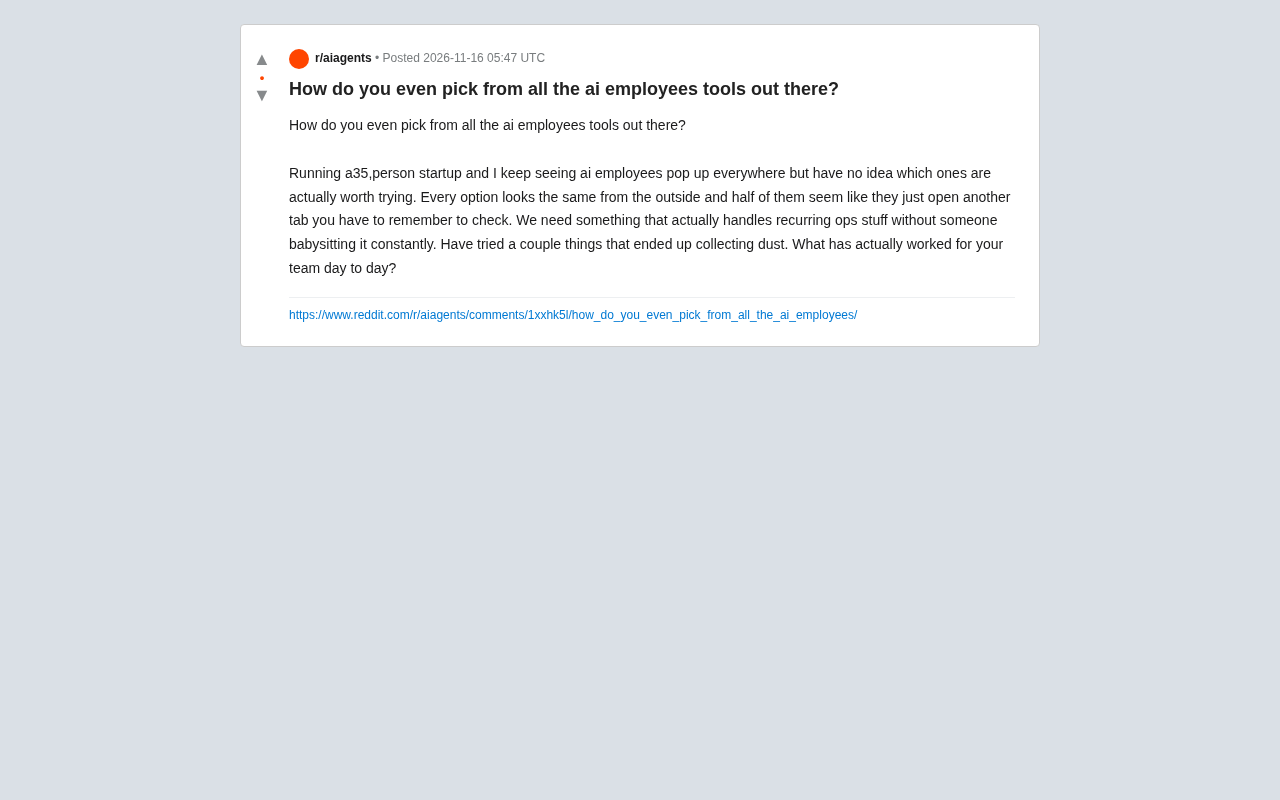
AI Employee Tools Are Everywhere — How Can a 35-Person Startup Pick the Ones That Actually Work?
A 35-person startup struggles with too many AI employee tools. Drawing on real community experience, this article distills three hard criteria—unattended operation, integration depth, and verifiability—to help you pick tools that actually work and avoid shelfware.

ModHarness-RL: Letting the Agent Training Framework Evolve Itself
ModHarness-RL redefines the agentic RL harness as a learnable, evolvable program, using compression and steering mechanisms with a propose-verify-replay loop to outperform fixed-harness baselines on CodeSearch, ALFWorld, and BIRD SQL in most settings.