Can Task-Specific 4B Models Replace Large Models?

Developer trains small models on 3D scene dataset, finds 350M task-specific model far exceeds expectations.
A developer training Qwen3.5-4B-3D-Coder and building a cross-domain 3D scene dataset changed his view of small task-specific models: domain-split 4B models suffice for 3D assets, web and backend tasks. The 350M model handled ~16K tokens context vs ~96K for the 4B. Key insight: epoch count is underestimated and eval loss can't indicate which checkpoint produces runnable code. SFT may achieve good results at far lower cost than RL, and the 350M can be fully fine-tuned on 8GB VRAM.
An Experiment That Started by Accident
A developer was training Qwen3.5-4B-3D-Coder with modest expectations. But as the model and subsequent GLB asset versions took shape, his assessment changed: a 4B model trained specifically for a particular task might be enough to cover most practical needs.
This judgment wasn't idle speculation. Generating 3D assets, building and orchestrating complex scenes, web development, backend development, reverse engineering—in his view, all of these tasks could be handled by different small, task-specific models. What he emphasizes is not "one universal small model" but "multiple specialized versions each doing their own job."
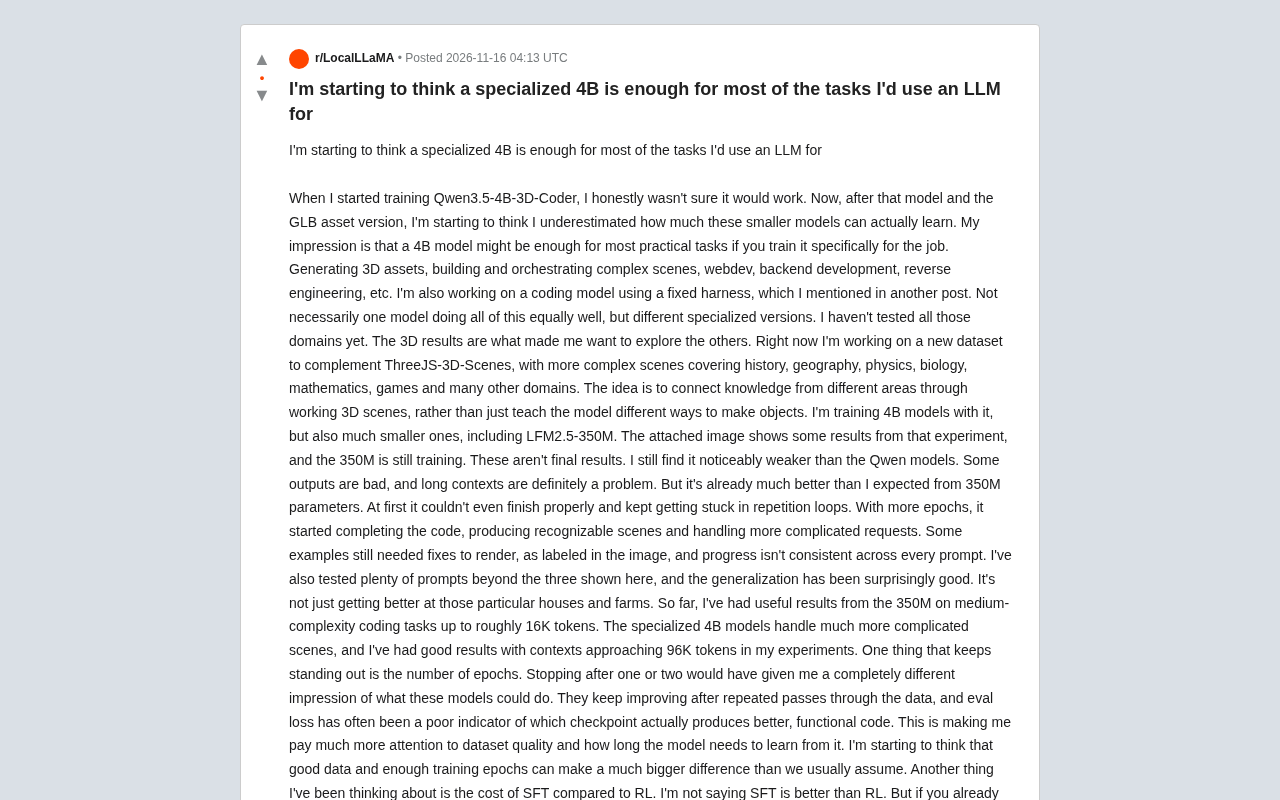
So far, he has only fully validated results in the 3D direction; other domains are still being tested. But the performance on 3D is enough to make him want to keep exploring.
Connecting Knowledge Through 3D Scenes, Not Just Teaching Models to Build Objects
He is building a new dataset to supplement the existing ThreeJS-3D-Scenes. Unlike simply teaching a model "how to generate different objects," the new dataset's approach is to connect knowledge across history, geography, physics, biology, mathematics, gaming, and other domains through runnable 3D scenes.
In other words, the model must not only write Three.js code but also understand the cross-domain knowledge behind the scenes and organize it into runnable, interactive 3D content. This places higher demands on the model's ability to integrate knowledge and makes the dataset itself a key variable in training outcomes.
He used this dataset to train the 4B model and also tried smaller models, including LFM2.5-350M.
The 350M Model's Surprising Performance and Obvious Shortcomings
350M parameters sounds almost impossible for generating code of real value, but the experimental results were far better than the author expected—though he explicitly states "this is not the final result yet."
Initial problems were straightforward: the model couldn't terminate output properly and fell into repeated loops. As training epochs increased, it began completing code, producing recognizable scenes, and handling more complex requests. Some examples in the screenshots still required manual fixes to render, which the author honestly noted, acknowledging that progress varied across different prompts.
More importantly, generalization was unexpectedly good. He tested prompts far beyond the example range, and the model wasn't just "overfitting-style" improving on those few houses and farms. Currently, the 350M model can handle roughly 16K tokens of context on medium-complexity coding tasks, while the specialized 4B model in experiments can approach 96K tokens of context and handle much more complex scenes.
The author admits the 350M still has a clear gap compared to the Qwen series, with long context being an explicit weakness, and complex reasoning and long-range dependencies also limited. But a 350M model achieving this level has itself changed his intuition about the "lower bound of parameter scale."
The Underestimated Epoch: Eval Loss Is Not a Good Judge
One of the most counterintuitive findings from the experiment is that the impact of epoch count is severely underestimated. The author states plainly that if he had stopped after one or two epochs, his assessment of these models' capabilities would have been completely different.
The models continued improving after repeatedly traversing the data, and eval loss often fails to indicate which checkpoint actually produces better, runnable code. This means relying on validation loss for early stopping may miss models with stronger actual capabilities.
This observation directs attention to two more fundamental variables: data quality and training duration. The author has come to believe that good data plus sufficient training epochs may have a greater impact than commonly assumed.
Eval loss (validation loss) refers to the loss value computed on a held-out validation set during training, commonly used to monitor overfitting and as a basis for early stopping and checkpoint selection. However, eval loss measures the model's predicted probability for the next token, which is not always consistent with actual usability on downstream tasks (such as whether code runs successfully or a 3D scene renders correctly). Especially when a model shifts in later training from "memorizing local patterns" to "mastering composable generation rules," the loss on the validation set may have plateaued or even risen slightly while generation quality continues to improve. Therefore, early stopping based solely on eval loss may stop at a checkpoint where capabilities haven't been fully realized—which is why the author emphasizes judging models by runnable output rather than loss after training for more epochs.
The Cost Debate Between SFT and RL
The author does not claim SFT is superior to RL. His point is more specific: if you already have high-quality samples covering the target domain, supervised fine-tuning can potentially achieve good results at far lower training cost than RL.
The trade-off exists, of course—creating and validating these samples requires significant time investment, and the author spent considerable effort on this step. But once the dataset is built, it can be reused, used to train models of different scales, and used for repeated experiments without needing to set up an entire RL pipeline.
For small task-specific models, this approach's cost-effectiveness deserves more attention.
SFT (Supervised Fine-Tuning) and RL (Reinforcement Learning) are two common paths for model alignment/capability shaping. SFT directly trains the model on "input—expected output" sample pairs with clear objectives and a simple process; RL (such as RLHF, GRPO, etc.) guides model exploration through reward signals, often requiring additional sampling, reward model, and policy optimization pipelines, with higher computational and engineering costs. For small task-specific models, SFT's advantages are: as long as high-quality samples covering the target domain exist, the training objective is to "replicate the behavior of these samples," converging quickly with strong controllability, and the dataset can be reused across models of different parameter scales. The cost is significant upfront data construction and validation work, and the model's capability ceiling is limited by sample coverage.
Full Fine-Tuning on Consumer Hardware
Another interesting finding is the hardware threshold. The 350M model can do full fine-tuning on a GPU with only 8GB of VRAM, rather than being limited to LoRA. With the right environment and memory optimization, training takes only a few hours for manageable dataset sizes and context lengths.
With longer context and larger datasets, training time increases significantly. But "training useful task-specific models on cheap consumer hardware" is itself compelling enough.
Full fine-tuning refers to updating all model parameters, as opposed to parameter-efficient methods like LoRA that train only a small number of additional parameters. Full fine-tuning typically requires storing gradients and optimizer states for all parameters, with memory overhead far exceeding LoRA, making it often infeasible for large models. For small models like 350M, combined with memory optimization techniques such as gradient checkpointing, mixed precision, and optimizer state sharding, a consumer GPU with 8GB VRAM can accommodate full fine-tuning. The advantage of full fine-tuning is that it's not limited by the capacity constraints of low-rank adaptation, allowing the model to more fully absorb domain data—especially meaningful for small models pursuing task-specific capabilities.
Capacity Limit, or Training Method Limit?
The author repeatedly emphasizes that he is not denying scaling laws, nor does he believe 350M can replace large models. Limitations objectively exist.
But he raises a thought-provoking question: how much of what we consider the model capacity ceiling is actually a limitation of training methods? Perhaps for many tasks we use large models far exceeding what's necessary, simply because we haven't fully explored how far small task-specific models can go.
These models are still training, and the author plans to release new models and an expanded 3D dataset soon. If the 350M continues improving to satisfactory quality, it will also be open-sourced.
Note: The original post was written in Portuguese by the author and translated to English with AI assistance.
One-line Summary
A developer trained small models on a 3D scene dataset and found that the 350M task-specific model far exceeded expectations.
Paragraph Summary
A developer training Qwen3.5-4B-3D-Coder and building a cross-domain 3D scene dataset changed his assessment of small task-specific models: 4B models split by domain are sufficient for tasks like 3D assets, web and backend development, rather than pursuing a single universal model. In experiments, the 350M small model handled roughly 16K tokens of context on medium-complexity coding, while the specialized 4B model approached 96K, though long context and complex reasoning remain weaknesses of small models. The most counterintuitive finding is that epoch count is severely underestimated, and eval loss cannot indicate which checkpoint produces runnable code. The author also believes that with high-quality domain samples, SFT can achieve good results at far lower cost than RL, and the 350M model can be fully fine-tuned on an 8GB VRAM GPU.
Related articles

AI Abuse Alert: Reports of Child Sexual Abuse Material Surge 8,400% in Two Years
Hacker News reports show AI-related child sexual abuse material reports rose 8,400% in two years. This article analyzes how generative AI lowers the barrier to producing illegal content, the dilemma facing platform detection and legal regulation, and feasible directions for technical countermeasures.

AI Employee Tools Are Everywhere — How Can a 35-Person Startup Pick the Ones That Actually Work?
A 35-person startup struggles with too many AI employee tools. Drawing on real community experience, this article distills three hard criteria—unattended operation, integration depth, and verifiability—to help you pick tools that actually work and avoid shelfware.
ModHarness-RL: Letting the Agent Training Framework Evolve Itself
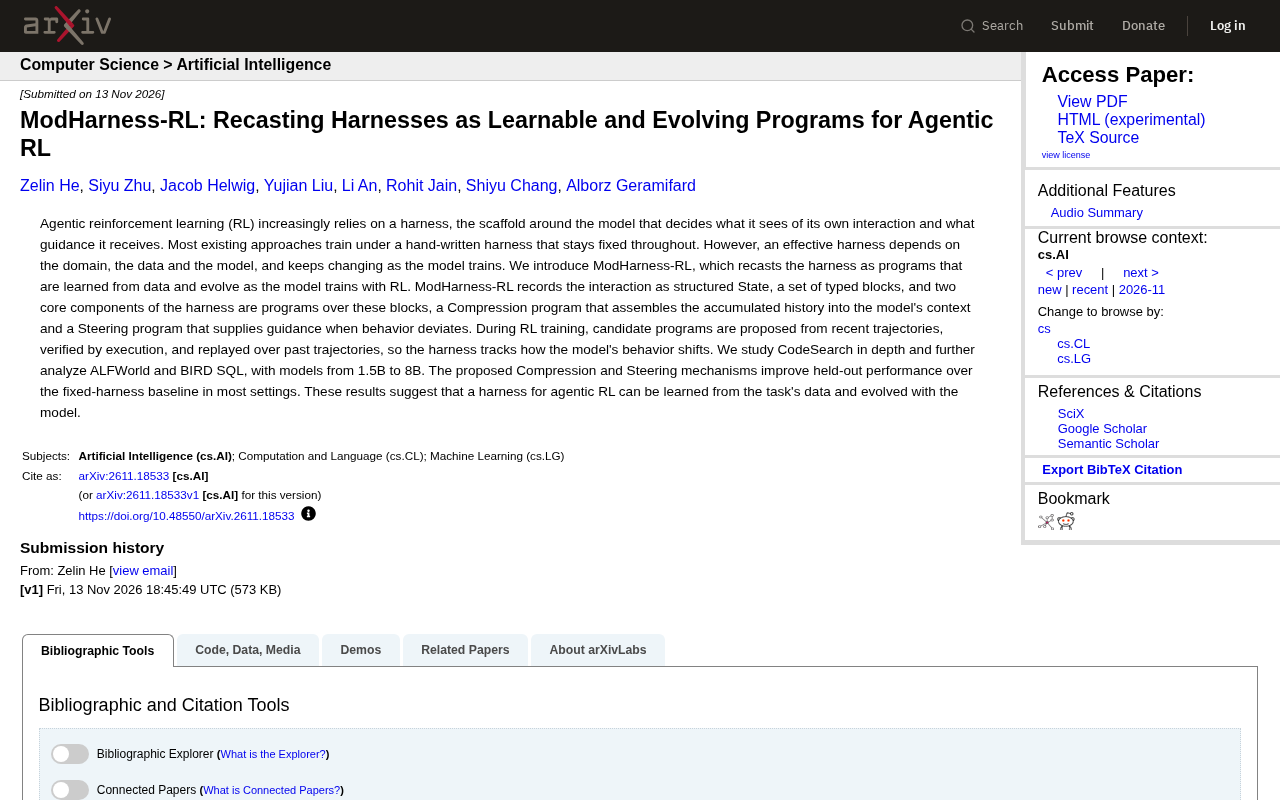
ModHarness-RL redefines the agentic RL harness as a learnable, evolvable program, using compression and steering mechanisms with a propose-verify-replay loop to outperform fixed-harness baselines on CodeSearch, ALFWorld, and BIRD SQL in most settings.